Mount Abu and Udaipur: Rajasthan’s Guide for this Independence Day Long Weekend

Mount Abu and Udaipur: Rajasthan's Long Weekend This Independence Day

Deciding between Rajasthan’s lakes and its hills usually means picking one and saving the other for later. This Independence Day weekend, that math changes. August 15 falls on a Saturday, and a single Friday off stretches the trip to three days, long enough to actually do both instead of choosing. Udaipur brings the city everyone already pictures, City Palace and Lake Pichola at sunset. Mount Abu brings the opposite: cooler air, forest, and a hunting palace that has stood in the Aravalli hills for four hundred years.

Udaipur and Mount Abu, this weekend, whether the start is a short drive out of Gujarat or a flight in from further afield. The full city-by-city breakdown is further down; first, what actually makes each one worth the trip.

Table of Contents:

Nakki Lake and Aravalli hills, Mount Abu, monsoon

Mount Abu: Rajasthan’s Only Hill Station

Mount Abu is the single hill station in a state otherwise defined by desert and fort country, which makes it a different kind of trip from the rest of Rajasthan. The Aravalli hills around it turn a deep green in August, Nakki Lake sits at the centre of town for an easy evening walk, and the Dilwara Jain Temples, marble carved fine enough to look like lacework rather than stone, are worth the visit even for travellers who do not usually seek out temple architecture. Guru Shikhar, the highest peak in the Aravalli range, is a 30 to 40 minute drive from town and clears on many mornings even when the rest of the hill is under cloud.

Marble carved fine enough to look like lacework rather than stone.

Where to Stay in Mount Abu

SaffronStays Sylvan Farms is not a conventional hill-station stay. A three-bedroom eco-luxury farm property spread across 4.4 acres of organic farmland about 15 minutes from Mount Abu’s main attractions, it runs on a real sustainability story: the estate supports seven local families, and the fireside evenings and farm-to-table meals come from land the property actively works rather than simply overlooks. It also sits close to one of Asia’s highest-resolution telescopes, and monsoon’s clearer air between showers often makes for better stargazing here than the hazier months on either side of it, worth timing an after-dinner walk outside for.

The final approach matters here. Roads from Ahmedabad to Abu Road are smooth highway, but the last 23 to 27 kilometres climbing into Mount Abu town wind through the hills and can turn slippery in heavy rain. Nothing about this rules out the drive, it just argues for daylight hours and an unhurried pace on that last stretch rather than pushing to arrive after dark.

Beyond Guru Shikhar and the temples, Achalgarh Fort makes an easy add-on on the way back from the peak, and Peace Park, a quiet garden built for meditation rather than sightseeing, is worth an hour for anyone who wants Mount Abu’s stillness without another monument to walk through. Honeymoon Point, a sunset viewpoint that draws a fraction of the crowd Sunset Point does, is the better choice for an unhurried evening. Food here leans vegetarian by local custom, and a proper Rajasthani thali, gatte ki sabzi, ker sangri, bajra roti, at any of the town’s established dining halls is worth planning a meal around rather than treating as a formality between sights.
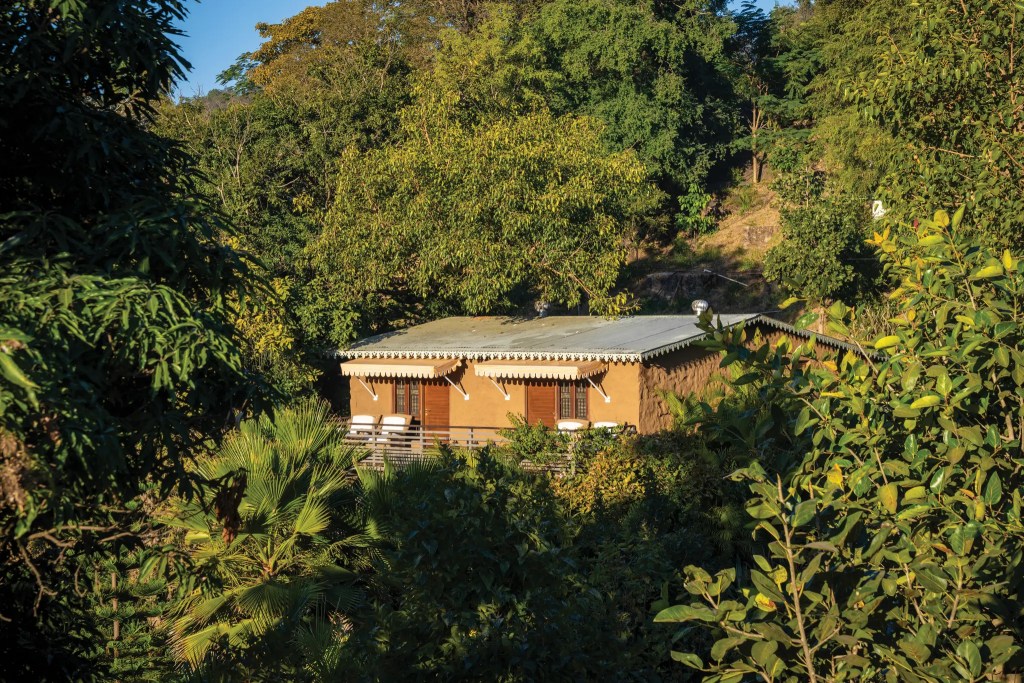
SaffronStays Sylvan Farms exterior with organic farmland and garden, misty Aravalli hills in the background
Eco-luxury farm villa with organic gardens, Sylvan Farms, Mount Abu

Udaipur: Two Very Different Stays

Udaipur needs little introduction: City Palace’s mirrored halls, Lake Pichola at sunset, the old city’s lanes opening onto lake views at nearly every turn. The NH48 route from Ahmedabad runs roughly 260 kilometres in about 5 hours, one of the more reliable highway drives on this list, and Gujarat consistently supplies a large share of Udaipur’s weekend visitors, close enough that a single day off still makes the trip worthwhile without the full three.

Gujarat consistently supplies a large share of Udaipur’s weekend visitors.

Where to Stay in Udaipur

SaffronStays Rang Havelii sits close enough to the City Palace to share a version of the same rooftop views. The haveli took a year and a half to rebuild from near-ruin, and each of its eight rooms is designed around a different Rajasthani craft tradition: Molela wall art from a village near Chittorgarh, marble from Makrana, sandstone floors from Dholpur. It suits a trip built around the old city itself, walking distance to the ghats and markets rather than a drive away from them.

SaffronStays The Shikargarh Palace takes an entirely different kind of heritage: a 400-year-old former royal hunting retreat of the Mewar dynasty, set in the Aravalli hills outside the city. The original hunting structure, called an Odi, still stands at the centre of the property, with a newer 14-bedroom palace built around it during a recent restoration. Gardens, courtyards and a swimming pool make it a stay built for a large group rather than a couple, the kind of property where the estate itself is the weekend’s centrepiece rather than a base for sightseeing elsewhere.

Beyond these two, SaffronStays lists villas across Udaipur ranging from compact three-bedroom pool homes to eight-bedroom estates near Fateh Sagar Lake. The full Udaipur collection is linked below for anyone who wants to compare more options before booking.
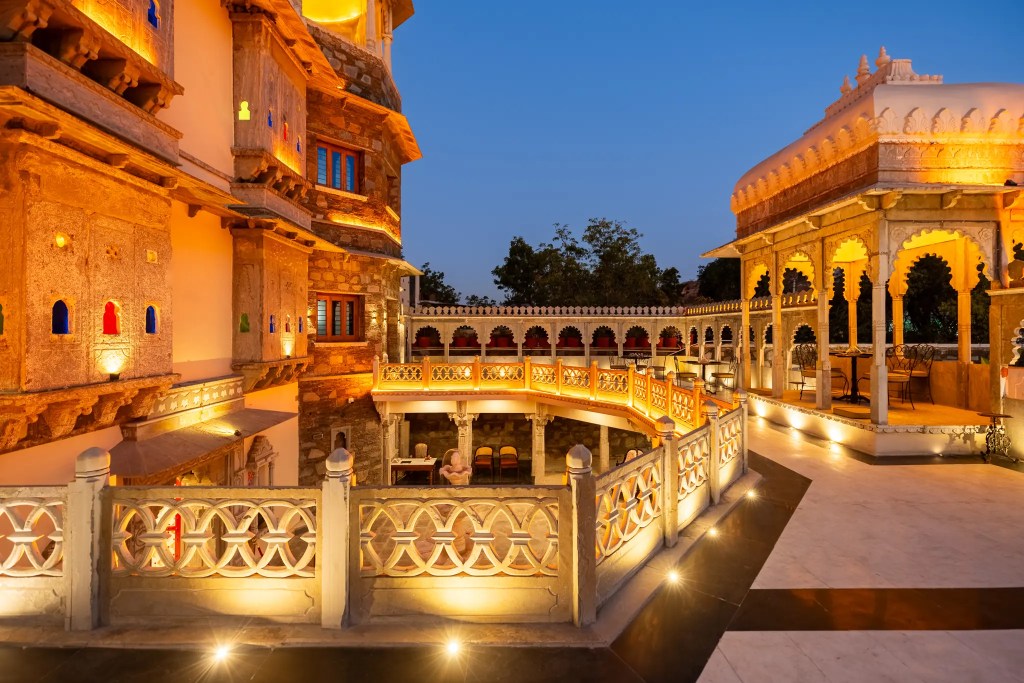
 SaffronStays The Shikargarh Palace heritage exterior with original stone Odi structure at centre, gardens and pool visible, Aravalli hills backdrop.
400-year-old heritage hunting palace, The Shikargarh Palace, Udaipur

How to Reach: A City-by-City Guide

Six cities, six real starting points. Here is exactly how each one gets to Mount Abu and Udaipur this Independence Day weekend.

From Ahmedabad

To Mount Abu: ~225-240 km, 4.5-5.5 hrs   |  

To Udaipur: ~260 km, ~5 hrs via NH48

The easiest version of this trip by a wide margin. Both routes run on good highway, and either destination is a comfortable single push without an overnight stop. One planning note specific to Ahmedabad: unlike Delhi or Mumbai, Gujarat’s own Independence Day ceremony has no fixed city-centre closure to route around, since the state ceremony moves venue every year rather than anchoring to one landmark.

From Vadodara

To Udaipur: ~300-360 km, 4-4.5 hrs   |  

To Mount Abu: via Udaipur or Abu Road, add ~1-1.5 hrs

Genuinely one of the shorter drives on this entire list, even shorter than Ahmedabad’s run to Udaipur.

From Surat

To Udaipur: ~450-500 km, 6-7 hrs   |  

To Mount Abu: via Ahmedabad or Abu Road, similar range

A longer stretch, but still a reasonable single-day push for a long weekend rather than a trip that needs a stopover.

From Mumbai

Direct drive: ~756-771 km, ~10 hrs   |  

Better option: Fly to Udaipur, then drive 3-4 hrs to Mount Abu

Ten hours is too long to start a three-day weekend with. Udaipur’s airport has direct Mumbai flights, and the local drive from there to Mount Abu is short and easy.

From Pune

Direct drive: ~865-900 km, ~15 hrs   |  

Better option: Fly to Udaipur via Mumbai or direct, then drive 3-4 hrs

The longest direct drive on this list. Flying is not a compromise here, it is the only realistic option for a weekend trip.

From Delhi

Direct drive: ~739-751 km, 13-14 hrs   |  

Fly option: Direct flights to Udaipur, then drive 3-4 hrs to Mount Abu   |  

Road-trip option: Delhi-Jaipur ~5 hrs, then Jaipur-Udaipur ~6.5 hrs

Delhi has a genuine road-trip alternative Mumbai and Pune do not: breaking the drive at Jaipur splits a 13-hour push into two manageable days, with Jaipur itself worth the overnight stop. That split works less well heading straight to Mount Abu, since Jaipur to Mount Abu alone still runs 9 to 11 hours; flying into Udaipur is the better call for that leg specifically.

Doing Both: The Loop Route

The useful thing about this particular pairing is that neither destination has to be chosen over the other. Mount Abu to Udaipur is a further 160 kilometres, about 3 hours on a route that counts among the better-maintained stretches in the region, which makes a full loop from Ahmedabad through both towns realistic across a 3-day weekend rather than a rushed add-on.

A straightforward version: Ahmedabad to Mount Abu on the morning of Friday, August 14, a full day and night there, then the 3-hour run to Udaipur on Saturday for two nights before the 5-hour drive back to Ahmedabad on Monday. Anyone with only the Saturday-Sunday weekend should pick one destination rather than force the loop into two days; Mount Abu suits a single-destination trip better given the shorter drive each way. Travellers flying in from Mumbai, Pune or Delhi can run the same loop in reverse from Udaipur airport, starting with Udaipur itself before the 3-hour drive out to Mount Abu.

PLANNING NOTE

Book villas two to three weeks ahead for this particular weekend. Independence Day is peak season for both destinations, and availability for larger properties tightens fast as the date approaches.

Mount Abu vs. Udaipur, Side by Side

Distance is covered above, by city. Here is how the two actually differ once you’re there.

DestinationCharacterBest ForFeatured Villa
Mount AbuForest, temples, altitudeRepeat Rajasthan visitors, quiet over sightseeingSylvan Farms
UdaipurLakes, palaces, the classic postcardFirst-time visitors, group celebrationsRang Havelii / Shikargarh Palace

Which One Fits

Content preference is one half of this decision: Udaipur suits anyone who has not been before and wants the version of Rajasthan postcards are made of, while Mount Abu suits anyone who has already done that trip, or who wants forest, altitude and a working heritage estate over palaces and lakes this particular weekend.

Ease of reach is the other half, and it matters more than usual this year. For Gujarat, that preference decides almost nothing, since both are within comfortable range. For Mumbai and Pune, where flying is the only realistic option either way, Udaipur’s better flight connectivity makes it the simpler single-destination pick if the loop is not on the table. For Delhi, the Jaipur stopover tips the balance toward Udaipur specifically, since that same road-trip logic does not extend cleanly to Mount Abu.

Rajasthan is closer than the drive feels. Browse private-pool villas in Mount Abu and Udaipur on SaffronStays and lock your Independence Day long weekend.

Frequently Asked Questions

How far is Mount Abu from Ahmedabad?

About 225 to 240 kilometres, roughly 4.5 to 5.5 hours by road. The route runs on smooth highway to Abu Road, then climbs a winding 23 to 27 kilometre hill road into Mount Abu town.

How far is Udaipur from Ahmedabad?

About 260 kilometres via NH48, roughly 5 hours under normal conditions. It is one of the more reliable highway drives from Ahmedabad.

What is the best way to reach Mount Abu or Udaipur from Mumbai or Delhi?

Flying, not driving. The direct road trip from Mumbai or Delhi runs past ten hours, closer to thirteen from Delhi. Udaipur’s airport has direct flights from both cities, and the local drive from Udaipur to Mount Abu is a manageable 3 to 4 hours.

Can I visit both Mount Abu and Udaipur in one long weekend?

Yes. Mount Abu to Udaipur is a further 160 kilometres, about 3 hours, making a loop trip through both destinations workable across a 3-day weekend with an early start each day, whether starting from Ahmedabad or from Udaipur airport.

Is Mount Abu safe to visit in monsoon?

Largely yes. Rajasthan’s monsoon is mild compared to coastal or Himalayan India. The one real caution is the final hill climb into Mount Abu town, which can get slippery in heavy rain.

What is the best villa in Mount Abu?

SaffronStays Sylvan Farms, a 3-bedroom eco-luxury farm stay about 15 minutes from Mount Abu’s main attractions, with a strong sustainability story and stargazing near one of Asia’s highest-resolution telescopes.

Does Gujarat have Independence Day traffic restrictions like Delhi or Mumbai?

Not in the same fixed way. Gujarat’s state-level Independence Day ceremony rotates venue each year rather than being anchored to one city landmark, so there is no recurring Ahmedabad-specific road closure to plan around.
Rang Havelii: The Udaipur Haveli That Shares Its Wall With a Palace

Exterior shot of the Rang Havelii entrance lane at Bhatiyani Chohatta, City Palace boundary wall visible alongside, golden-hour light.

In the lane called Bhatiyani Chohatta, the walls do not so much end as surrender to a bigger one. Shopfronts give way, cows find their shade under low eaves, and then the stone itself changes character: this is the outer skin of Udaipur’s City Palace, four centuries old, running the length of the street like a border nobody thought to question. Somewhere along that stretch, without a signboard announcing itself, sits a doorway into eight rooms, seven living craft traditions, and one woman’s very deliberate refusal to be tasteful in the way the world currently defines tasteful.

That doorway opens into Rang Havelii, a heritage-style haveli built not from a restored palace wing but from a shell of collapsed chambers that its founder, Rashmi, found in ruins two years ago. What stands there now is arguably Udaipur’s most striking recent addition to the city’s old quarter: a boutique stay that treats colour not as a decorating choice but as its entire argument. The name says as much. Rang, in Hindi, means colour. Havelii is the traditional courtyard mansion of Rajasthan and North India. Put together, they describe exactly what waits on the other side of that unmarked door, and precisely what this property borrows from the past rather than inherits from it.

Table of Contents:

The Banker Who Built a Haveli

Rashmi did not train as an interior designer, an architect, or a hotelier. She spent her working years in banking before she began writing about food under the Instagram handle @kasoor_e_methi, building a loyal following for a voice that was unmistakably, unapologetically Rajasthani. When she first walked into what would become Rang Havelii, the building offered her nothing to work with in the conventional sense. “When I first found this place two years back, it was in complete shambles,” she says. “But in my heart I knew that this place had a lot of potential and I could turn this into something really special.”

She did not hire a design firm and hand over a mood board. She commissioned artisans directly, brief by brief, room by room. The dining table, made from ethically sourced camel bone carved and embedded into wood in an intricate technique local to Rajasthan, was built to a specification she gave craftspeople who work almost exclusively in this material. The mural above the breakfast nook, mapping Udaipur’s own skyline onto a stairwell wall, began as a scale drawing by her illustrator friend Monica, based in Mumbai, who plotted the City Palace, the ghats, and the lake against real dimensions before local artists reproduced it by hand. “I was just a little confused what to kind of make here,” Rashmi recalls of that particular wall. “So I took the help of my illustrator friend… I told her that I want something unique.”

The result reads less like a restoration and more like a personal statement rendered at the scale of a building, built from scratch in the visual language of a much older Rajasthan. “It’s just a representation of me,” she says of the finished haveli. “And when you come here, you will experience the same love and warmth that I grew up with and that Rajasthan has to offer.”

A Living Gallery: Eight Rooms, Eight Colours

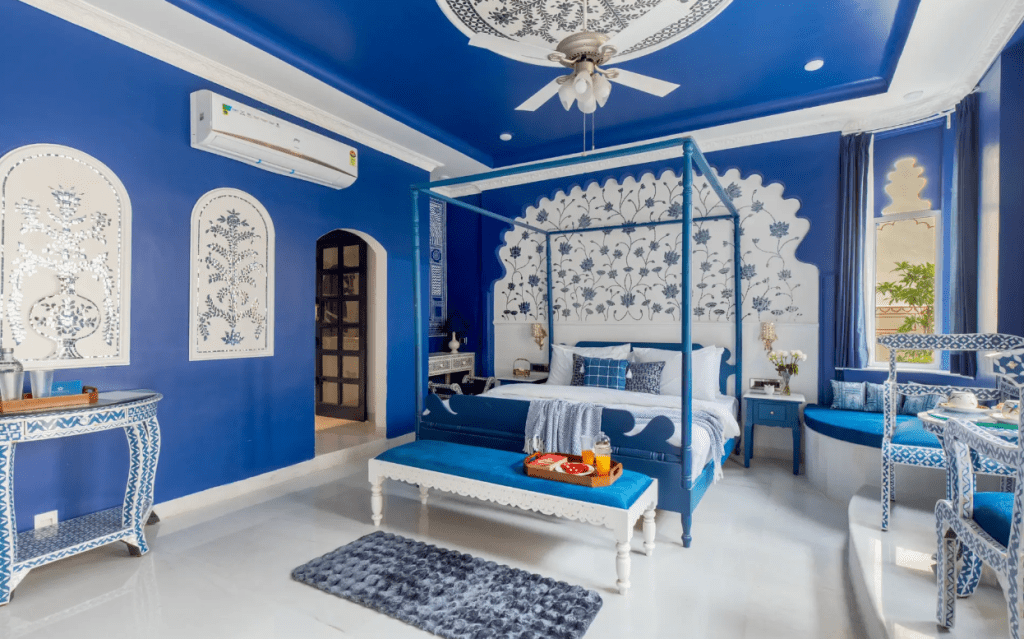
Every one of Rang Havelii’s eight rooms is painted, furnished, and dressed in a single dominant colour, and every room showcases a distinct craft tradition. Guests do not simply sleep at a heritage-style property here. They sleep inside a specific, deliberately unrepeated art installation, then walk down a corridor into a completely different one.

Bagh Baradari carries the storytelling energy of Phad scroll painting, a tradition rooted in the Bhilwara belt of Mewar, its walls animated with the loose, narrative brushwork this folk art is known for. Panna Bagh, on the ground floor, goes the other way entirely: mint-green walls with hand-painted trees and birds, a quiet garden room that borrows its calm from the Rajput palace gardens of old. Maaru Mahal, one floor up, trades green for gold, taking its warmth from the sandstone palaces of Jaisalmer and the open Thar beyond them.

RoomColourCraft Focus / Inspiration
Bagh BaradariForest tonesPhad scroll painting (Bhilwara belt)
Panna BaghMint greenHand-painted garden motifs, Rajput palace gardens
Maaru MahalGold / sandstoneJaisalmer and Thar desert palette
Kamal TalaiSoft pink / lotusPichwai art, Nathdwara (17th century)
Surkh DarbarCrimsonMewar miniature painting
Neel JharokhaBlueJodhpur’s Blue City tradition
Rajwadi VatikaPinkJaipur palace garden aesthetic
Darpan DarbarMirror / white-goldThikri mirror-glass art, Udaipur
Thikri mirror art room Darpan Darbar at Rang Havelii Udaipur

Two rooms reward the closest attention. Darpan Darbar is built around Thikri, an inlaid mirror-glass craft specific to the Mewar region, in which small pieces of convex mirror and coloured glass are cut, polished, and set into plaster to catch and multiply light across a wall. By evening, a single lit candle in this room throws itself into dozens of reflected points across the ceiling and walls, an effect the room was clearly designed around. Surkh Darbar, by contrast, is quieter and more exacting: its walls carry Mewar miniature painting, worked in fine detail with squirrel-hair brushes and pigments traditionally drawn from minerals and plant matter, the same technique used for centuries in courtly manuscripts across this region.

The communal spaces do not let up either. The living room holds a hand-painted Pichwai mural, a collaboration between Rashmi’s sister and a local artist. The entrance is marked by a Toran, the ceremonial door hanging central to Rajasthani weddings, flanked by chairs shaped like elephants, a nod to the elephant rides up to Jaipur’s Amer Fort. A hand-carved Kavad, sourced from artisans in Bassi near Chittorgarh, sits nearby: a wooden shrine that opens like a series of folding doors, each panel painted with its own episode from a larger story of gods and goddesses, traditionally narrated aloud by the Kavadiya Brahmin families who carried these shrines door to door.

“Just as these days minimalism is trending, but as you know, Rajasthan is all about maximalism. So there will be a lot of colours and patterns and textures. Having been born in Rajasthan myself, I have this natural inclination towards colours and vibrance.”

— Rashmi, Founder, Rang Havelii

Seven Crafts, Under One Roof

What separates Rang Havelii from Udaipur’s many other heritage-styled stays is specificity. Almost anyone can call a property a living museum. Rang Havelii can name the village each craft came from.

Pichwai, the devotional cloth painting depicting Srinathji, traces to Nathdwara, near Udaipur, and dates to the seventeenth century. Thikri mirror-glass work is native to Udaipur and the wider Mewar region. Miniature painting here follows the Mewar school, distinguished from the more famous Mughal miniature tradition by its palette and its subject matter, closer to courtly and devotional life than imperial record-keeping. Phad, the scroll paintings that narrate the deeds of folk deities like Pabuji and Devnarayan, comes out of the Bhilwara belt, traditionally unrolled and sung by travelling bhopa performers rather than simply displayed. Bone inlay, seen throughout the property in furniture, uses ethically sourced camel bone carved and set into wood, then filled with resin. Kavad shrine-making is specific to Bassi, a small town near Chittorgarh. And Molela terracotta, added to the property’s craft roster after the press materials for this piece were written, comes from a single village of that name on the Banas river near Nathdwara, a GI-tagged tradition of flat terracotta plaques depicting local deities, made almost exclusively by the Kumhar potter families who have worked that clay for generations.

None of these crafts are displayed behind glass at Rang Havelii. They are load-bearing, in the most literal sense: walls, furniture, shrines, and tabletops that a guest touches, sits at, and sleeps beside rather than views from a rope barrier. The building itself is new. The hands that made everything inside it are not.

Food, Hosting, and Atithi Devo Bhava

“Rang Havelii for me was a perfect blend of the two things that I love: food and hosting,” Rashmi says, and the kitchen bears this out. It runs less like a hotel restaurant and more like the kitchen of someone who has spent years feeding people she cares about, which, as a food blogger for years before Rang Havelii existed, is exactly what Rashmi was already doing. The in-house chef prepares Rajasthani food with the kind of personal attention a restaurant kitchen rarely offers, and meals are available at an additional charge rather than folded into a flat room rate, closer in spirit to eating at someone’s home than paying for a fixed hotel menu.

That hosting philosophy has a name in Rajasthan: Atithi Devo Bhava, the guest as god. The Toran at the entrance is not purely decorative. It references a wedding-day ritual in which a groom touches the door hanging with his sword on reaching his bride’s threshold, a gesture of respect and welcome that predates the building by centuries, even where the building itself does not. Guests crossing into Rang Havelii cross the same threshold. On the ground, this translates into specific, remembered service: reviews on the live listing repeatedly single out staff members by name, and the property currently holds a 4.9-out-of-5 rating across more than fifty stays, with cleanliness, safety, and staff attentiveness scoring particularly high.

Rajasthani thali meal experience at Rang Havelii Udaipur

A Wall Away From the City Palace

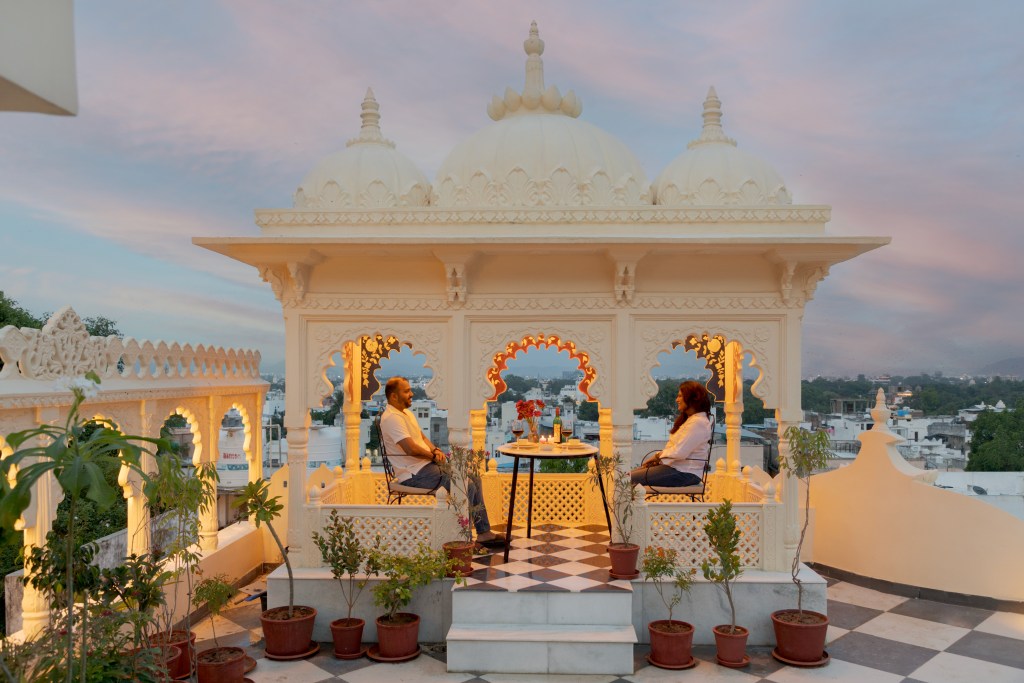
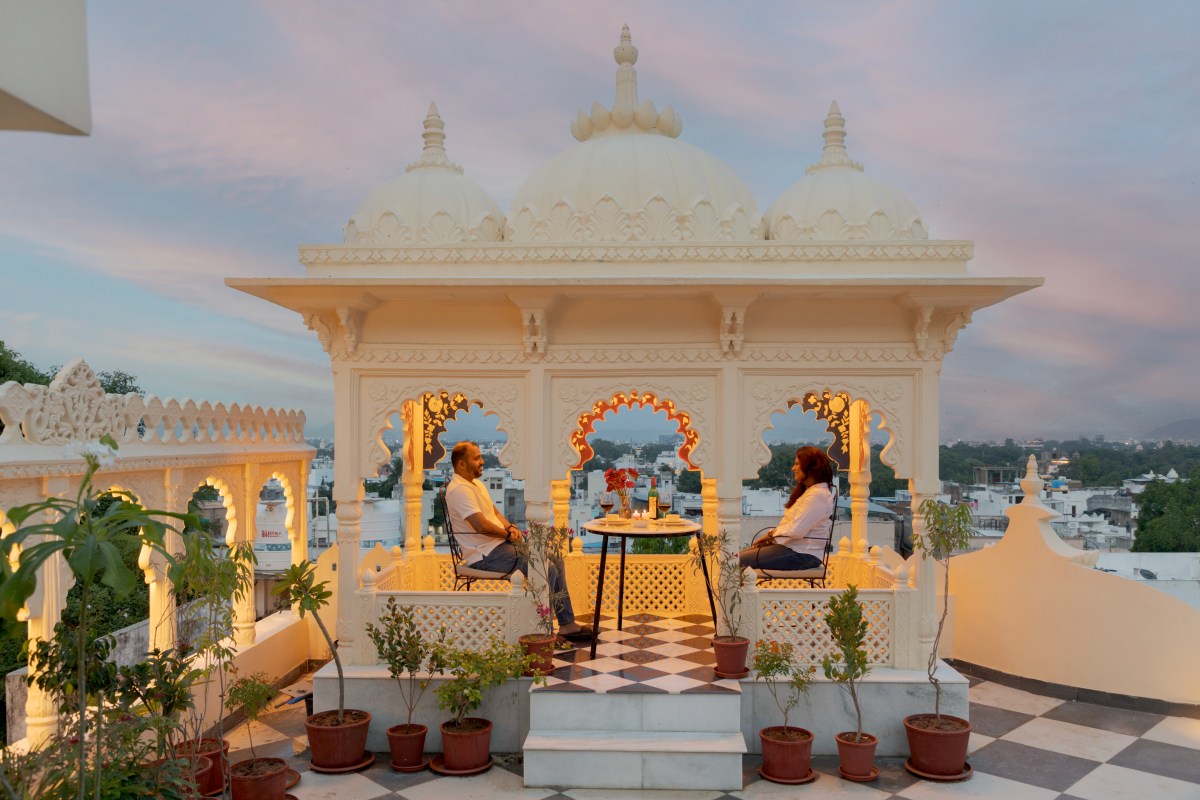
Location does most of the remaining work. Rang Havelii shares a boundary wall with the City Palace of Udaipur, one of the largest palace complexes in Rajasthan and, after dark, one of the most theatrically lit buildings in the city. From the rooftop chhatri and the private pool at Rang Havelii, guests watch that illumination directly, and during Diwali, the same terrace becomes a private viewing point for fireworks across the old city skyline. Jagdish Temple and Lake Pichola are each roughly a five-minute walk away. Fateh Sagar Lake is closer to fifteen minutes. The haveli sits inside Udaipur’s old city grid, within the kind of walkable radius that lets a stay double as a base for exploring rather than a destination requiring its own transport plan for every outing.

GOOD TO KNOW

Rang Havelii shares a boundary wall with the City Palace, Udaipur’s largest palace complex.

Jagdish Temple and Lake Pichola: approximately 5 minutes on foot.

Fateh Sagar Lake: approximately 15 minutes on foot.

Best light for the rooftop chhatri and pool: late afternoon into the evening, when the City Palace begins its nightly illumination.

Diwali is a particularly strong time to book this specific property, given the terrace’s direct sightline to the city’s fireworks.

Getting There, Including the Drive Every Gujarati Traveller Already Knows

Rang Havelii sits close enough to the centre of Udaipur that the wider question is less about reaching the haveli and more about reaching the city. Maharana Pratap Airport is roughly 24 kilometres away, a 30 to 40 minute drive depending on traffic. Udaipur City Railway Station and the main bus stand are both about 2 to 3 kilometres out, a 10 to 15 minute drive from the property, or a manageable one for anyone willing to walk part of the old city on arrival.

For travellers coming from Gujarat, this is a familiar route long before it is a search query. Ahmedabad to Udaipur runs roughly 260 kilometres via NH48, a drive of four to four and a half hours that has become one of the state’s most reliable weekend getaways, popular enough that Himmatnagar and the Shamlaji temple stop are landmarks in their own right for anyone who has made the drive before. Direct trains, including the ADI-UDZ Express, connect Ahmedabad’s Kalupur station to Udaipur City, and flights run the route as well, though most Gujarati travellers making a weekend of it still choose the highway for the flexibility it offers to detour toward Nathdwara, Eklingji, or Kumbhalgarh along the way. Travellers from Surat and Vadodara add roughly two and four hours respectively onto that same NH48 corridor, making Udaipur, and a stay inside its old city walls, a realistic two-night plan rather than a stretch.

From Mumbai, Pune, Delhi NCR, and Bangalore, Udaipur is well served by direct flights into Maharana Pratap Airport, putting Rang Havelii within a half-day’s travel from each of these cities door to door.

Rooftop pool and chhatri at dusk with the illuminated City Palace visible in the background.
Rooftop pool with City Palace view at Rang Havelii Udaipur
Stay Inside the Story

Book a room, a wing, or the entire eight-room haveli at Rang Havelii, Udaipur, through SaffronStays.
BOOK RANG HAVELII

Frequently Asked Questions

Where exactly is Rang Havelii located in Udaipur?

Rang Havelii is located in Bhatiyani Chohatta, in Udaipur’s old city, sharing a boundary wall with the City Palace. It sits within a five-minute walk of Jagdish Temple and Lake Pichola.

Is Rang Havelii an actual heritage building?

No. Rang Havelii is a heritage-style haveli, built two years ago from a collapsed shell of chambers and designed using traditional Rajasthani architecture, materials, and craft. It is not a centuries-old or protected heritage structure, and it shares a boundary wall with one that is: the City Palace.

How far is Rang Havelii from Udaipur’s airport and railway station?

Maharana Pratap Airport is approximately 24 kilometres away, a 30 to 40 minute drive. Udaipur City Railway Station and the main bus stand are both roughly 2 to 3 kilometres away, about 10 to 15 minutes by road.

What Rajasthani art forms can I see at Rang Havelii?

The property features seven craft traditions across its rooms and common areas: Pichwai painting from Nathdwara, Thikri mirror-glass art from Udaipur, Mewar miniature painting, Phad scroll painting from the Bhilwara belt, camel bone inlay furniture, hand-carved Kavad shrines from Bassi, and Molela terracotta from Rajsamand district.

Can I book just one or two rooms, or do I need to book the entire haveli?

Rang Havelii can be booked room by room, as a partial wing, or in its entirety for larger groups and celebrations. Room configurations and exact availability are confirmed at the time of booking on the SaffronStays listing.

Is Rang Havelii within walking distance of Lake Pichola and the City Palace?

Yes. The City Palace is directly adjacent, sharing a wall with the property, and Lake Pichola is approximately a five-minute walk away.

Is Udaipur a good weekend getaway from Ahmedabad and Gujarat?

Udaipur is one of Gujarat’s most popular weekend destinations, roughly 260 kilometres and four to four and a half hours from Ahmedabad via NH48. It is also well connected from Surat and Vadodara by the same highway, and by direct train and flight options.

Does Rang Havelii provide meals?

Yes, meals are available at an additional charge, prepared by an in-house chef, with vegetarian, non-vegetarian, and Jain options on the menu.

Udaipur City of Lakes: Palaces, Cruises & Cultural Evenings

Udaipur, affectionately known as the “City of Lakes”, is a destination where shimmering waters, marble palaces, and vibrant traditions create one of India’s most enchanting travel experiences. Beyond being a backdrop for films around the world, Udaipur is living history—an artistic city that continues to breathe in every courtyard, ghat, and palace.

An Iconic Showcase of Rajput Grandeur

Aerial view of Udaipur showcasing the City Palace along the shores of Lake Pichola, with mountains in the background and boats on the water.

The palaces of Udaipur are more than just architectural wonders. They were once the centers of power, symbols of Mewar pride, and today stand as global cultural icons. Blending Mughal and Rajasthani art with murals, mirror inlays, and stone carvings, these structures are pieces of history turned into works of art.

The City Palace Udaipur, the largest palace complex in Rajasthan, took more than 400 years to complete and still dominates the eastern banks of Lake Pichola. Within its marble courtyards and halls, treaties were signed, wars were planned, and royal ceremonies were held. Today, its museums preserve weapons, paintings, costumes, and treasures that narrate the resilience of the Mewar dynasty.

In the middle of Lake Pichola, the Lake Palace seems to float like a marble mirage. Built in the mid-18th century by Maharana Jagat Singh II as a summer retreat, it became a symbol of royal luxury and is now one of the most celebrated heritage hotels in Udaipur. It gained global fame after appearing in the James Bond movie Octopussy and remains one of the most photographed palaces in the world.

Nearby, Jag Mandir, the “Lake Garden Palace”, has its own legacy, having sheltered Prince Khurram (later known as Shah Jahan) during a rebellion. The palace’s marble pavilions are said to have inspired the Taj Mahal.

High above the city, the Monsoon Palace crowns a hilltop. Originally built by Maharana Sajjan Singh in 1884 to study the monsoon clouds, it later became a royal retreat. Although unfinished, it offers one of the best sunset views in Udaipur, especially beautiful during the rainy season when the Aravalli Hills turn lush and green.

The Lifeblood of Udaipur’s History

The lakes of Udaipur are more than scenic—they are the city’s very identity. Designed as reservoirs to sustain life in this dry region, they became cultural centers where devotion, festivals, and daily activities intertwined. Palaces and ghats along the water’s edge turned them into living canvases of grandeur.

Lake Pichola, built in 1362 CE, remains the most iconic. Taking a boat ride in Udaipur at night, when palaces glow with golden light, is among the most unforgettable experiences in the city. Fateh Sagar Lake, built in 1687, with its tranquil islands and backdrop of the Aravalli Hills, is equally charming, especially for families who can enjoy boating and picnics by the water.

Just beyond the city, Badi Lake (Badi Talab) offers an offbeat experience. Created to overcome a drought, it is now a favorite spot for swimming, cycling, and photography. Surrounded by the lush Bahubali Hills, it is one of the best places to visit in Udaipur during the monsoon and a perfect escape for travelers seeking quiet away from the crowds.

A scenic view of Lake Pichola in Udaipur, featuring ornate white marble architecture, flying birds, and the serene waters reflecting the sky.

Arts and Culture

Walking through Udaipur’s old city is like stepping into another time. Gangaur Ghat offers the most captivating views of the City Palace and Lake Pichola, making it a perfect starting point for exploration. Along the way, you’ll encounter the grand Jagdish Temple, intricately carved havelis, colorful bazaars, and gateways that open into lively streets.

Rajasthan’s artistic legacy thrives in Udaipur. The Mewar School of Miniature Painting, known for its fine detail and vibrant colors, continues to flourish. Local artisans keep alive traditions of marble carving, block-printed fabrics like Bandhani, silver jewelry, and handmade puppets. Shopping in Udaipur’s bazaars is as much a cultural experience as it is a souvenir hunt.

As night falls, the city offers unforgettable cultural evenings. The Bagore Ki Haveli Dharohar Dance Show is a family favorite, with folk performances of music, dance, and puppetry staged in an atmospheric courtyard on Lake Pichola. Festivals like Shilpgram in December bring rural and tribal traditions to life, blending music, crafts, and cuisine. Dining is also an experience here—whether enjoying Rajasthani thalis at Natraj Dining Hall or savoring fine dining at Ambrai Restaurant with views of the illuminated City Palace across the lake.

Beyond Udaipur

Many travelers extend their journey to explore places to visit near Udaipur. The hill station of Mount Abu, Rajasthan’s only hill station, offers a refreshing contrast with its cool climate, Nakki Lake, and the intricately carved Dilwara Temples. Other nearby treasures include Kumbhalgarh Fort, Ranakpur Jain Temples, and Chittorgarh Fort—all easy day trips that complement Udaipur’s cultural and natural splendor.

A City That Lives in Water and Light

Udaipur is beyond its lakes more than a tourist destination; it is a an of lakes, palaces, and traditions woven together by centuries of history. Whether you’re seeking things to do in Udaipur at night, planning a family trip, searching for offbeat experiences, or exploring the region in the monsoon season, Udaipur always reveals a new side of itself. 

In the end, Udaipur isn’t just a city you visit—it’s a place that lingers in your memory, shimmering like its lakes at twilight.

Udaipur City of Lakes: Palaces, Cruises & Cultural Evenings

Udaipur, affectionately known as the “City of Lakes”, is a destination where shimmering waters, marble palaces, and vibrant traditions create one of India’s most enchanting travel experiences. Beyond being a backdrop for films around the world, Udaipur is living history—an artistic city that continues to breathe in every courtyard, ghat, and palace.

An Iconic Showcase of Rajput Grandeur

The palaces of Udaipur are more than just architectural wonders. They were once the centers of power, symbols of Mewar pride, and today stand as global cultural icons. Blending Mughal and Rajasthani art with murals, mirror inlays, and stone carvings, these structures are pieces of history turned into works of art.

The City Palace Udaipur, the largest palace complex in Rajasthan, took more than 400 years to complete and still dominates the eastern banks of Lake Pichola. Within its marble courtyards and halls, treaties were signed, wars were planned, and royal ceremonies were held. Today, its museums preserve weapons, paintings, costumes, and treasures that narrate the resilience of the Mewar dynasty.

In the middle of Lake Pichola, the Lake Palace seems to float like a marble mirage. Built in the mid-18th century by Maharana Jagat Singh II as a summer retreat, it became a symbol of royal luxury and is now one of the most celebrated heritage hotels in Udaipur. It gained global fame after appearing in the James Bond movie Octopussy and remains one of the most photographed palaces in the world.

Nearby, Jag Mandir, the “Lake Garden Palace”, has its own legacy, having sheltered Prince Khurram (later known as Shah Jahan) during a rebellion. The palace’s marble pavilions are said to have inspired the Taj Mahal.

High above the city, the Monsoon Palace crowns a hilltop. Originally built by Maharana Sajjan Singh in 1884 to study the monsoon clouds, it later became a royal retreat. Although unfinished, it offers one of the best sunset views in Udaipur, especially beautiful during the rainy season when the Aravalli Hills turn lush and green.

The Lifeblood of Udaipur’s History

The lakes of Udaipur are more than scenic—they are the city’s very identity. Designed as reservoirs to sustain life in this dry region, they became cultural centers where devotion, festivals, and daily activities intertwined. Palaces and ghats along the water’s edge turned them into living canvases of grandeur.

Lake Pichola, built in 1362 CE, remains the most iconic. Taking a boat ride in Udaipur at night, when palaces glow with golden light, is among the most unforgettable experiences in the city. Fateh Sagar Lake, built in 1687, with its tranquil islands and backdrop of the Aravalli Hills, is equally charming, especially for families who can enjoy boating and picnics by the water.

Just beyond the city, Badi Lake (Badi Talab) offers an offbeat experience. Created to overcome a drought, it is now a favorite spot for swimming, cycling, and photography. Surrounded by the lush Bahubali Hills, it is one of the best places to visit in Udaipur during the monsoon and a perfect escape for travelers seeking quiet away from the crowds.

Arts and Culture

Walking through Udaipur’s old city is like stepping into another time. Gangaur Ghat offers the most captivating views of the City Palace and Lake Pichola, making it a perfect starting point for exploration. Along the way, you’ll encounter the grand Jagdish Temple, intricately carved havelis, colorful bazaars, and gateways that open into lively streets.

Rajasthan’s artistic legacy thrives in Udaipur. The Mewar School of Miniature Painting, known for its fine detail and vibrant colors, continues to flourish. Local artisans keep alive traditions of marble carving, block-printed fabrics like Bandhani, silver jewelry, and handmade puppets. Shopping in Udaipur’s bazaars is as much a cultural experience as it is a souvenir hunt.

As night falls, the city offers unforgettable cultural evenings. The Bagore Ki Haveli Dharohar Dance Show is a family favorite, with folk performances of music, dance, and puppetry staged in an atmospheric courtyard on Lake Pichola. Festivals like Shilpgram in December bring rural and tribal traditions to life, blending music, crafts, and cuisine. Dining is also an experience here—whether enjoying Rajasthani thalis at Natraj Dining Hall or savoring fine dining at Ambrai Restaurant with views of the illuminated City Palace across the lake.

City Palace Udaipur, a large complex showcasing Rajasthani and Mughal architecture, situated on the banks of Lake Pichola.

Beyond Udaipur

Many travelers extend their journey to explore places to visit near Udaipur. The hill station of Mount Abu, Rajasthan’s only hill station, offers a refreshing contrast with its cool climate, Nakki Lake, and the intricately carved Dilwara Temples. Other nearby treasures include Kumbhalgarh Fort, Ranakpur Jain Temples, and Chittorgarh Fort—all easy day trips that complement Udaipur’s cultural and natural splendor.

A City That Lives in Water and Light

Udaipur is beyond its lakes more than a tourist destination; it is a an of lakes, palaces, and traditions woven together by centuries of history. Whether you’re seeking things to do in Udaipur at night, planning a family trip, searching for offbeat experiences, or exploring the region in the monsoon season, Udaipur always reveals a new side of itself. 

In the end, Udaipur isn’t just a city you visit—it’s a place that lingers in your memory, shimmering like its lakes at twilight.

Discover Rang Havelii: Transforming Ruins into Art

From Ruins to Rang Havelii

When Rashmi Vaishnav stumbled upon a house in shambles a few steps away from the iconic Udaipur City Palace, she knew she had truly found a diamond in the rough. She had the idea that the property could become more than just a home, a place that truly celebrates where it is located. One and a half years later, the home was turned into a cozy exhibit of Rajasthani art and culture and came to be known as Rang Havelii, eponymously named after the kaleidoscopic rooms it hosts.

Unique art and persevering craftsmanship

In SaffronStays Rang Havelii, each bedroom is designed with an artistic eye—one that pays tribute to the major cultural cities of Rajasthan. Every detail, from architecture to décor, reflects this vision. The eight rooms have been meticulously designed around specific Rajasthani art forms and themes. From the deep royal blue room showcasing intricate Thikri (glass inlay) work referencing Jodhpur, crafted by master artisans over four months, to the green Pichwai room with storytelling murals of Krishna from Nathdwara, each space narrates its tale.

You’ll find regional arts like Phad, Molela, Mother-of-Pearl inlay, and more, woven into the very fabric of the Havelii. Even the furniture (chairs, almirahs, side tables) has been custom-made to complement each room’s character. Bathroom tiles and doors are also color-coordinated, with Rashmi sourcing precise shades over months of travel and even multiple visits to tile factories in Morbi, Gujarat. This was never just about renovating a house; it was about creating an immersive, authentic expression of Rajasthan’s artistic soul.

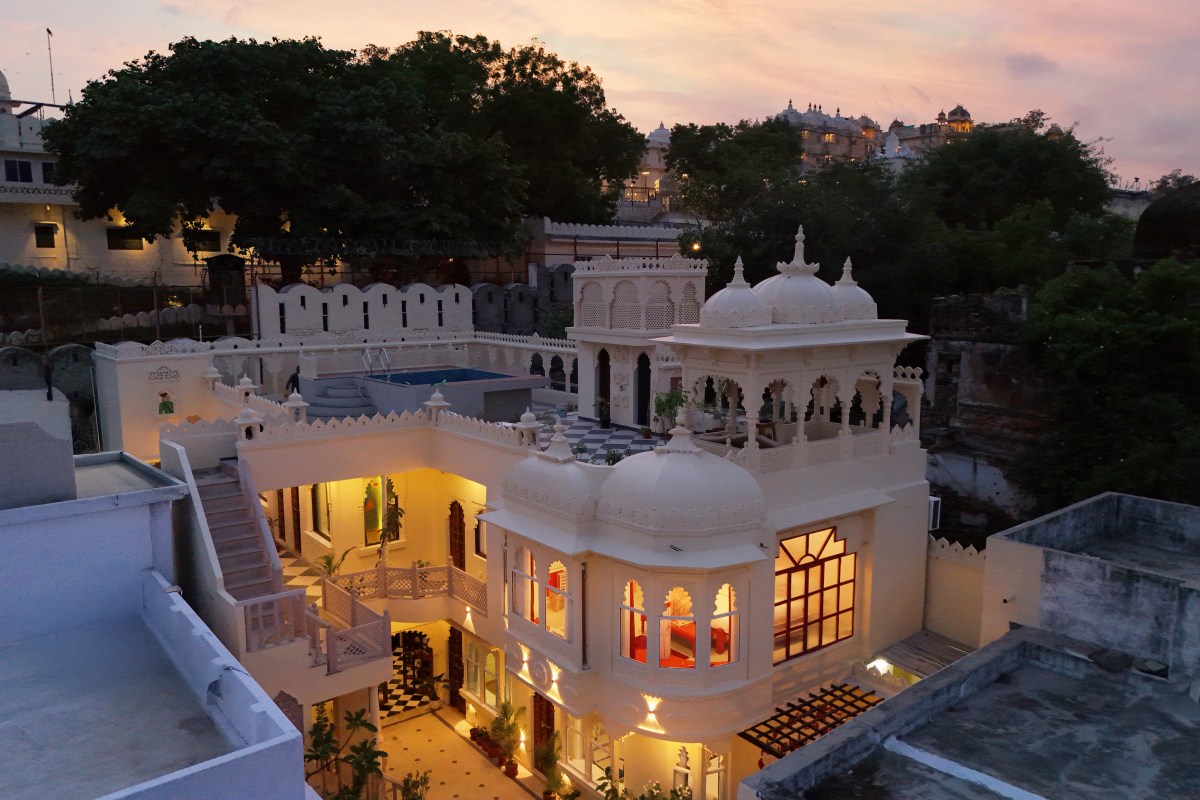
A stunning view of Rang Havelii in Udaipur during sunset, showcasing its intricate Rajasthani architecture with domes, ornamental details, and vibrant windows.

The artistic journey doesn’t stop in the bedrooms. The veranda features Molela wall art, crafted by artisans from a village near Chittorgarh, where 80% of the local community practices this age-old tradition. From Makrana marble seating to Dholpur stone flooring, every material used has been consciously sourced from within Rajasthan. One special wall in the veranda brings together Udaipur’s iconic landmarks—City Palace, Lake Palace, Jagmandir, Fateh Sagar, and more—designed as both a tribute and an idyllic photographic memory for guests.

Heart of the city

The rooftop terrace is where the magic culminates. Offering panoramic views—with the City Palace on one side, Karni Mata hills on the other, and the city skyline all around—it’s a breathtaking space to unwind. There’s a small swimming pool, loungers, and custom-built bajot-style floor seating, perfect for candlelit Rajasthani thali dinners under the stars. The terrace can be set up for special occasions or just soulful evenings, and it is also available for on-demand folk performances, from traditional Sarangi players to lively Kalbelia dancers.

Designed by hearts

Rang Havelii was not designed by an architect or decorated by an interior designer. It was entirely visualized and executed by the homeowners themselves. As proud locals of Rajasthan, they wanted to pour their love for the region into every detail. Except for technical consultation on the pool and staircase, every decision—every color, pattern, tile, and piece of furniture—was made with heart, vision, and intention. The goal was never to build just another boutique stay, but to revive endangered art forms, preserve tradition, and offer a soulful slice of Rajasthan.

Preserving culture

Many of the art forms showcased here, like Kavad storytelling boxes and Phad scrolls, are at risk of fading into history. Rashmi made it her mission to work with national-award-winning artisans, source rare artwork from limited-edition books, and give these traditions a new canvas within Rang Havelii. She hopes that guests leave not just rested, but inspired by the craftsmanship, touched by the stories, and deeply connected to the land.

If a guest says, “We didn’t want to leave,” she knows she has succeeded.

A true homecoming

Guests don’t just check into a room. They walk into a story and are welcomed like family. Whether it’s arranging transport, planning bonfires or projector nights, or surprising someone with a candlelight dinner, the caretakers go above and beyond to make every guest feel special.

As Rashmi says, it’s not about commercial gain. It’s about offering an experience that lingers—something that spoils guests with sincerity and soul.

A Living Canvas of Rajasthan

Aerial view of Udaipur showcasing the City Palace, Lake Pichola, and surrounding hills, under a cloudy sky.

SaffronStays Rang Havelii is a rare gem nestled in the heart of Udaipur’s white-marble cityscape. It is a tribute to the colors, craft, and cultural legacy of Rajasthan, designed to preserve, celebrate, and pass on. More than a place to stay, it’s a place to remember.

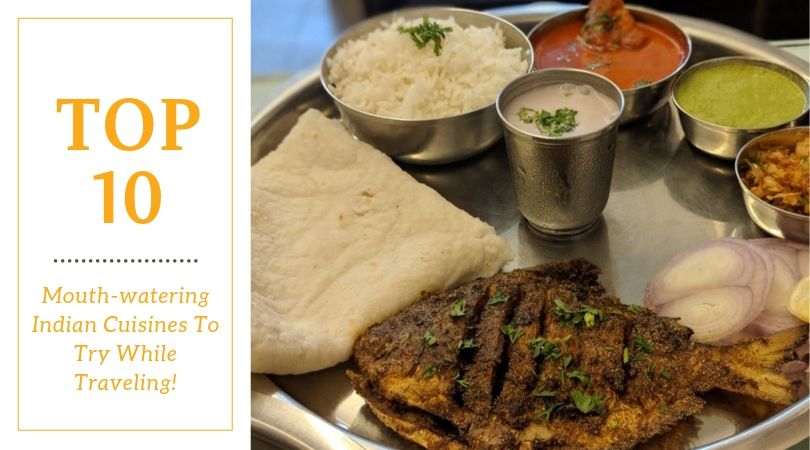
Top 10 Mouth-watering Indian Cuisines To Try While Traveling

Mouth-watering Indian Cuisines To Try While Traveling!

Indian cuisines are predominantly a mixture of a variety of spices and flavors. Apart from cultural diversity, the culinary style in India also varies from place to place. These Indian cuisines are so much more than the staple Punjabi dishes served at most Indian restaurants.

Indian Cuisines

Each region has a certain flavor and taste of their own. So if you’re a foodie, what better than exploring these Indian cuisines at a private homestay? Imagine tasting lip-smacking “Ghar Ka Khaana” made specially for you! Here is what kind of Indian cuisines to expect as you travel through the different regions in India.

Behold the amazing, mouth-watering Indian cuisines from each region as we give you the top 10 homes of SaffronStays which serve you these.

SaffronStays Parnakuti, Nashik

A spacious 5 bedroom villa with the comforts and luxury of a home, SaffronStays Parnakuti is an exotic, farm stay.  This home serves authentic Maharashtrian food to all it’s guests. Dishes like “Bharli Wangi, Jhunka Bhakri, Chicken Rassa” are to die for here. This is one of those Indian cuisines which will make you lick your fingers clean.

So come, luxuriate in the privacy of this exclusive villa, SaffronStays Parnakuti, with friends and family for a fun-filled holiday 

Book Now: book@saffronstays.com | (+91) 2268110811

SaffronStays La Casa Maestro, Kashid

Influenced largely by the homeowners’ time in Argentina and Spain, SaffronStays La Casa Maestro has a taste of Spanish architecture, with terraces and arches dominating the look. 

A beachfront property, that serves authentic Malvani and Alibaug-style dishes like Fish curry, malvani chicken curry and more that’ll surely make your mouth water.

P.s our caretakers also prep up the barbeque! Don’t forget to inform in advance.

Book Now: book@saffronstays.com | (+91) 2268110811

SaffronStays Masaya, Alibaug

Just 15 minutes from Mandwa Jetty, SaffronStays Masaya, is set on a picturesque hill. You can spend quiet hours enjoying the clean fresh air or identifying the fruit-bearing trees that surround the home. 

This Veg-Only home has one of the best cooks who serves soft Gulab Jamuns and delicious food, fresh from the kitchen. Ghar ka Khaana like this is our definition of ultimate luxury!

Book Now:book@saffronstays.com|(+91)2268110811

SaffronStays Falcon Hill, Lonavala

 A 6-bedroom villa, SaffronStays Falcon Hill boasts of sleek interiors in muted tones. Your trip isn’t complete without tasting our Indian specialities made by our rockstar cook, Sukhchandji.

Right from authentic Indian to Desi Chinese to Royal Italian, you get all kinds of cuisines served up on your plate here. Doesn’t this want to make you visit this home all the more?

Book Now:book@saffronstays.com|(+91)2268110811

SaffronStays Nandanvan Estate, Tamil Nadu

Refreshing coffee aroma, lush farmlands a well-manicured lawn and an earthy countryside villa awaits your presence at SaffronStays Nandanvan Estate near Kodaikanal.

Savor delicious South-Indian cuisines where most of the ingredients have been sourced from their own herb garden. South Indian cuisines can’t do without rice. It’s included in their staple diet. Watch out for Chettinad cuisine, perhaps one of the fieriest Indian Cuisines of all time!
Also savor delicious South-Indian breakfast on the spacious porch, outfitted with cosy bamboo furniture.

Breakfast with a view

Book Now:book@saffronstays.com|(+91)2268110811

SaffronStays Kurinji Estate, Tamil Nadu

Tucked away from the chaos of the main market, SaffronStays Kurinji Estate is an idyllic retreat for those looking to relax and unwind. Surrounded by lush greenery, this 9-acre estate features a gorgeous 6-bedroom heritage homestay built in the 1930s, landscaped gardens and a scenic pond complete with a rustic sit-out.

As one of the best Indian cuisines, the food here is known for its light, low-calorie appetizing dishes. This Indian cuisine is famous for its wonderful mixing of rice and lentils to prepare yummy lip smacking dosas, vadas, idlis, and uttapams.

Book Now:book@saffronstays.com|(+91)2268110811

SaffronStays Suvarna Sangam, Udupi

SaffronStays Suvarna Sangam, a rustic-luxe homestay, rests upon a river island formed by the splitting, then merging, of the mighty Suvarna River.  Untouched and unharmed, the raw pulsating beauty will leave you spellbound!

The Udupi region of Karnataka is renowned for its simple but vast vegetarian fare. However, if you’re at the deck at the right time, you may chance upon a fisherman, and ask for the catch of the day!

Book Now: book@saffronstays.com|(+91)2268110811

SaffronStays Jaipura Garh, Jaipur

SaffronStays Jaipura Garh, a royal heritage home is an ideal destination for a quick yet enriching getaway, 40 km from Jaipur city. For those seeking to witness a melting pot of cultures, encounter fascinating anecdotes of history and take their taste-buds on a roller coaster ride, SaffronStays Jaipura Garh is your answer.

Known for its slight sweet touch, Rajasthani cuisine is one of the finest vegetarian cuisines in India. This home offers many exciting experiences like Dinner with the Royals and the joy of flavorsome Indian cuisines. While on their stay here one must savor the Rajasthani Thali with delicacies like Dal Bhaati Churma, Gevar, etc.

Book Now: book@saffronstays.com|(+91)2268110811

SaffronStays Elgin Hall, Himachal Pradesh

With a legacy of more than 100 years, SaffronStays Elgin Hall is a majestic 7 bedroom stone villa. As you enter the villa, you are sure to be carried back to a regal era with its charming vintage vibe. The wooden plank flooring gives the home a warm, cozy vibe while the chandeliers and the vintage artifacts lend an elegant touch.

Meat and Indian bread are the main features of North Indian food served here. This is one of the Indian cuisines which is hearty and commonly cooked in a tandoor. Also, north Indian curries have a usually thick, moderately spicy and creamy gravies.

Book Now: book@saffronstays.com|(+91)2268110811

SaffronStays Master’s Courtyard, Gholvad

A charming four bedroom homestay located 15 minutes from Gholvad beach, SaffronStays Master’s Courtyard is ideal for families looking to escape the city for a weekend.

Parsi cuisine is one of the Indian cuisines which has an eclectic mix of hot and sweet, nice and spice. It involved simple yet diverse ingredients. Don’t miss out on experiencing authentic Parsi food and Taari while on your stay here with us.

Book Now: book@saffronstays.com|(+91)2268110811

Indian Cuisines are different from the rest of the world. Not only in taste but also in our cooking methods. They reflect a perfect blend of various cultures and ages. So come, explore more cultures, more cuisines with us!

Have you not yet booked your stay with us? Well, what are you waiting for!

VEG OK PLEASE: A Definitive Guide for Veg Only Villas Near Mumbai and Pune

If one were to define the relationship between Indians and vegetarianism, it would be safe to say, “it’s complicated”. Don’t believe us? Well, we’ll let the meme below do the talking:

With so many sub-categories, it becomes important for anyone even remotely associated with the F&B industry to cater to these diverse palates. This is because while we are experimental, we also want to play it safe. Therefore, carrying thepla and instant noodles on international trips, or seeking recommendations for restaurants that serve vegetarian fare in Japan is not uncommon. Being a vegetarian myself, this is what I’m always looking at while travelling. When it comes to food, comfort is the keyword. Keeping the needs of several vegetarians like me (No. 4 from the list above) in mind, SaffronStays has several fully staffed and serviced veg only villas. Let’s take a look at some veg only villas near Mumbai and Pune.

SaffronStays Sanvina Farm, Karjat

Experience a humble living amidst the greens of nature at SaffronStays Sanvina Farm in Karjat. Located within an organic farm of 10-acres, this veg-only villa in Karjat serves an authentic taste of the farm-to-table experience. There are plantations of over 2000+ trees including sal, teakwood, fruit plantations like mango, pineapple, lychee, phalsa, mulberry to masalas like tamarind and many other vegetables. Our inhouse cook Ganesh will ensure you gorge on authentic Maharashtrian cuisine
like Pitla Bhakari, Bharli Vangi and Bharli Mirch.

SaffronStays Foresta By The Lake, Kamshet

Spread across sprawling 70-acres, this veg-only villa near Mumbai is located on the banks of Andre Dam. There is just so much to do here, be it peacefully reading in the library, a picnic around the lake, play tennis or volleyball in the multipurpose court or sit out sessions in the gazebo. Despite being a veg-only villa, there’s a provision of savouring some delectable Indian and international meals cooked by our trained chefs on site. They can prepare simple local food to Punjabi and Gujarati cuisine too.
To know more about the villa, click here.
(In The News: Out In The Open: How A Pandemic Intensified Our Connection To The Outdoors)

SaffronStays Falcon Hill, Lonavala

It’s a dream to have wholesome, home-style meals as you enjoy breathtaking views. At this 6-bedroom veg only villa in Lonavala, do just that. Madan, our in-home cook is known for his fluffy dosas, spicy Misal Pav and delicious Chinese preparations. With an infinity pool, TT, snooker and poker table, this villa is ideal for groups to bond over games. Guests can also opt for glamping here.
To know more about the villa, click here.
(Read More: A New Villa in Lonavala)

SaffronStays Masaya, Alibaug

Imagine having piping hot bhajiyas with chai as you surrender yourself to them greens. Or having authentic Rajasthani cuisine by the in-home chef, Mahendra, in an outdoor dining area. Or picking fresh herbs, including peppermint and basil from the garden here. If these ideas excite you, then head to SaffronStays Masaya. This veg only villa in Alibaug with 3 bedrooms is where comfort resides. How about planning your next college reunion at this pet-friendly home with decks and open-air bathrooms?
To know more about the villa, click here.

SaffronStays Asanji Wadi, Alibaug

SaffronStays Asanji Wadi in Alibaug, is a heritage property in Alibaug, where every corner is steeped in history. This veg only villa near Mandwa Jetty stands as a testimony of how the home-owners have resurrected it from remains of the Bhuj earthquake. This elderly-friendly villa will definitely take one back to their childhood memories of spending time in ancestral homes. It offers veg Maharashtrian meals, soups, daals, Pav Bhaji and Chhole. Our cook can also prepare Kutchi-style meals and some delicious egg-based breakfast dishes.
To know more about the villa, click here.

SaffronStays Avabodha, Panchgani

If you want to experience a stark contrast to the madding city crowd, this is where you should be. Forget your worries at this eco-friendly nature’s retreat where you’re surrounded by herbal treasures like Ashok Sita, Sonchafa and Beheda among others; if you’re lucky, you’ll also spot a deer, peacock, giant squirrel and mongoose. Try out the Zunka-Bhakar, Sabudana Khichdi, Appams and Basundi by Kalpana, the in-home cook. At this 3-bedroom veg only villa, food is prepared using locally sourced ingredients.
To know more about the villa, click here.

SaffronStays Mega Farms, Igatpuri

Known for its Tarris (spicy gravy) and Tarri Poha, Misal Pav and authentic Maharashtrian cuisines, Nashik-style food is quite a thing. And besides trying out street-side food on a road trip, you could try out these bursting flavours at SaffronStays Mega Farms. Balaji, the in-home cook here, prepares delicious Nashik-style meals and Shev Bhaji. Experience quietude at this 4-bedroom waterfront veg only villa near Bhandardara.
To know more about the villa, click here.

SaffronStays By The Beach, Alibaug

If you have any kind of celebration coming up, and have a specific veg-only preference, SaffronStays By The Beach in Alibaug is the perfect venue. This beach villa in Mandwa requires you to take a ride on the beach to arrive here. The well-manicured lawns, a beach-facing large pool, and garden of a variety of tree plantations is ideal to host wedding functions, sundowners, family get-togethers and so on. This veg only villa in Alibaug will definitely give you a taste of luxurious living too. The culinary experience here is about fine dining, so you can enjoy gourmet, breakfast, lunch and dinner spreads.
To know more about the villa, click here.

SaffronStays Fragrant Sun, Mulshi

Who said homestay food items were limited to Indian menu only? In the 2,000 sq ft open kitchen at SaffronStays Fragrant Sun, it’s all about Dhondi’s special Cheesecake, Tacos and Pani Puri. To better soak in the vibe here, ask for the meals in the outdoor dining area. This eco-friendly veg only villa near Pune is located right on the banks of Mulshi Lake. Plan a storytelling night in the bonfire sit-out area that is surrounded by lawns, fruit trees, herbs and vegetable patches. Experience nature, uninterrupted.
Pssst! Kavita and Sanjiv Berry, the Home Owners, are both alumni of Institute of Hotel Management (IHM). Interestingly, until a few years ago, they used to run a popular eatery in Udaipur called Berry’s. That should speak volumes about the food served here!
To know more about the villa, click here.

SaffronStays Kamal Farms, Karjat

While you create memories with your loved ones here, the in-home cook, Jyoti, will ensure you never forget the food as well. With the hills, River Tez and lots of greens for company, enjoy her specialities Kanda Poha, Pav Bhaji and Kheer. With spacious lawns and stunning views, this 4-bedroom villa in Karjat is perfect for large group outings. Most of our guests are known to head towards the gaming room here for TT, carom, chess, monopoly, Jenga and UNO among others.
To know more about the villa, click here.

SaffronStays Serene Gardens, Lonavala

Just like the name suggests, this private pool villa in Lonavala will ensure you have a serene stay surrounded by hills and paddy fields. This cozy veg only home offers simple home-cooked meals. Guests can also order vegetarian meals from nearby restaurants. Some of the famous dhabas in Lonavala like Kinara Village Dhaba, Sunny Da Dhaba, Sooraj Dhaba, Amber Dhaba and Mumbai Masala are in the vicinity.
To know more about the villa, click here.

SaffronStays Riverside Hideaway, Karjat

There’s another veg-only villa in Karjat, ideal for family getaways called SaffronStays Riverside Hideaway. This elderly-friendly home is situated right beside the Pej river. Its beautiful verandah overlooking the flowy river is where you can have some great conversations and family bonding time. We would definitely recommend you to try dishes like pav-bhaji, parathas, bhindi and veg-biryani by our local cook.
To know more about the villa, click here.

Email: book@saffronstays.com | Call: (022) 6811 0811 |
WhatsApp: +91 84240 40040