Rang Havelii: The Udaipur Haveli That Shares Its Wall With a Palace

Exterior shot of the Rang Havelii entrance lane at Bhatiyani Chohatta, City Palace boundary wall visible alongside, golden-hour light.

In the lane called Bhatiyani Chohatta, the walls do not so much end as surrender to a bigger one. Shopfronts give way, cows find their shade under low eaves, and then the stone itself changes character: this is the outer skin of Udaipur’s City Palace, four centuries old, running the length of the street like a border nobody thought to question. Somewhere along that stretch, without a signboard announcing itself, sits a doorway into eight rooms, seven living craft traditions, and one woman’s very deliberate refusal to be tasteful in the way the world currently defines tasteful.

That doorway opens into Rang Havelii, a heritage-style haveli built not from a restored palace wing but from a shell of collapsed chambers that its founder, Rashmi, found in ruins two years ago. What stands there now is arguably Udaipur’s most striking recent addition to the city’s old quarter: a boutique stay that treats colour not as a decorating choice but as its entire argument. The name says as much. Rang, in Hindi, means colour. Havelii is the traditional courtyard mansion of Rajasthan and North India. Put together, they describe exactly what waits on the other side of that unmarked door, and precisely what this property borrows from the past rather than inherits from it.

Table of Contents:

The Banker Who Built a Haveli

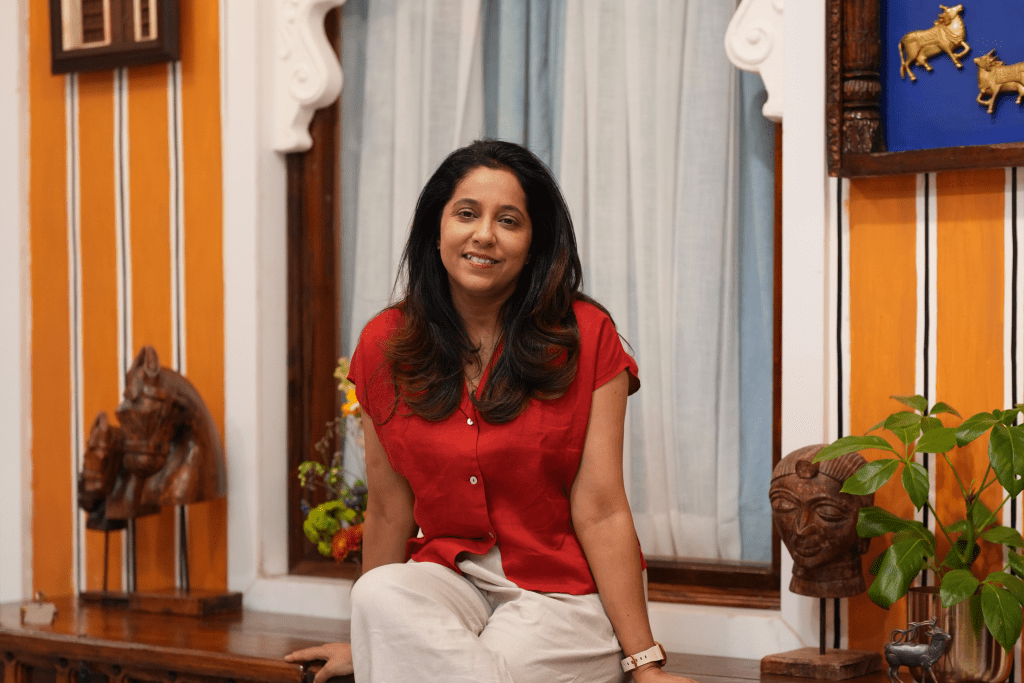
Rashmi did not train as an interior designer, an architect, or a hotelier. She spent her working years in banking before she began writing about food under the Instagram handle @kasoor_e_methi, building a loyal following for a voice that was unmistakably, unapologetically Rajasthani. When she first walked into what would become Rang Havelii, the building offered her nothing to work with in the conventional sense. “When I first found this place two years back, it was in complete shambles,” she says. “But in my heart I knew that this place had a lot of potential and I could turn this into something really special.”

She did not hire a design firm and hand over a mood board. She commissioned artisans directly, brief by brief, room by room. The dining table, made from ethically sourced camel bone carved and embedded into wood in an intricate technique local to Rajasthan, was built to a specification she gave craftspeople who work almost exclusively in this material. The mural above the breakfast nook, mapping Udaipur’s own skyline onto a stairwell wall, began as a scale drawing by her illustrator friend Monica, based in Mumbai, who plotted the City Palace, the ghats, and the lake against real dimensions before local artists reproduced it by hand. “I was just a little confused what to kind of make here,” Rashmi recalls of that particular wall. “So I took the help of my illustrator friend… I told her that I want something unique.”

The result reads less like a restoration and more like a personal statement rendered at the scale of a building, built from scratch in the visual language of a much older Rajasthan. “It’s just a representation of me,” she says of the finished haveli. “And when you come here, you will experience the same love and warmth that I grew up with and that Rajasthan has to offer.”

A Living Gallery: Eight Rooms, Eight Colours

Every one of Rang Havelii’s eight rooms is painted, furnished, and dressed in a single dominant colour, and every room showcases a distinct craft tradition. Guests do not simply sleep at a heritage-style property here. They sleep inside a specific, deliberately unrepeated art installation, then walk down a corridor into a completely different one.

Bagh Baradari carries the storytelling energy of Phad scroll painting, a tradition rooted in the Bhilwara belt of Mewar, its walls animated with the loose, narrative brushwork this folk art is known for. Panna Bagh, on the ground floor, goes the other way entirely: mint-green walls with hand-painted trees and birds, a quiet garden room that borrows its calm from the Rajput palace gardens of old. Maaru Mahal, one floor up, trades green for gold, taking its warmth from the sandstone palaces of Jaisalmer and the open Thar beyond them.

RoomColourCraft Focus / Inspiration
Bagh BaradariForest tonesPhad scroll painting (Bhilwara belt)
Panna BaghMint greenHand-painted garden motifs, Rajput palace gardens
Maaru MahalGold / sandstoneJaisalmer and Thar desert palette
Kamal TalaiSoft pink / lotusPichwai art, Nathdwara (17th century)
Surkh DarbarCrimsonMewar miniature painting
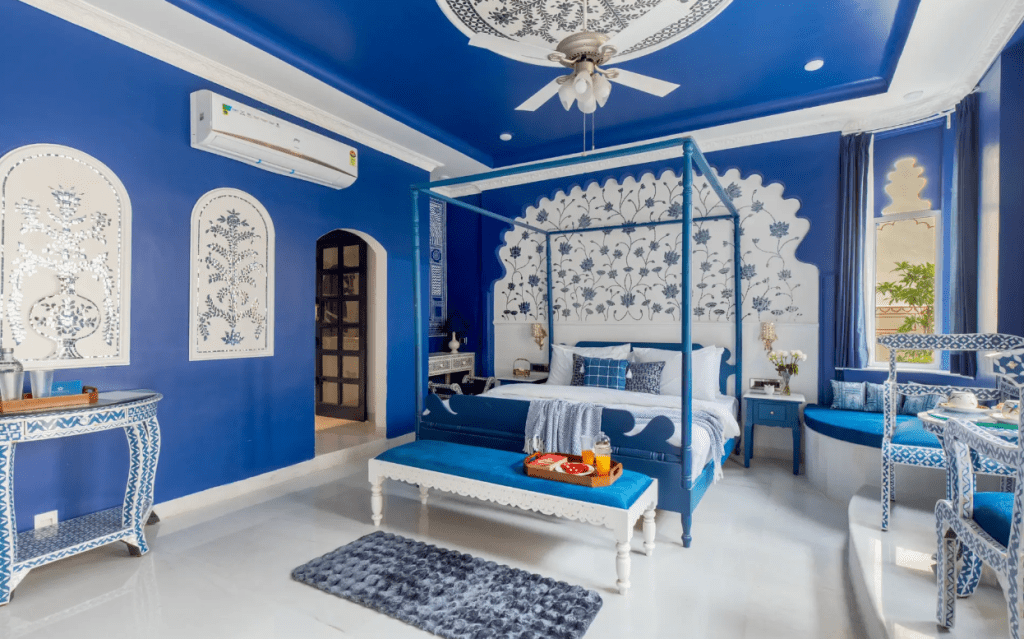
Neel JharokhaBlueJodhpur’s Blue City tradition
Rajwadi VatikaPinkJaipur palace garden aesthetic
Darpan DarbarMirror / white-goldThikri mirror-glass art, Udaipur
Thikri mirror art room Darpan Darbar at Rang Havelii Udaipur

Two rooms reward the closest attention. Darpan Darbar is built around Thikri, an inlaid mirror-glass craft specific to the Mewar region, in which small pieces of convex mirror and coloured glass are cut, polished, and set into plaster to catch and multiply light across a wall. By evening, a single lit candle in this room throws itself into dozens of reflected points across the ceiling and walls, an effect the room was clearly designed around. Surkh Darbar, by contrast, is quieter and more exacting: its walls carry Mewar miniature painting, worked in fine detail with squirrel-hair brushes and pigments traditionally drawn from minerals and plant matter, the same technique used for centuries in courtly manuscripts across this region.

The communal spaces do not let up either. The living room holds a hand-painted Pichwai mural, a collaboration between Rashmi’s sister and a local artist. The entrance is marked by a Toran, the ceremonial door hanging central to Rajasthani weddings, flanked by chairs shaped like elephants, a nod to the elephant rides up to Jaipur’s Amer Fort. A hand-carved Kavad, sourced from artisans in Bassi near Chittorgarh, sits nearby: a wooden shrine that opens like a series of folding doors, each panel painted with its own episode from a larger story of gods and goddesses, traditionally narrated aloud by the Kavadiya Brahmin families who carried these shrines door to door.

“Just as these days minimalism is trending, but as you know, Rajasthan is all about maximalism. So there will be a lot of colours and patterns and textures. Having been born in Rajasthan myself, I have this natural inclination towards colours and vibrance.”

— Rashmi, Founder, Rang Havelii

Seven Crafts, Under One Roof

What separates Rang Havelii from Udaipur’s many other heritage-styled stays is specificity. Almost anyone can call a property a living museum. Rang Havelii can name the village each craft came from.

Pichwai, the devotional cloth painting depicting Srinathji, traces to Nathdwara, near Udaipur, and dates to the seventeenth century. Thikri mirror-glass work is native to Udaipur and the wider Mewar region. Miniature painting here follows the Mewar school, distinguished from the more famous Mughal miniature tradition by its palette and its subject matter, closer to courtly and devotional life than imperial record-keeping. Phad, the scroll paintings that narrate the deeds of folk deities like Pabuji and Devnarayan, comes out of the Bhilwara belt, traditionally unrolled and sung by travelling bhopa performers rather than simply displayed. Bone inlay, seen throughout the property in furniture, uses ethically sourced camel bone carved and set into wood, then filled with resin. Kavad shrine-making is specific to Bassi, a small town near Chittorgarh. And Molela terracotta, added to the property’s craft roster after the press materials for this piece were written, comes from a single village of that name on the Banas river near Nathdwara, a GI-tagged tradition of flat terracotta plaques depicting local deities, made almost exclusively by the Kumhar potter families who have worked that clay for generations.

None of these crafts are displayed behind glass at Rang Havelii. They are load-bearing, in the most literal sense: walls, furniture, shrines, and tabletops that a guest touches, sits at, and sleeps beside rather than views from a rope barrier. The building itself is new. The hands that made everything inside it are not.

Food, Hosting, and Atithi Devo Bhava

“Rang Havelii for me was a perfect blend of the two things that I love: food and hosting,” Rashmi says, and the kitchen bears this out. It runs less like a hotel restaurant and more like the kitchen of someone who has spent years feeding people she cares about, which, as a food blogger for years before Rang Havelii existed, is exactly what Rashmi was already doing. The in-house chef prepares Rajasthani food with the kind of personal attention a restaurant kitchen rarely offers, and meals are available at an additional charge rather than folded into a flat room rate, closer in spirit to eating at someone’s home than paying for a fixed hotel menu.

That hosting philosophy has a name in Rajasthan: Atithi Devo Bhava, the guest as god. The Toran at the entrance is not purely decorative. It references a wedding-day ritual in which a groom touches the door hanging with his sword on reaching his bride’s threshold, a gesture of respect and welcome that predates the building by centuries, even where the building itself does not. Guests crossing into Rang Havelii cross the same threshold. On the ground, this translates into specific, remembered service: reviews on the live listing repeatedly single out staff members by name, and the property currently holds a 4.9-out-of-5 rating across more than fifty stays, with cleanliness, safety, and staff attentiveness scoring particularly high.

Rajasthani thali meal experience at Rang Havelii Udaipur

A Wall Away From the City Palace

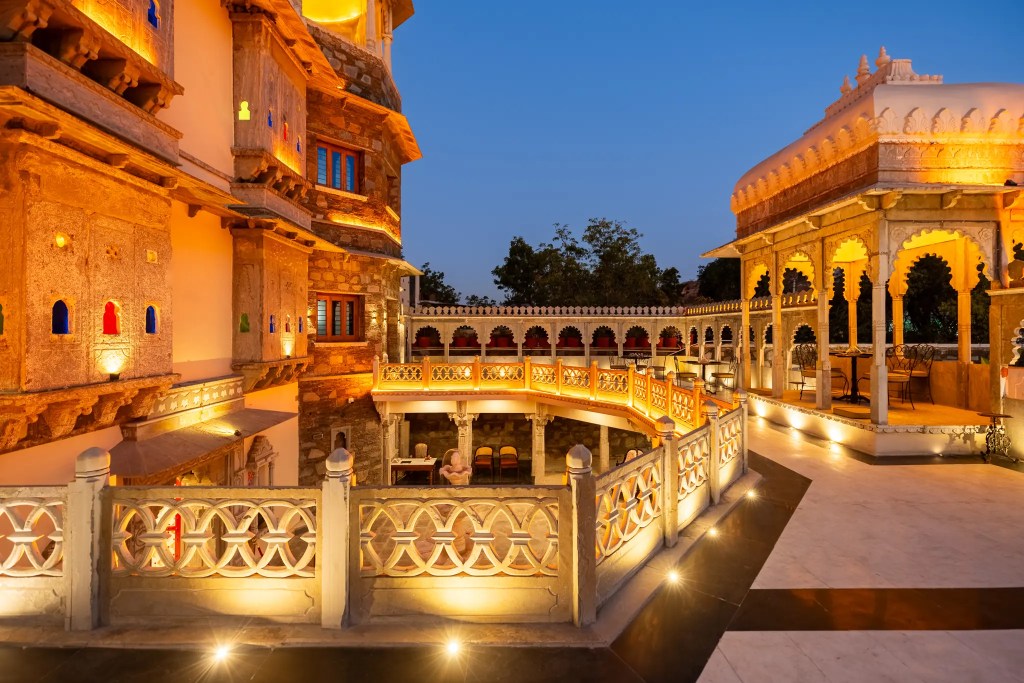
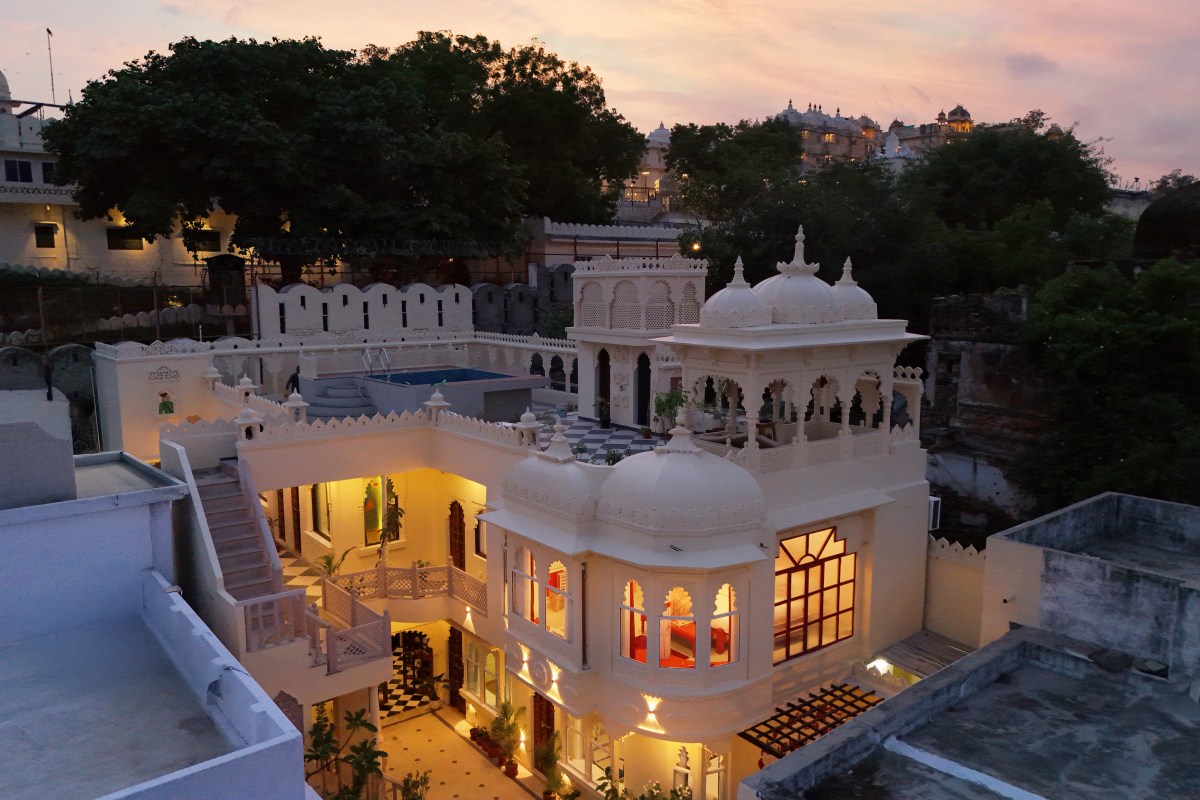
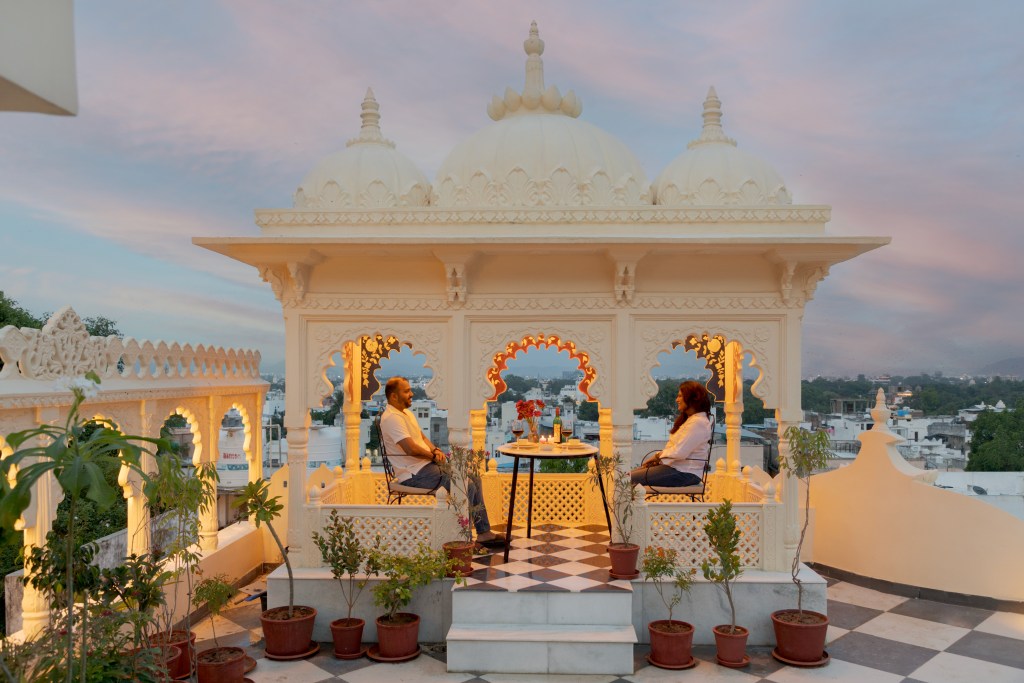
Location does most of the remaining work. Rang Havelii shares a boundary wall with the City Palace of Udaipur, one of the largest palace complexes in Rajasthan and, after dark, one of the most theatrically lit buildings in the city. From the rooftop chhatri and the private pool at Rang Havelii, guests watch that illumination directly, and during Diwali, the same terrace becomes a private viewing point for fireworks across the old city skyline. Jagdish Temple and Lake Pichola are each roughly a five-minute walk away. Fateh Sagar Lake is closer to fifteen minutes. The haveli sits inside Udaipur’s old city grid, within the kind of walkable radius that lets a stay double as a base for exploring rather than a destination requiring its own transport plan for every outing.

GOOD TO KNOW

Rang Havelii shares a boundary wall with the City Palace, Udaipur’s largest palace complex.

Jagdish Temple and Lake Pichola: approximately 5 minutes on foot.

Fateh Sagar Lake: approximately 15 minutes on foot.

Best light for the rooftop chhatri and pool: late afternoon into the evening, when the City Palace begins its nightly illumination.

Diwali is a particularly strong time to book this specific property, given the terrace’s direct sightline to the city’s fireworks.

Getting There, Including the Drive Every Gujarati Traveller Already Knows

Rang Havelii sits close enough to the centre of Udaipur that the wider question is less about reaching the haveli and more about reaching the city. Maharana Pratap Airport is roughly 24 kilometres away, a 30 to 40 minute drive depending on traffic. Udaipur City Railway Station and the main bus stand are both about 2 to 3 kilometres out, a 10 to 15 minute drive from the property, or a manageable one for anyone willing to walk part of the old city on arrival.

For travellers coming from Gujarat, this is a familiar route long before it is a search query. Ahmedabad to Udaipur runs roughly 260 kilometres via NH48, a drive of four to four and a half hours that has become one of the state’s most reliable weekend getaways, popular enough that Himmatnagar and the Shamlaji temple stop are landmarks in their own right for anyone who has made the drive before. Direct trains, including the ADI-UDZ Express, connect Ahmedabad’s Kalupur station to Udaipur City, and flights run the route as well, though most Gujarati travellers making a weekend of it still choose the highway for the flexibility it offers to detour toward Nathdwara, Eklingji, or Kumbhalgarh along the way. Travellers from Surat and Vadodara add roughly two and four hours respectively onto that same NH48 corridor, making Udaipur, and a stay inside its old city walls, a realistic two-night plan rather than a stretch.

From Mumbai, Pune, Delhi NCR, and Bangalore, Udaipur is well served by direct flights into Maharana Pratap Airport, putting Rang Havelii within a half-day’s travel from each of these cities door to door.

Rooftop pool and chhatri at dusk with the illuminated City Palace visible in the background.
Rooftop pool with City Palace view at Rang Havelii Udaipur
Stay Inside the Story

Book a room, a wing, or the entire eight-room haveli at Rang Havelii, Udaipur, through SaffronStays.
BOOK RANG HAVELII

Frequently Asked Questions

Where exactly is Rang Havelii located in Udaipur?

Rang Havelii is located in Bhatiyani Chohatta, in Udaipur’s old city, sharing a boundary wall with the City Palace. It sits within a five-minute walk of Jagdish Temple and Lake Pichola.

Is Rang Havelii an actual heritage building?

No. Rang Havelii is a heritage-style haveli, built two years ago from a collapsed shell of chambers and designed using traditional Rajasthani architecture, materials, and craft. It is not a centuries-old or protected heritage structure, and it shares a boundary wall with one that is: the City Palace.

How far is Rang Havelii from Udaipur’s airport and railway station?

Maharana Pratap Airport is approximately 24 kilometres away, a 30 to 40 minute drive. Udaipur City Railway Station and the main bus stand are both roughly 2 to 3 kilometres away, about 10 to 15 minutes by road.

What Rajasthani art forms can I see at Rang Havelii?

The property features seven craft traditions across its rooms and common areas: Pichwai painting from Nathdwara, Thikri mirror-glass art from Udaipur, Mewar miniature painting, Phad scroll painting from the Bhilwara belt, camel bone inlay furniture, hand-carved Kavad shrines from Bassi, and Molela terracotta from Rajsamand district.

Can I book just one or two rooms, or do I need to book the entire haveli?

Rang Havelii can be booked room by room, as a partial wing, or in its entirety for larger groups and celebrations. Room configurations and exact availability are confirmed at the time of booking on the SaffronStays listing.

Is Rang Havelii within walking distance of Lake Pichola and the City Palace?

Yes. The City Palace is directly adjacent, sharing a wall with the property, and Lake Pichola is approximately a five-minute walk away.

Is Udaipur a good weekend getaway from Ahmedabad and Gujarat?

Udaipur is one of Gujarat’s most popular weekend destinations, roughly 260 kilometres and four to four and a half hours from Ahmedabad via NH48. It is also well connected from Surat and Vadodara by the same highway, and by direct train and flight options.

Does Rang Havelii provide meals?

Yes, meals are available at an additional charge, prepared by an in-house chef, with vegetarian, non-vegetarian, and Jain options on the menu.

Udaipur in the Monsoon: A Complete Guide

Lake Pichola and the City Palace under monsoon cloud, water at full level, soft grey light.

What changes in the city, where to stay, and how to get there from Gujarat, Madhya Pradesh, Mumbai, Delhi and Pune

Udaipur looks like a different city once the monsoon arrives. For most of the year, it is a place people visit for clear skies and dry heat, its lakes and white marble palaces photographed under bright winter sun. Between July and September, that picture changes. The Aravalli hills around the city turn green. The lakes rise to levels they hold for only a few months a year, and the light softens into a grey that suits old sandstone and marble better than sharp sunlight usually does.

Most travel advice still treats Rajasthan as a winter destination and skips the monsoon question entirely. That misses what makes this particular season worth planning around. Udaipur was built around its lakes, quite literally, and monsoon is really the only time of year the city looks the way it was designed to look.

Table of Content:

What Changes in Udaipur During Monsoon

Lake Pichola existed before the city did, but Maharana Udai Singh II expanded it further when he founded Udaipur here in 1559. Every ruler after him added another lake, or another palace on an island in the middle of one, and the whole city grew up around water and reflection. For most of the year, Pichola and Fateh Sagar, the two main lakes, sit well below their full level. Monsoon changes that. Rain usually arrives through July, and by August both lakes are close to full, deep enough that the City Palace and its reflection blur into one another on a calm morning.

The weather itself is easier than most people expect. Rain tends to arrive in short bursts rather than settling in for the whole day, so mornings are often clear enough for sightseeing, with showers more likely in the afternoon or evening. Daytime temperatures run from the high 20s to low 30s in degrees Celsius, a real drop from the 40°C-plus the city sees in May and June. The crowds thin out too. Winter remains the busiest season for tourism in Udaipur, which makes monsoon the quietest and most affordable time to visit.

Monsoon shows Udaipur the way it was actually built to look.

Things to Do in Udaipur in Monsoon

The City Palace is worth visiting twice if there is time. Go once in the late morning, when the light is flat and even, and again closer to evening, when the marble catches whatever sun breaks through the clouds. A boat ride on Lake Pichola works better in monsoon than in any other season. The water sits high enough for the palace and surrounding hills to reflect clearly, instead of the muddy shallows visible for most of the year.

Sajjangarh Monsoon Palace seen through low cloud, hillside forest below.

Above the city, Sajjangarh, better known as the Monsoon Palace, was built in the 1880s by Maharana Sajjan Singh specifically to watch the clouds roll in over his kingdom. The drive up passes through a wildlife sanctuary that stays thick with mist through most of the season, and on a clear break in the weather, the view from the top stretches across the whole lake basin.

In the evenings, Bagore Ki Haveli, a restored eighteenth-century mansion on the Pichola waterfront, runs a nightly Dharohar dance show, a set of Rajasthani folk performances that ends with a dancer balancing seven brass pots on her head. During monsoon, the courtyard show has rain for a soundtrack, which makes it a good deal more atmospheric than the same performance in dry summer heat.

Food is worth building time around too. A Rajasthani thali, usually a dozen small dishes built around dal, gatte and kadhi, tastes better after a morning spent outdoors in cooler air. The cafés along the lake, half-empty for most of the year, fill up just enough in monsoon to feel lively, without a wait for a table. The old city rewards slow walking as well. Hathi Pol Bazaar, close to the City Palace, is where most of the miniature paintings and Pichwai art on sale in Udaipur are actually made, not just sold.

Where to Stay in Udaipur

Where a traveller stays in Udaipur changes the kind of trip it becomes. SaffronStays Rang Havelii sits close enough to the City Palace to share a version of the same rooftop views. The haveli took a year and a half to rebuild from near-ruin. Each of its eight rooms is designed around a different Rajasthani city’s craft tradition: Molela wall art from a village near Chittorgarh, marble from Makrana, sandstone floors from Dholpur. The rooftop pool looks out at the City Palace on one side and the Karni Mata hills on the other.

Villa feature, Udaipur SaffronStays Rang Havelii rooftop pool, City Palace visible across the water.

Pristine Manor takes a quieter approach. It sits between two lakes, a few hundred metres from Fateh Sagar, with a ten-thousand-square-foot garden that turns fully green by August, room enough for a large family or a pre-wedding function without feeling crowded. Kilakot, also near Fateh Sagar, is built around the same idea: slow mornings, open living, no fixed itinerary.

Between the three, most of what a traveller wants from Udaipur is covered: proximity to the palaces for anyone here to look at architecture, and enough distance from the noise for anyone here mainly to slow down. We have written a full lake-by-lake, café-by-café guide to Udaipur’s monsoon season separately, for anyone planning to spend a full week in the city rather than a long weekend.

Hariyali Teej Falls in August This Year

Within Teej section Women in green traditional attire celebrating Teej, decorated swings hung from a tree, henna-adorned hands visible.

August adds one more reason to plan around this season. Hariyali Teej, Rajasthan’s main monsoon festival, falls on 15 August this year. It marks the reunion of Shiva and Parvati, and the name roughly translates to green festival. For one day, women dress in green, apply fresh henna, and hang swings from trees and courtyard beams. Rajasthan calls it Shingara Teej locally, and it is celebrated more visibly here, with processions and decorated swings in courtyards and temples, than in most of the other states that also mark the day. It is not something a trip needs to be built around, but arriving during Teej week adds a genuine layer to a Udaipur visit that a dry-season trip does not offer.

Mount Abu: A Short Detour for Drivers

For anyone driving in from Gujarat, and often Madhya Pradesh too, Mount Abu makes a natural stop before or after Udaipur. It is Rajasthan’s only hill station, and the monsoon contrast is dramatic. While the rest of the state sits above 40°C in July, Mount Abu settles into the low twenties, with cloud low enough to touch the hills around Nakki Lake. The Dilwara Temples, a set of 11th and 13th century Jain temples known for their fine marble carving, are worth the climb in any season, but rain does nothing to them except clean the stone.

Rain does nothing to the temples except clean the stone.

SaffronStays Sylvan Farms sits on a hilltop above the town, its gardens and small working farms turning green through the season. Mount Abu to Udaipur is about 160 km, a three-hour drive through hills that turn from brown to green within a few weeks each year.

Getting to Udaipur

For Gujarat, Udaipur is close enough to be a proper weekend trip rather than a full holiday. Ahmedabad to Udaipur is about 260 km by road, a drive of 4.5 to 5 hours via NH48, and it is a route Ahmedabad already knows well, usually for weddings in the winter months. Vadodara and Surat add roughly one to two hours to the drive but follow largely the same road through Mehsana and Palanpur. Driving remains far more common than flying on this route, since the highway is faster door to door than the airport connections from Ahmedabad. Travellers routing through Mount Abu, Rajasthan’s only hill station and already a popular stop for Gujarat travellers, should plan for a full day of driving, with the hill station as a stop along the way rather than a separate detour.

From elsewhere in India, flying is usually the more practical option. Madhya Pradesh is the exception: Indore to Udaipur is about 390 km, roughly 5.5 to 6 hours by road, similar to the Gujarat drive, or under an hour and a half by direct flight. Delhi and Mumbai both have several direct flights to Udaipur a day, each taking around 1.5 hours, a shorter trip than the 10 to 13 hour drive from Delhi or the 750 km-plus drive from Mumbai. Pune has fewer direct options, with most flights connecting through Delhi, Mumbai or Ahmedabad and total travel time running 5.5 to 9 hours depending on the layover. Trains cover all of these routes too, but at 11 hours or more, they suit travellers who prefer an overnight journey over a short flight.

Planning the Trip

Monsoon runs July through September in Udaipur and the surrounding region. Rain tends to arrive in short spells rather than lasting all day, so most mornings stay clear enough for sightseeing. Daytime temperatures: high 20s to low 30s (°C) in Udaipur, low-to-mid 20s in Mount Abu, both a real break from the 40°C-plus both places see in peak summer. Ahmedabad to Udaipur: ~260 km, 4.5 to 5 hours by road. Indore to Udaipur: ~390 km, 5.5 to 6 hours by road. Delhi and Mumbai to Udaipur: ~1.5 hours by direct flight. Pack light layers for daytime humidity, something warmer for Mount Abu evenings if that is part of the trip, and a proper rain layer rather than a travel umbrella.

None of this needs much planning. A long weekend covers Udaipur comfortably on its own. Four or five days allow time for Mount Abu too, for anyone driving in from Gujarat or Madhya Pradesh. A private villa suits this season particularly well, since rain becomes part of a slow day rather than an interruption to a packed one. What changes most about a monsoon trip to Udaipur is not the itinerary but the season most people skip entirely. Winter shows the city at its clearest. Monsoon shows it the way it was actually built to look: lakes full, marble catching grey light instead of hard sun, and considerably fewer crowds in between.

Plan Your Monsoon Trip to Udaipur Explore SaffronStays villas in Udaipur and Mount Abu, from lakeside heritage havelis to hilltop farm retreats.

FAQ: Udaipur in Monsoon

Is Udaipur worth visiting in the monsoon, or is winter really the better season?

Winter remains the most comfortable season for sightseeing, but monsoon is when Udaipur’s lakes, Pichola and Fateh Sagar especially, fill closest to the level they were originally built for, and the city empties of winter crowds.

Is Udaipur a good weekend trip from Ahmedabad?

Yes. At around 260 km and 4.5 to 5 hours by road, Udaipur is one of the easiest weekend drives out of Ahmedabad, Vadodara or Surat, and it is a route Gujarat travellers already make often for weddings and family functions.

How do I reach Udaipur from Mumbai or Delhi?

Both cities have frequent direct flights to Udaipur, taking around 1.5 hours. Trains run too, but take 11 hours or more, so flying is the practical option for a short trip.

Is Indore a good starting point for a Udaipur trip?

Yes. Indore to Udaipur is about 390 km, roughly 5.5 to 6 hours by road, similar in length to the drive from Ahmedabad, and there are also direct flights under an hour and a half.

Can Mount Abu be combined with a Udaipur trip from Gujarat?

Yes, easily. Mount Abu and Udaipur are about 160 km and 3 hours apart, and it is a common route for Gujarat travellers driving in via Ahmedabad.

What is Hariyali Teej, and does it affect travel plans?

Hariyali Teej is Rajasthan’s main monsoon festival, marking the reunion of Shiva and Parvati with green clothing, henna, and decorated swings. In 2026 it falls on 15 August. It does not close attractions, but it brings extra colour and local celebration that week.

The Ultimate Udaipur Travel Guide: How to Plan the Perfect City of Lakes Escape

Let’s be honest: planning a trip to Rajasthan’s most romantic destination can feel like trying to solve a 1,000-piece puzzle where every piece is made of white marble. You want the sunset boat rides and the “Venice of the East” charm, but you’d rather skip the part where you’re stuck in a Tuk-Tuk traffic jam behind a very confused cow. 

Whether you are chasing the golden January sun or looking for a private pool to beat the summer heat, this comprehensive Udaipur travel guide is your shortcut. We have broken down the city into bite-sized categories, from the non-negotiable sightseeing spots in Udaipur to the best local street food secrets. Consider this your local companion to navigate the Mewar region like a royal, without the typical tourist stress.

Best time to visit Udaipur

The best time to visit Udaipur is undoubtedly between October and March, when the desert heat retreats and the “City of Lakes” is bathed in a soft, golden winter glow. During these months, the weather in Udaipur is so perfect; expect crisp, sunny days and nights that are just chilly enough to justify that expensive pashmina you’re going to buy. January is the absolute peak for a reason; the lakes sparkle, the palaces are cool to the touch, and the vibe is purely celebratory. If you are a fan of drama, the monsoon months (July to September) turn the Aravalli hills into a lush green paradise, though you may encounter some humidity.

View of a vibrant cityscape through an intricately designed arch, showcasing colourful buildings and distant hills under a clear blue sky.

Things to do in Udaipur & places to visit in Udaipur

Udaipur isn’t just a city; it’s a sprawling gallery of history and nature. To help you navigate, we have divided the top sightseeing spots in Udaipur by their unique local character.

  •  Palaces & Heritage Landmarks
    • City Palace: The largest palace complex in Rajasthan. It’s a labyrinth of mirror-work and hanging gardens. Pro-tip: Enter through the Badi Pol gate at 9:15 AM to beat the tour buses.
    • Jag Mandir: An island palace on Lake Pichola accessible by boat. It is so beautiful that it reportedly inspired the design of the Taj Mahal.
    • Sajjangarh (Monsoon Palace): Perched high on a hill, this 19th-century palace offers the best panoramic sunset views of the city.
    • Bagore Ki Haveli Show: Every evening at 7:00 PM, they host the “Dharohar” folk dance. It is intense, colorful, and genuinely impressive—a perfect way to see Rajasthan’s heritage in motion.
  •  Lakes & Waterfront Areas
    • Lake Pichola: The oldest and most iconic lake. A sunset boat ride to see the Lake Palace glowing on the water is a core memory you actually want.
    • Fateh Sagar Lake: This is where the locals hang out. It is great for a long evening walk or a quick “Kulhad Coffee” by the promenade.
    • Lake Badi (Bahubali Hills): Located on the outskirts, a short 20-minute hike leads to a view that looks like a scene from an epic fantasy movie.
  •  Temples & Spiritual Sites
    • Jagdish Temple: A stunning Indo-Aryan temple near the City Palace. The morning “Aarti” (prayer) is loud, rhythmic, and incredibly soulful.
    • Eklingji Temple: Located 22 km away, this complex of 108 temples is a masterpiece of stone carving dedicated to the Lord of Mewar.
    • Karni Mata Temple: Accessible via a ropeway, this hilltop shrine provides a breathtaking bird’s-eye view of the entire city.
  •  Old City & Markets
    • Hathi Pol Bazaar: The primary choice for authentic Pichwai paintings and traditional Rajasthani footwear (Juttis).
    • Bada Bazaar: The bustling heart of the city for silver jewelry, camel leather journals, and vibrant Bandhani fabrics.
A waterfront view showcasing historic buildings with ornate facades, illuminated by the golden light of sunset, reflecting in the calm water below.

Best Day Trips from Udaipur

If you have an extra day, these legendary locations are worth the drive.

  • Chittorgarh Fort: A must-do day trip located 2 hours away. This UNESCO giant is one of the largest forts in India, echoing stories of Jauhar and Rajput bravery.
  • Kumbhalgarh Fort: A UNESCO site located 85 km from the city. It features the second-longest wall in the world (after the Great Wall of China). It is a spectacular drive through the Aravalli hills.
  • Ranthambore National Park: While it is a longer journey (roughly 6-7 hours), many travelers include it as a “long day trip” or a next-stop destination. It is the premier place in Rajasthan to spot the Royal Bengal Tiger in its natural habitat.

Places to stay in Udaipur 

Deciding where to stay in Udaipur is all about deciding how much of the city’s energy you want to wake up to.

  • Stay near the City Palace or Lake Pichola: For those who want to be in the heart of the action and hear the temple bells from their balcony, this is the spot. In the evening, explore the lanes of Udaipur for local handicraft, art and antique shops.
  • Stay near Fateh Sagar Lake: If you prefer wider roads and a more relaxed evening vibe, look for stays in this area. The sunsets at Fateh Sagar lake are breathtaking and definitely don’t want to miss it. 
  • Moringa Valley Region: For a truly immersive nature experience, the Moringa Valley area on the outskirts offers a secluded retreat. It is the ideal location for a private villa in Udaipur where the only neighbors are the Aravalli hills and the occasional peacock.

Famous Delicacies and Cafes in Udaipur

Udaipur’s food scene is a wild ride of spice and scenery. You haven’t truly arrived until you’ve tried the legendary Laal Maas (fiery mutton curry) or a massive Dal Baati Churma thali. For a breakfast that hits different, hunt down Mirchi Wada, Pyaaz Kachori, and Dal Kachori near the Clock Tower.

  • Experience royal dining in u\Udaipur: Ambrai is a must for a romantic dinner with a view of the lit-up City Palace. For a royal experience, try Sheesh Mahal at the Leela Palace.
  • Iconic Eats: Harigarh Restaurant and Khamma Gani are the heavyweights for lakeside fine dining with authentic Rajasthani flavors.
  • Charming Cafes: For a modern break, head to Jheel’s Ginger Coffee Bar for the best view of the ghats, or Appetite Food Zone for local favorites. Upre by 1559 AD and Sun and Moon Rooftop are also excellent for those looking for a blend of contemporary and traditional fusion.

Don’t Let the Sun Set on Your Chance

Udaipur is the kind of city that ruins other vacations for you. It is a city you soak in. Once you have watched the Aravalli hills turn purple from your private terrace or felt the cool marble of a thousand-year-old temple under your feet, everything else feels a little too quiet, a little too ordinary. 

This is the year to stop saying “someday” and finally walk through the marble gates yourself. Once you’ve had a private breakfast overlooking the mountains, you’ll never want to stay in a “regular” hotel again.

Udaipur City of Lakes: Palaces, Cruises & Cultural Evenings

Udaipur, affectionately known as the “City of Lakes”, is a destination where shimmering waters, marble palaces, and vibrant traditions create one of India’s most enchanting travel experiences. Beyond being a backdrop for films around the world, Udaipur is living history—an artistic city that continues to breathe in every courtyard, ghat, and palace.

An Iconic Showcase of Rajput Grandeur

Aerial view of Udaipur showcasing the City Palace along the shores of Lake Pichola, with mountains in the background and boats on the water.

The palaces of Udaipur are more than just architectural wonders. They were once the centers of power, symbols of Mewar pride, and today stand as global cultural icons. Blending Mughal and Rajasthani art with murals, mirror inlays, and stone carvings, these structures are pieces of history turned into works of art.

The City Palace Udaipur, the largest palace complex in Rajasthan, took more than 400 years to complete and still dominates the eastern banks of Lake Pichola. Within its marble courtyards and halls, treaties were signed, wars were planned, and royal ceremonies were held. Today, its museums preserve weapons, paintings, costumes, and treasures that narrate the resilience of the Mewar dynasty.

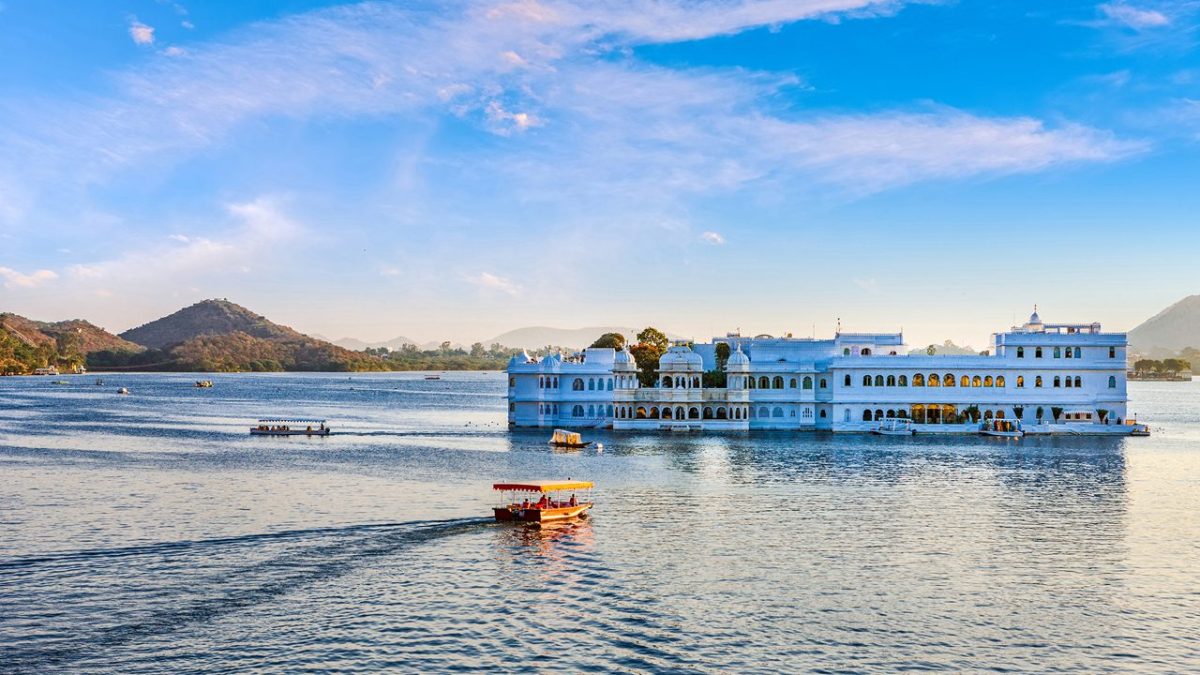
In the middle of Lake Pichola, the Lake Palace seems to float like a marble mirage. Built in the mid-18th century by Maharana Jagat Singh II as a summer retreat, it became a symbol of royal luxury and is now one of the most celebrated heritage hotels in Udaipur. It gained global fame after appearing in the James Bond movie Octopussy and remains one of the most photographed palaces in the world.

Nearby, Jag Mandir, the “Lake Garden Palace”, has its own legacy, having sheltered Prince Khurram (later known as Shah Jahan) during a rebellion. The palace’s marble pavilions are said to have inspired the Taj Mahal.

High above the city, the Monsoon Palace crowns a hilltop. Originally built by Maharana Sajjan Singh in 1884 to study the monsoon clouds, it later became a royal retreat. Although unfinished, it offers one of the best sunset views in Udaipur, especially beautiful during the rainy season when the Aravalli Hills turn lush and green.

The Lifeblood of Udaipur’s History

The lakes of Udaipur are more than scenic—they are the city’s very identity. Designed as reservoirs to sustain life in this dry region, they became cultural centers where devotion, festivals, and daily activities intertwined. Palaces and ghats along the water’s edge turned them into living canvases of grandeur.

Lake Pichola, built in 1362 CE, remains the most iconic. Taking a boat ride in Udaipur at night, when palaces glow with golden light, is among the most unforgettable experiences in the city. Fateh Sagar Lake, built in 1687, with its tranquil islands and backdrop of the Aravalli Hills, is equally charming, especially for families who can enjoy boating and picnics by the water.

Just beyond the city, Badi Lake (Badi Talab) offers an offbeat experience. Created to overcome a drought, it is now a favorite spot for swimming, cycling, and photography. Surrounded by the lush Bahubali Hills, it is one of the best places to visit in Udaipur during the monsoon and a perfect escape for travelers seeking quiet away from the crowds.

A scenic view of Lake Pichola in Udaipur, featuring ornate white marble architecture, flying birds, and the serene waters reflecting the sky.

Arts and Culture

Walking through Udaipur’s old city is like stepping into another time. Gangaur Ghat offers the most captivating views of the City Palace and Lake Pichola, making it a perfect starting point for exploration. Along the way, you’ll encounter the grand Jagdish Temple, intricately carved havelis, colorful bazaars, and gateways that open into lively streets.

Rajasthan’s artistic legacy thrives in Udaipur. The Mewar School of Miniature Painting, known for its fine detail and vibrant colors, continues to flourish. Local artisans keep alive traditions of marble carving, block-printed fabrics like Bandhani, silver jewelry, and handmade puppets. Shopping in Udaipur’s bazaars is as much a cultural experience as it is a souvenir hunt.

As night falls, the city offers unforgettable cultural evenings. The Bagore Ki Haveli Dharohar Dance Show is a family favorite, with folk performances of music, dance, and puppetry staged in an atmospheric courtyard on Lake Pichola. Festivals like Shilpgram in December bring rural and tribal traditions to life, blending music, crafts, and cuisine. Dining is also an experience here—whether enjoying Rajasthani thalis at Natraj Dining Hall or savoring fine dining at Ambrai Restaurant with views of the illuminated City Palace across the lake.

Beyond Udaipur

Many travelers extend their journey to explore places to visit near Udaipur. The hill station of Mount Abu, Rajasthan’s only hill station, offers a refreshing contrast with its cool climate, Nakki Lake, and the intricately carved Dilwara Temples. Other nearby treasures include Kumbhalgarh Fort, Ranakpur Jain Temples, and Chittorgarh Fort—all easy day trips that complement Udaipur’s cultural and natural splendor.

A City That Lives in Water and Light

Udaipur is beyond its lakes more than a tourist destination; it is a an of lakes, palaces, and traditions woven together by centuries of history. Whether you’re seeking things to do in Udaipur at night, planning a family trip, searching for offbeat experiences, or exploring the region in the monsoon season, Udaipur always reveals a new side of itself. 

In the end, Udaipur isn’t just a city you visit—it’s a place that lingers in your memory, shimmering like its lakes at twilight.

Udaipur City of Lakes: Palaces, Cruises & Cultural Evenings

Udaipur, affectionately known as the “City of Lakes”, is a destination where shimmering waters, marble palaces, and vibrant traditions create one of India’s most enchanting travel experiences. Beyond being a backdrop for films around the world, Udaipur is living history—an artistic city that continues to breathe in every courtyard, ghat, and palace.

An Iconic Showcase of Rajput Grandeur

The palaces of Udaipur are more than just architectural wonders. They were once the centers of power, symbols of Mewar pride, and today stand as global cultural icons. Blending Mughal and Rajasthani art with murals, mirror inlays, and stone carvings, these structures are pieces of history turned into works of art.

The City Palace Udaipur, the largest palace complex in Rajasthan, took more than 400 years to complete and still dominates the eastern banks of Lake Pichola. Within its marble courtyards and halls, treaties were signed, wars were planned, and royal ceremonies were held. Today, its museums preserve weapons, paintings, costumes, and treasures that narrate the resilience of the Mewar dynasty.

In the middle of Lake Pichola, the Lake Palace seems to float like a marble mirage. Built in the mid-18th century by Maharana Jagat Singh II as a summer retreat, it became a symbol of royal luxury and is now one of the most celebrated heritage hotels in Udaipur. It gained global fame after appearing in the James Bond movie Octopussy and remains one of the most photographed palaces in the world.

Nearby, Jag Mandir, the “Lake Garden Palace”, has its own legacy, having sheltered Prince Khurram (later known as Shah Jahan) during a rebellion. The palace’s marble pavilions are said to have inspired the Taj Mahal.

High above the city, the Monsoon Palace crowns a hilltop. Originally built by Maharana Sajjan Singh in 1884 to study the monsoon clouds, it later became a royal retreat. Although unfinished, it offers one of the best sunset views in Udaipur, especially beautiful during the rainy season when the Aravalli Hills turn lush and green.

The Lifeblood of Udaipur’s History

The lakes of Udaipur are more than scenic—they are the city’s very identity. Designed as reservoirs to sustain life in this dry region, they became cultural centers where devotion, festivals, and daily activities intertwined. Palaces and ghats along the water’s edge turned them into living canvases of grandeur.

Lake Pichola, built in 1362 CE, remains the most iconic. Taking a boat ride in Udaipur at night, when palaces glow with golden light, is among the most unforgettable experiences in the city. Fateh Sagar Lake, built in 1687, with its tranquil islands and backdrop of the Aravalli Hills, is equally charming, especially for families who can enjoy boating and picnics by the water.

Just beyond the city, Badi Lake (Badi Talab) offers an offbeat experience. Created to overcome a drought, it is now a favorite spot for swimming, cycling, and photography. Surrounded by the lush Bahubali Hills, it is one of the best places to visit in Udaipur during the monsoon and a perfect escape for travelers seeking quiet away from the crowds.

Arts and Culture

Walking through Udaipur’s old city is like stepping into another time. Gangaur Ghat offers the most captivating views of the City Palace and Lake Pichola, making it a perfect starting point for exploration. Along the way, you’ll encounter the grand Jagdish Temple, intricately carved havelis, colorful bazaars, and gateways that open into lively streets.

Rajasthan’s artistic legacy thrives in Udaipur. The Mewar School of Miniature Painting, known for its fine detail and vibrant colors, continues to flourish. Local artisans keep alive traditions of marble carving, block-printed fabrics like Bandhani, silver jewelry, and handmade puppets. Shopping in Udaipur’s bazaars is as much a cultural experience as it is a souvenir hunt.

As night falls, the city offers unforgettable cultural evenings. The Bagore Ki Haveli Dharohar Dance Show is a family favorite, with folk performances of music, dance, and puppetry staged in an atmospheric courtyard on Lake Pichola. Festivals like Shilpgram in December bring rural and tribal traditions to life, blending music, crafts, and cuisine. Dining is also an experience here—whether enjoying Rajasthani thalis at Natraj Dining Hall or savoring fine dining at Ambrai Restaurant with views of the illuminated City Palace across the lake.

City Palace Udaipur, a large complex showcasing Rajasthani and Mughal architecture, situated on the banks of Lake Pichola.

Beyond Udaipur

Many travelers extend their journey to explore places to visit near Udaipur. The hill station of Mount Abu, Rajasthan’s only hill station, offers a refreshing contrast with its cool climate, Nakki Lake, and the intricately carved Dilwara Temples. Other nearby treasures include Kumbhalgarh Fort, Ranakpur Jain Temples, and Chittorgarh Fort—all easy day trips that complement Udaipur’s cultural and natural splendor.

A City That Lives in Water and Light

Udaipur is beyond its lakes more than a tourist destination; it is a an of lakes, palaces, and traditions woven together by centuries of history. Whether you’re seeking things to do in Udaipur at night, planning a family trip, searching for offbeat experiences, or exploring the region in the monsoon season, Udaipur always reveals a new side of itself. 

In the end, Udaipur isn’t just a city you visit—it’s a place that lingers in your memory, shimmering like its lakes at twilight.

Heritage Meets Hospitality: Where India’s Legacy Inspires Modern Luxury

In India, heritage is not confined to monuments or museums; it lives in the very walls of ancestral homes, the courtyards where families once gathered, and the craftsmanship passed down through generations. Today, as hospitality evolves to meet the demands of discerning global travelers, heritage meets hospitality in the form of carefully revived spaces that blend cultural richness with modern comforts. This union redefines luxury hospitality in India as something deeply rooted in authenticity, elegance, and a sense of belonging.

Article content
SaffronStays Milton Abbott Estate

The idea of transforming heritage into hospitality is more than architectural restoration; it is a preservation of stories, traditions, and values. Each revived home is a living narrative that carries the soul of its past while embracing the needs of today’s guest. When a traveler walks through arched hallways, touches intricately carved wooden panels, or gazes at frescoes that have witnessed centuries, they experience something no contemporary hotel can replicate. These are premium Indian stays that are both personal and profound. For businesses and collaborators, such properties offer a unique positioning: a niche where heritage hospitality in India itself becomes the greatest differentiator.

What sets heritage hospitality apart is its rootedness in India’s cultural identity. The aesthetic is not imported but indigenous, shaped by artisans, materials, and traditions of the region. Each detail, from hand-carved stonework to the rhythms of local music echoing in the background, speaks of a land that values memory as much as modernity. This India-rooted premium aesthetic ensures that hospitality is not merely about offering comfort; it is about creating an emotional connection that lingers long after the stay is over. For partners and stakeholders, this approach delivers long-term value by combining cultural preservation with premium demand for heritage stays in India.

This philosophy comes alive in carefully restored SaffronStays properties. In Coorg, the SaffronStays Calamondin Bungalow, a century-old planter’s bungalow, sits amidst lush coffee plantations. With its tiled roofs, airy verandahs, and colonial architecture, the home offers an authentic plantation heritage experience, while curated meals and warm service add the comforts of modern luxury.

In Matheran, SaffronStays Parsi Manor reflects the elegance of Parsi culture with its wooden staircases, antique chandeliers, and timeless design. This villa stands as a rare gem, preserving the heritage of a community known for sophistication and hospitality.

Article content
SaffronStays King Mahal

Further South in Ooty, SaffronStays Milton Abbott embodies colonial grandeur. The restored British-era bungalow is surrounded by oak and deodar forests, offering a tranquil escape infused with history and charm.

Guests seeking a serene mountain retreat find it at SaffronStays Amaya in Kerala, where heritage-inspired architecture is complemented by sweeping views of the Himalayas. In Belur, the SaffronStays Biccode Woodside Heritage, an estate from the 12th century, carries whispers of generations past, with its period furniture and sprawling estate gardens, offering guests a rare chance to live history.

In the Kashmir Valley, the story of heritage takes on a mystical charm with SaffronStays Awakening, Srinagar. Overlooking the Zabarwan Range and built in classic Kashmiri style, the villa is adorned with intricate wooden details and expansive lawns that reflect the region’s regal past. Here, heritage hospitality meets the soul of Kashmir, creating an unforgettable stay that is as much about cultural immersion as it is about comfort.

Beyond their aesthetic appeal, these homes represent a sustainable business model. Reviving traditional structures generates livelihoods for local communities, from artisans and craftsmen to service professionals who bring these spaces to life. At the same time, integrating eco-friendly practices, from responsible sourcing to energy-conscious infrastructure, ensures that these heritage stays remain future-ready. The result is a harmonious balance between heritage and modern hospitality, where profitability aligns with purpose.

Article content
SaffronStays Prince of Kashmir

At SaffronStays, our vision is to curate and elevate India’s living legacies into immersive, premium Indian experiences. By bringing together heritage and hospitality, we are not only creating unique destinations for travelers but also safeguarding the cultural and architectural identity of our country. For collaborators, developers, and custodians of heritage, this journey offers more than a commercial opportunity. It is an invitation to become stewards of India’s timeless elegance while delivering luxury heritage hospitality that resonates on a global stage.

The future of luxury travel in India lies in authenticity. As the world looks to India for experiences that go beyond the ordinary, heritage hospitality stands as a symbol of rootedness and refinement. It is not just about offering a stay but about offering a story, not just about providing comfort but about preserving a legacy. And in that space, where the past inspires the present, heritage truly meets hospitality.

6 Best Places to celebrate Holi in India

Holi in Vrindavan

Holi, the festival of colour, is one of the major events in the Hindu calendar and is celebrated with much prompt all over India. It is no surprise that most of us begin a countdown to the festival days in advance. SaffronStays takes great pleasure in introducing you to some regions that celebrate Holi differently, where you can travel to make your Holi a little more festive this year.

Yes, Holi falls on a long weekend in 2016 and we think you should make the most of it!

1. A Royal Affair – Udaipur, Rajasthan

Holi celebration in India

Holi is of particular importance to the people of Udaipur because of the special interest the members of the royal family take in bringing the festival of colour to their people. The first day of Holika Dahan is observed at the City Palace every year in the presence of Mewar’s Royal family. The customs of lighting the Holi pyre is traditionally performed by the current custodian of the Mewar dynasty. An elaborate function then takes place at the City Palace.

Click here to plan or book your stay in Udaipur

2. Elephant Festival – Jaipur, Rajasthan

Holi celebration in India

What sets Holi in Jaipur apart from celebrations in any other part of the country is the Elephant Festival. Watch as elephant after elephant parades past you, bedecked in jewellery, anklets, bells and even elaborate head-plates specially designed for the procession. Elephants march into the Jaipur Polo Ground to the accompaniment of nagadas (Indian kettle drums) and bankiyas. Soon follow events which include elephant parades, elephant beauty contests, folk dances, and elephant tug-of-war. All of this makes for a beautiful Holi in Jaipur.

Note: The celebrations in Polo Ground have not included Elephants in the last 2 years. It would be advisable to check with the authorities in advance.

Click here to plan or book your stay in Jaipur

3. Carnival of Colors – Goa

Holi celebration in India

Holi in Goa is celebrated as Shigmotsav, and is seen as a kind of fusion between the festival of colour and a full-fledged carnival.  People from all religions and walks of life come together to drench each other in water and colour. Shigmotsav is celebrated over an entire fortnight, and the grand finale of the festival involves colourful parades and folk dances that are organised by the Goan locals. Of special mention are the artistically designed and beautifully lit floats that are taken out in Panaji and other places like Ponda, Vasco, Madgaon and Mapusa. The shimmering floats move along with the parade gripping the attention of a huge crowd that aligns the streets of Goa. It is a great time to experience a unique side of Goa.

Click here to plan or book your stay in Goa

4. 40 Days of Celebration – Kullu, Himachal Pradesh

Holi celebration in India

The hill town of Kullu began Holi celebrations on the day of Basant Panchami in January. The festivities date back to 1660 AD when, Jagat Singh, the then King of Kullu, brought the idol of Lord Raghunath (Lord Rama) from Ayodhya and installed it at a temple in Sultanpur in Kullu. Since then, locals gather at the temple every year and apply gulaal or colors to the idol. Following a special ritual, the chariot of Lord Rama is wheeled to a festival ground, amidst the sound of drums and trumpets, where temporary camp is set up by devotees. Prayers and colors are offered for 40 days until the day of Holi. The festivities will definitely add to the charm of the snow-clad hill town, we think.

Click here to plan or book your stay in Kullu-Manali

5. Spring Festival – Shantiniketan, West Bengal

Holi celebration in India

The renowned Poet Noble Laureate, Rabindranath Tagore, began the tradition of celebrating Holi as Basant Utsav or Spring Festival in Shantiniketan. Every year, the students and faculty of Vishva Bharati Institute dress up in colors of spring and put together a cultural programme for visitors – with colors, folk dances and performances to Tagore’s songs and poems. An important part of Bengal’s history and culture, the celebration of Basant Utsav in Shantiniketan is definitely worth travelling for.

Santiniketan is about 160 km from Kolkata and you can make the city your base and take a day trip from there. Click here to plan or book your stay in Kolkata

6. Traditional Celebration – Vrindavan & Mathura, Uttar Pradesh

Holi in Vrindavan

This list will perhaps be incomplete without the mention of Holi celebrations in Uttar Pradesh. The towns of Mathura, the birthplace of Krishna, and Vrindavan, where he spent his childhood, come alive with colour and zeal for a whole week during Holi. What is interesting is that the different temples of Lord Krishna celebrate Holi on different days while the celebrations at Shri Banke Bihari Mandir in Vrindavan go on for an entire week. If you’ve ever wanted to experience the local culture of Uttar Pradesh, this is the best time to do so.

Mathura is about 160 km from Delhi.

Click here to plan or book your stay in Delhi

Where will you be celebrating Holi this year? Share with us in your comments. 


About the Authors:

Born and raised in Assam, Sarita Santoshini has been travelling around India and penning down her experiences over the past year. She currently works as the Content Editor for SaffronStays. You can read more of her travelogues on her blog-http://crumbsfromyourtale.wordpress.com.

Alaric Moras spends most of his time reading, writing and interning with industries that read and write. He aims to become a clinical psychologist, providing therapy and catching Freudian slips during the day, writing and reading through the night. He likes all manner of animals, the smell of books, and the oxford comma.