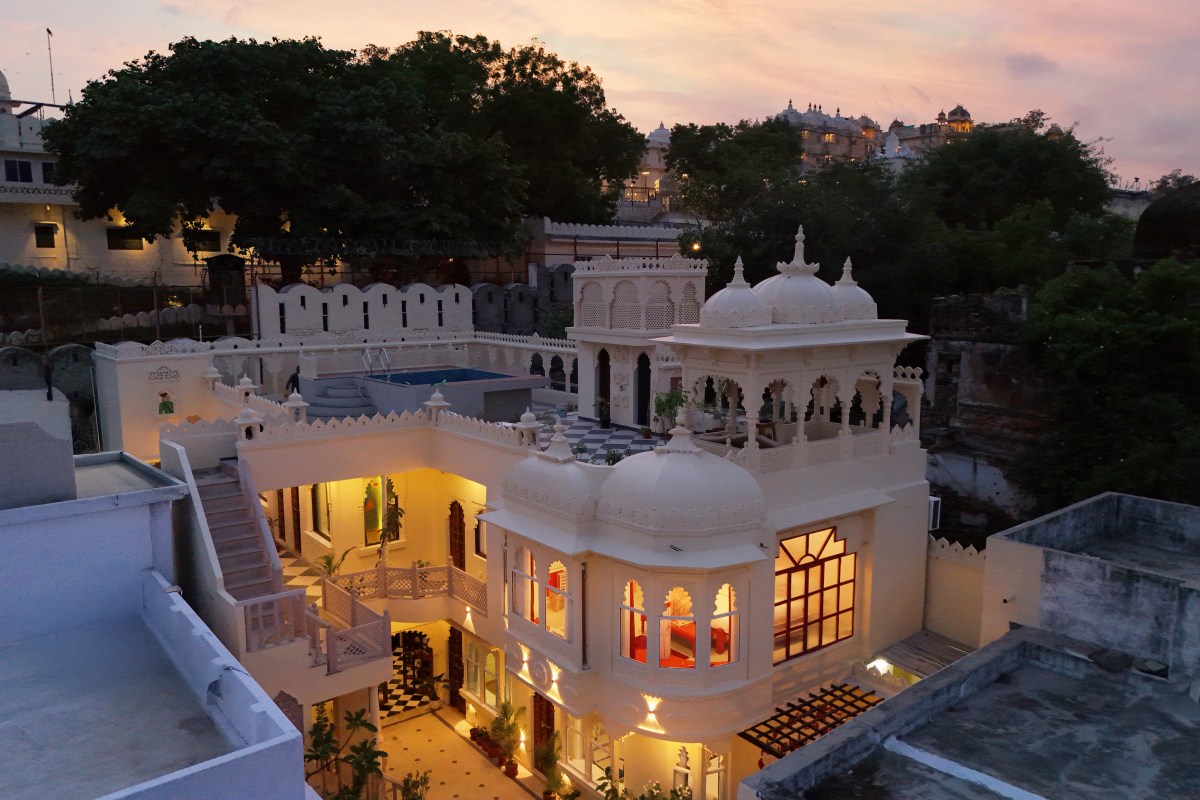
In the lane called Bhatiyani Chohatta, the walls do not so much end as surrender to a bigger one. Shopfronts give way, cows find their shade under low eaves, and then the stone itself changes character: this is the outer skin of Udaipur’s City Palace, four centuries old, running the length of the street like a border nobody thought to question. Somewhere along that stretch, without a signboard announcing itself, sits a doorway into eight rooms, seven living craft traditions, and one woman’s very deliberate refusal to be tasteful in the way the world currently defines tasteful.
That doorway opens into Rang Havelii, a heritage-style haveli built not from a restored palace wing but from a shell of collapsed chambers that its founder, Rashmi, found in ruins two years ago. What stands there now is arguably Udaipur’s most striking recent addition to the city’s old quarter: a boutique stay that treats colour not as a decorating choice but as its entire argument. The name says as much. Rang, in Hindi, means colour. Havelii is the traditional courtyard mansion of Rajasthan and North India. Put together, they describe exactly what waits on the other side of that unmarked door, and precisely what this property borrows from the past rather than inherits from it.
Table of Contents:
The Banker Who Built a Haveli
Rashmi did not train as an interior designer, an architect, or a hotelier. She spent her working years in banking before she began writing about food under the Instagram handle @kasoor_e_methi, building a loyal following for a voice that was unmistakably, unapologetically Rajasthani. When she first walked into what would become Rang Havelii, the building offered her nothing to work with in the conventional sense. “When I first found this place two years back, it was in complete shambles,” she says. “But in my heart I knew that this place had a lot of potential and I could turn this into something really special.”
She did not hire a design firm and hand over a mood board. She commissioned artisans directly, brief by brief, room by room. The dining table, made from ethically sourced camel bone carved and embedded into wood in an intricate technique local to Rajasthan, was built to a specification she gave craftspeople who work almost exclusively in this material. The mural above the breakfast nook, mapping Udaipur’s own skyline onto a stairwell wall, began as a scale drawing by her illustrator friend Monica, based in Mumbai, who plotted the City Palace, the ghats, and the lake against real dimensions before local artists reproduced it by hand. “I was just a little confused what to kind of make here,” Rashmi recalls of that particular wall. “So I took the help of my illustrator friend… I told her that I want something unique.”
The result reads less like a restoration and more like a personal statement rendered at the scale of a building, built from scratch in the visual language of a much older Rajasthan. “It’s just a representation of me,” she says of the finished haveli. “And when you come here, you will experience the same love and warmth that I grew up with and that Rajasthan has to offer.”
A Living Gallery: Eight Rooms, Eight Colours
Every one of Rang Havelii’s eight rooms is painted, furnished, and dressed in a single dominant colour, and every room showcases a distinct craft tradition. Guests do not simply sleep at a heritage-style property here. They sleep inside a specific, deliberately unrepeated art installation, then walk down a corridor into a completely different one.
Bagh Baradari carries the storytelling energy of Phad scroll painting, a tradition rooted in the Bhilwara belt of Mewar, its walls animated with the loose, narrative brushwork this folk art is known for. Panna Bagh, on the ground floor, goes the other way entirely: mint-green walls with hand-painted trees and birds, a quiet garden room that borrows its calm from the Rajput palace gardens of old. Maaru Mahal, one floor up, trades green for gold, taking its warmth from the sandstone palaces of Jaisalmer and the open Thar beyond them.
| Room | Colour | Craft Focus / Inspiration |
| Bagh Baradari | Forest tones | Phad scroll painting (Bhilwara belt) |
| Panna Bagh | Mint green | Hand-painted garden motifs, Rajput palace gardens |
| Maaru Mahal | Gold / sandstone | Jaisalmer and Thar desert palette |
| Kamal Talai | Soft pink / lotus | Pichwai art, Nathdwara (17th century) |
| Surkh Darbar | Crimson | Mewar miniature painting |
| Neel Jharokha | Blue | Jodhpur’s Blue City tradition |
| Rajwadi Vatika | Pink | Jaipur palace garden aesthetic |
| Darpan Darbar | Mirror / white-gold | Thikri mirror-glass art, Udaipur |
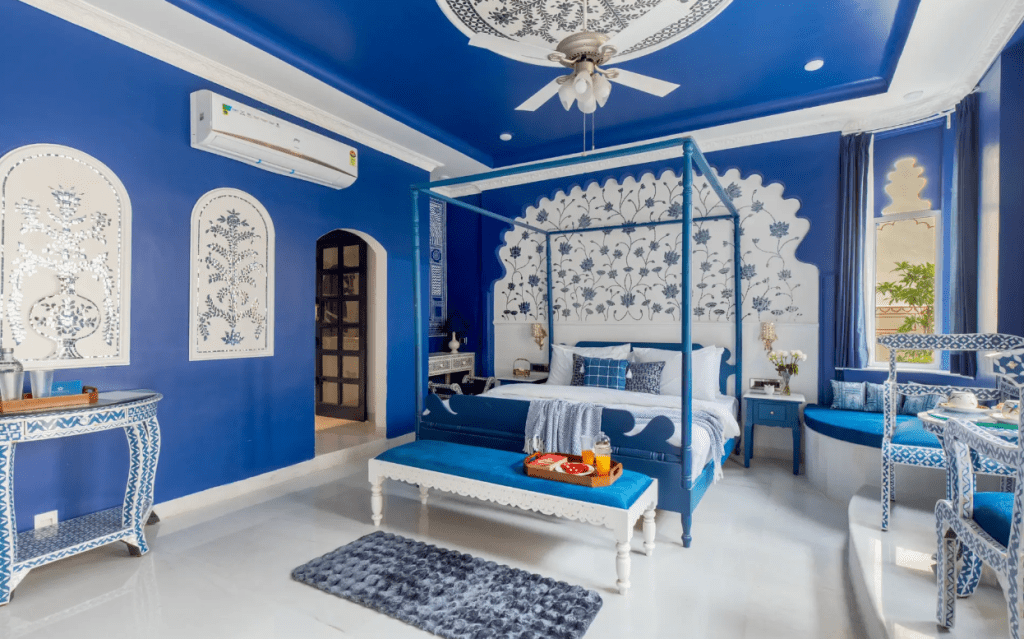
Two rooms reward the closest attention. Darpan Darbar is built around Thikri, an inlaid mirror-glass craft specific to the Mewar region, in which small pieces of convex mirror and coloured glass are cut, polished, and set into plaster to catch and multiply light across a wall. By evening, a single lit candle in this room throws itself into dozens of reflected points across the ceiling and walls, an effect the room was clearly designed around. Surkh Darbar, by contrast, is quieter and more exacting: its walls carry Mewar miniature painting, worked in fine detail with squirrel-hair brushes and pigments traditionally drawn from minerals and plant matter, the same technique used for centuries in courtly manuscripts across this region.
The communal spaces do not let up either. The living room holds a hand-painted Pichwai mural, a collaboration between Rashmi’s sister and a local artist. The entrance is marked by a Toran, the ceremonial door hanging central to Rajasthani weddings, flanked by chairs shaped like elephants, a nod to the elephant rides up to Jaipur’s Amer Fort. A hand-carved Kavad, sourced from artisans in Bassi near Chittorgarh, sits nearby: a wooden shrine that opens like a series of folding doors, each panel painted with its own episode from a larger story of gods and goddesses, traditionally narrated aloud by the Kavadiya Brahmin families who carried these shrines door to door.
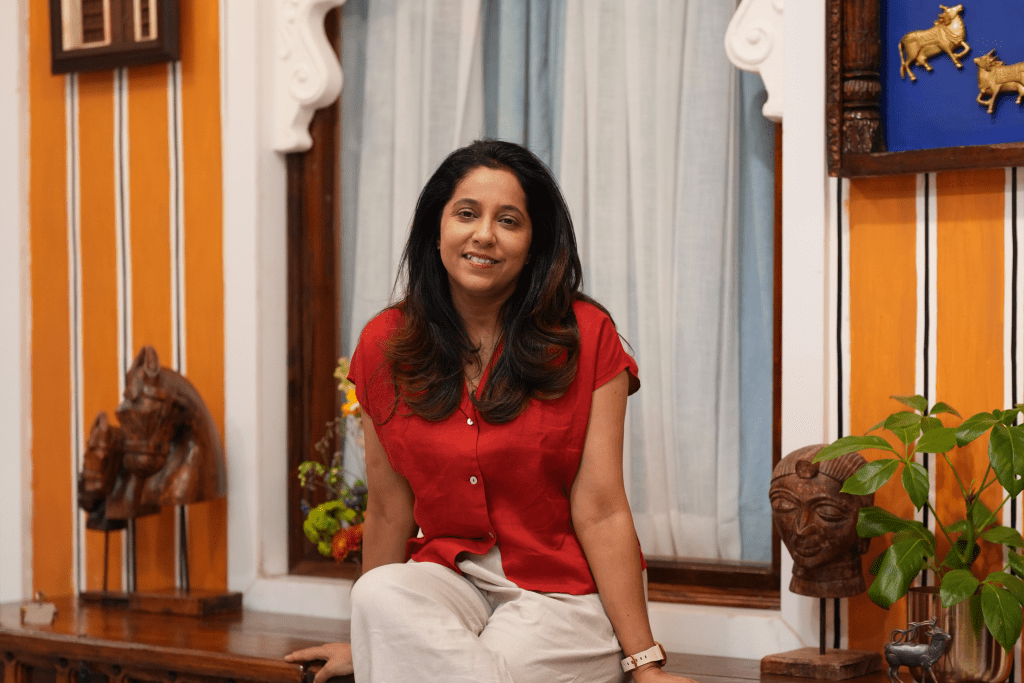
| “Just as these days minimalism is trending, but as you know, Rajasthan is all about maximalism. So there will be a lot of colours and patterns and textures. Having been born in Rajasthan myself, I have this natural inclination towards colours and vibrance.” — Rashmi, Founder, Rang Havelii |
Seven Crafts, Under One Roof
What separates Rang Havelii from Udaipur’s many other heritage-styled stays is specificity. Almost anyone can call a property a living museum. Rang Havelii can name the village each craft came from.
Pichwai, the devotional cloth painting depicting Srinathji, traces to Nathdwara, near Udaipur, and dates to the seventeenth century. Thikri mirror-glass work is native to Udaipur and the wider Mewar region. Miniature painting here follows the Mewar school, distinguished from the more famous Mughal miniature tradition by its palette and its subject matter, closer to courtly and devotional life than imperial record-keeping. Phad, the scroll paintings that narrate the deeds of folk deities like Pabuji and Devnarayan, comes out of the Bhilwara belt, traditionally unrolled and sung by travelling bhopa performers rather than simply displayed. Bone inlay, seen throughout the property in furniture, uses ethically sourced camel bone carved and set into wood, then filled with resin. Kavad shrine-making is specific to Bassi, a small town near Chittorgarh. And Molela terracotta, added to the property’s craft roster after the press materials for this piece were written, comes from a single village of that name on the Banas river near Nathdwara, a GI-tagged tradition of flat terracotta plaques depicting local deities, made almost exclusively by the Kumhar potter families who have worked that clay for generations.
None of these crafts are displayed behind glass at Rang Havelii. They are load-bearing, in the most literal sense: walls, furniture, shrines, and tabletops that a guest touches, sits at, and sleeps beside rather than views from a rope barrier. The building itself is new. The hands that made everything inside it are not.

Food, Hosting, and Atithi Devo Bhava
“Rang Havelii for me was a perfect blend of the two things that I love: food and hosting,” Rashmi says, and the kitchen bears this out. It runs less like a hotel restaurant and more like the kitchen of someone who has spent years feeding people she cares about, which, as a food blogger for years before Rang Havelii existed, is exactly what Rashmi was already doing. The in-house chef prepares Rajasthani food with the kind of personal attention a restaurant kitchen rarely offers, and meals are available at an additional charge rather than folded into a flat room rate, closer in spirit to eating at someone’s home than paying for a fixed hotel menu.
That hosting philosophy has a name in Rajasthan: Atithi Devo Bhava, the guest as god. The Toran at the entrance is not purely decorative. It references a wedding-day ritual in which a groom touches the door hanging with his sword on reaching his bride’s threshold, a gesture of respect and welcome that predates the building by centuries, even where the building itself does not. Guests crossing into Rang Havelii cross the same threshold. On the ground, this translates into specific, remembered service: reviews on the live listing repeatedly single out staff members by name, and the property currently holds a 4.9-out-of-5 rating across more than fifty stays, with cleanliness, safety, and staff attentiveness scoring particularly high.

A Wall Away From the City Palace
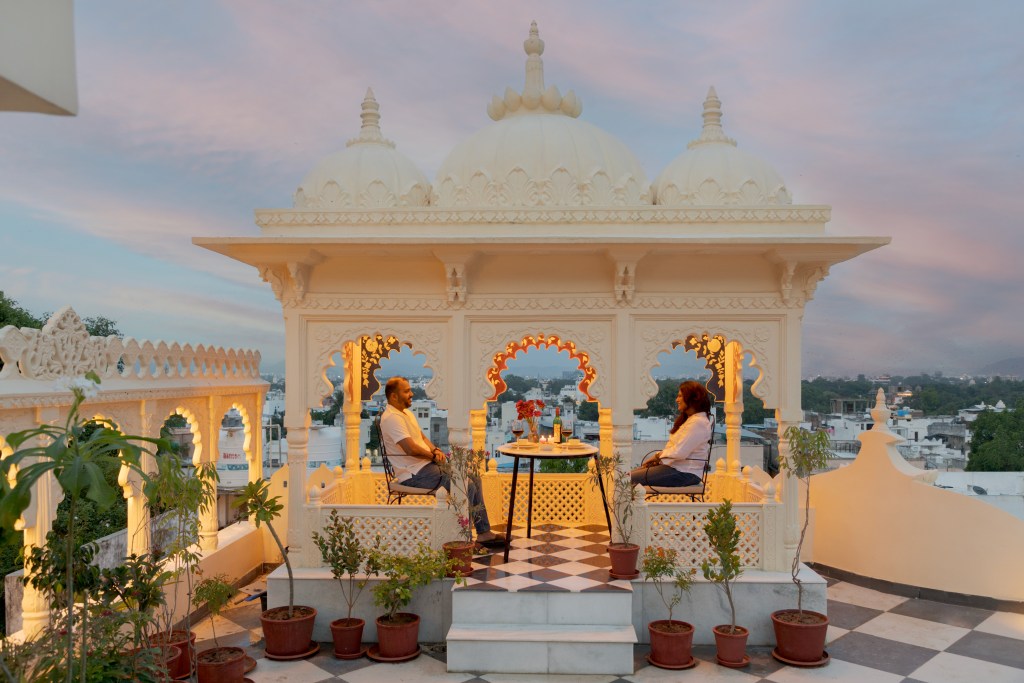
Location does most of the remaining work. Rang Havelii shares a boundary wall with the City Palace of Udaipur, one of the largest palace complexes in Rajasthan and, after dark, one of the most theatrically lit buildings in the city. From the rooftop chhatri and the private pool at Rang Havelii, guests watch that illumination directly, and during Diwali, the same terrace becomes a private viewing point for fireworks across the old city skyline. Jagdish Temple and Lake Pichola are each roughly a five-minute walk away. Fateh Sagar Lake is closer to fifteen minutes. The haveli sits inside Udaipur’s old city grid, within the kind of walkable radius that lets a stay double as a base for exploring rather than a destination requiring its own transport plan for every outing.
| GOOD TO KNOW Rang Havelii shares a boundary wall with the City Palace, Udaipur’s largest palace complex. Jagdish Temple and Lake Pichola: approximately 5 minutes on foot. Fateh Sagar Lake: approximately 15 minutes on foot. Best light for the rooftop chhatri and pool: late afternoon into the evening, when the City Palace begins its nightly illumination. Diwali is a particularly strong time to book this specific property, given the terrace’s direct sightline to the city’s fireworks. |
Getting There, Including the Drive Every Gujarati Traveller Already Knows
Rang Havelii sits close enough to the centre of Udaipur that the wider question is less about reaching the haveli and more about reaching the city. Maharana Pratap Airport is roughly 24 kilometres away, a 30 to 40 minute drive depending on traffic. Udaipur City Railway Station and the main bus stand are both about 2 to 3 kilometres out, a 10 to 15 minute drive from the property, or a manageable one for anyone willing to walk part of the old city on arrival.
For travellers coming from Gujarat, this is a familiar route long before it is a search query. Ahmedabad to Udaipur runs roughly 260 kilometres via NH48, a drive of four to four and a half hours that has become one of the state’s most reliable weekend getaways, popular enough that Himmatnagar and the Shamlaji temple stop are landmarks in their own right for anyone who has made the drive before. Direct trains, including the ADI-UDZ Express, connect Ahmedabad’s Kalupur station to Udaipur City, and flights run the route as well, though most Gujarati travellers making a weekend of it still choose the highway for the flexibility it offers to detour toward Nathdwara, Eklingji, or Kumbhalgarh along the way. Travellers from Surat and Vadodara add roughly two and four hours respectively onto that same NH48 corridor, making Udaipur, and a stay inside its old city walls, a realistic two-night plan rather than a stretch.
From Mumbai, Pune, Delhi NCR, and Bangalore, Udaipur is well served by direct flights into Maharana Pratap Airport, putting Rang Havelii within a half-day’s travel from each of these cities door to door.

| Stay Inside the Story Book a room, a wing, or the entire eight-room haveli at Rang Havelii, Udaipur, through SaffronStays. BOOK RANG HAVELII |
Frequently Asked Questions
Where exactly is Rang Havelii located in Udaipur?
Rang Havelii is located in Bhatiyani Chohatta, in Udaipur’s old city, sharing a boundary wall with the City Palace. It sits within a five-minute walk of Jagdish Temple and Lake Pichola.
Is Rang Havelii an actual heritage building?
No. Rang Havelii is a heritage-style haveli, built two years ago from a collapsed shell of chambers and designed using traditional Rajasthani architecture, materials, and craft. It is not a centuries-old or protected heritage structure, and it shares a boundary wall with one that is: the City Palace.
How far is Rang Havelii from Udaipur’s airport and railway station?
Maharana Pratap Airport is approximately 24 kilometres away, a 30 to 40 minute drive. Udaipur City Railway Station and the main bus stand are both roughly 2 to 3 kilometres away, about 10 to 15 minutes by road.
What Rajasthani art forms can I see at Rang Havelii?
The property features seven craft traditions across its rooms and common areas: Pichwai painting from Nathdwara, Thikri mirror-glass art from Udaipur, Mewar miniature painting, Phad scroll painting from the Bhilwara belt, camel bone inlay furniture, hand-carved Kavad shrines from Bassi, and Molela terracotta from Rajsamand district.
Can I book just one or two rooms, or do I need to book the entire haveli?
Rang Havelii can be booked room by room, as a partial wing, or in its entirety for larger groups and celebrations. Room configurations and exact availability are confirmed at the time of booking on the SaffronStays listing.
Is Rang Havelii within walking distance of Lake Pichola and the City Palace?
Yes. The City Palace is directly adjacent, sharing a wall with the property, and Lake Pichola is approximately a five-minute walk away.
Is Udaipur a good weekend getaway from Ahmedabad and Gujarat?
Udaipur is one of Gujarat’s most popular weekend destinations, roughly 260 kilometres and four to four and a half hours from Ahmedabad via NH48. It is also well connected from Surat and Vadodara by the same highway, and by direct train and flight options.
Does Rang Havelii provide meals?
Yes, meals are available at an additional charge, prepared by an in-house chef, with vegetarian, non-vegetarian, and Jain options on the menu.