Deciding between Rajasthan’s lakes and its hills usually means picking one and saving the other for later. This Independence Day weekend, that math changes. August 15 falls on a Saturday, and a single Friday off stretches the trip to three days, long enough to actually do both instead of choosing. Udaipur brings the city everyone already pictures, City Palace and Lake Pichola at sunset. Mount Abu brings the opposite: cooler air, forest, and a hunting palace that has stood in the Aravalli hills for four hundred years.
Udaipur and Mount Abu, this weekend, whether the start is a short drive out of Gujarat or a flight in from further afield. The full city-by-city breakdown is further down; first, what actually makes each one worth the trip.
Table of Contents:

Mount Abu: Rajasthan’s Only Hill Station
Mount Abu is the single hill station in a state otherwise defined by desert and fort country, which makes it a different kind of trip from the rest of Rajasthan. The Aravalli hills around it turn a deep green in August, Nakki Lake sits at the centre of town for an easy evening walk, and the Dilwara Jain Temples, marble carved fine enough to look like lacework rather than stone, are worth the visit even for travellers who do not usually seek out temple architecture. Guru Shikhar, the highest peak in the Aravalli range, is a 30 to 40 minute drive from town and clears on many mornings even when the rest of the hill is under cloud.
| Marble carved fine enough to look like lacework rather than stone. |
Where to Stay in Mount Abu
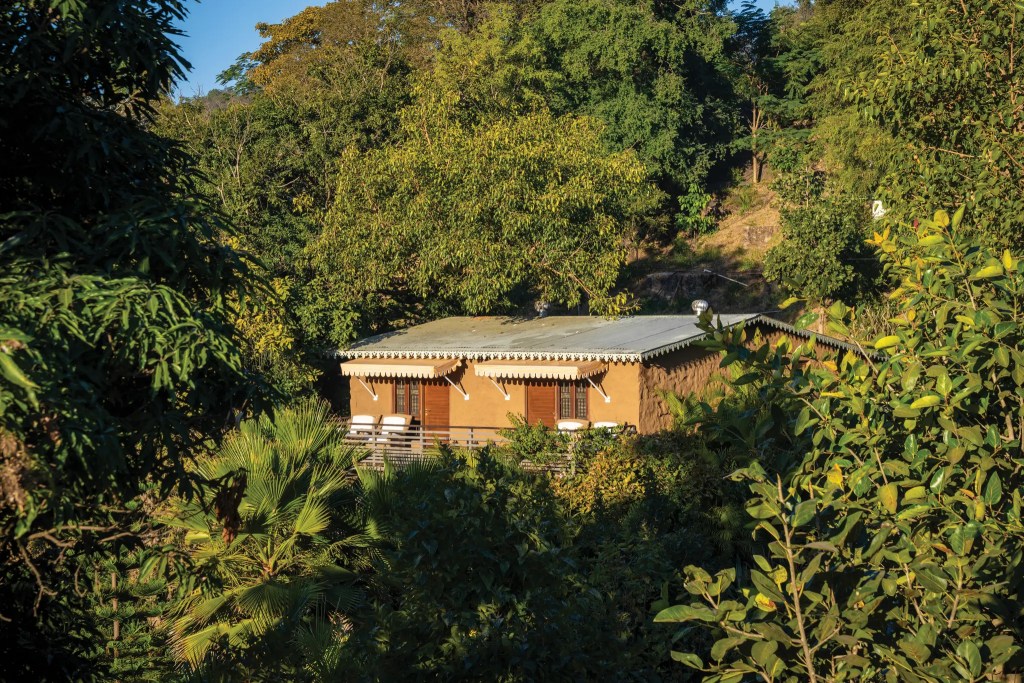
SaffronStays Sylvan Farms is not a conventional hill-station stay. A three-bedroom eco-luxury farm property spread across 4.4 acres of organic farmland about 15 minutes from Mount Abu’s main attractions, it runs on a real sustainability story: the estate supports seven local families, and the fireside evenings and farm-to-table meals come from land the property actively works rather than simply overlooks. It also sits close to one of Asia’s highest-resolution telescopes, and monsoon’s clearer air between showers often makes for better stargazing here than the hazier months on either side of it, worth timing an after-dinner walk outside for.
The final approach matters here. Roads from Ahmedabad to Abu Road are smooth highway, but the last 23 to 27 kilometres climbing into Mount Abu town wind through the hills and can turn slippery in heavy rain. Nothing about this rules out the drive, it just argues for daylight hours and an unhurried pace on that last stretch rather than pushing to arrive after dark.
Beyond Guru Shikhar and the temples, Achalgarh Fort makes an easy add-on on the way back from the peak, and Peace Park, a quiet garden built for meditation rather than sightseeing, is worth an hour for anyone who wants Mount Abu’s stillness without another monument to walk through. Honeymoon Point, a sunset viewpoint that draws a fraction of the crowd Sunset Point does, is the better choice for an unhurried evening. Food here leans vegetarian by local custom, and a proper Rajasthani thali, gatte ki sabzi, ker sangri, bajra roti, at any of the town’s established dining halls is worth planning a meal around rather than treating as a formality between sights.
Udaipur: Two Very Different Stays
Udaipur needs little introduction: City Palace’s mirrored halls, Lake Pichola at sunset, the old city’s lanes opening onto lake views at nearly every turn. The NH48 route from Ahmedabad runs roughly 260 kilometres in about 5 hours, one of the more reliable highway drives on this list, and Gujarat consistently supplies a large share of Udaipur’s weekend visitors, close enough that a single day off still makes the trip worthwhile without the full three.
| Gujarat consistently supplies a large share of Udaipur’s weekend visitors. |
Where to Stay in Udaipur

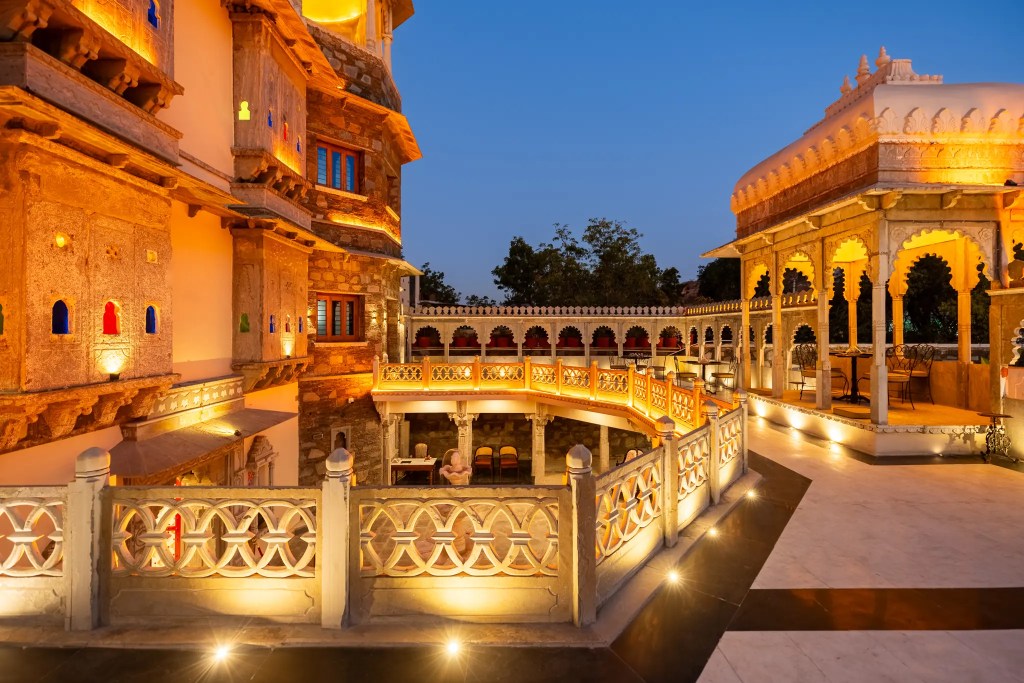
SaffronStays Rang Havelii sits close enough to the City Palace to share a version of the same rooftop views. The haveli took a year and a half to rebuild from near-ruin, and each of its eight rooms is designed around a different Rajasthani craft tradition: Molela wall art from a village near Chittorgarh, marble from Makrana, sandstone floors from Dholpur. It suits a trip built around the old city itself, walking distance to the ghats and markets rather than a drive away from them.
SaffronStays The Shikargarh Palace takes an entirely different kind of heritage: a 400-year-old former royal hunting retreat of the Mewar dynasty, set in the Aravalli hills outside the city. The original hunting structure, called an Odi, still stands at the centre of the property, with a newer 14-bedroom palace built around it during a recent restoration. Gardens, courtyards and a swimming pool make it a stay built for a large group rather than a couple, the kind of property where the estate itself is the weekend’s centrepiece rather than a base for sightseeing elsewhere.
Beyond these two, SaffronStays lists villas across Udaipur ranging from compact three-bedroom pool homes to eight-bedroom estates near Fateh Sagar Lake. The full Udaipur collection is linked below for anyone who wants to compare more options before booking.
How to Reach: A City-by-City Guide
Six cities, six real starting points. Here is exactly how each one gets to Mount Abu and Udaipur this Independence Day weekend.
From Ahmedabad
To Mount Abu: ~225-240 km, 4.5-5.5 hrs |
To Udaipur: ~260 km, ~5 hrs via NH48
The easiest version of this trip by a wide margin. Both routes run on good highway, and either destination is a comfortable single push without an overnight stop. One planning note specific to Ahmedabad: unlike Delhi or Mumbai, Gujarat’s own Independence Day ceremony has no fixed city-centre closure to route around, since the state ceremony moves venue every year rather than anchoring to one landmark.
From Vadodara
To Udaipur: ~300-360 km, 4-4.5 hrs |
To Mount Abu: via Udaipur or Abu Road, add ~1-1.5 hrs
Genuinely one of the shorter drives on this entire list, even shorter than Ahmedabad’s run to Udaipur.
From Surat
To Udaipur: ~450-500 km, 6-7 hrs |
To Mount Abu: via Ahmedabad or Abu Road, similar range
A longer stretch, but still a reasonable single-day push for a long weekend rather than a trip that needs a stopover.
From Mumbai
Direct drive: ~756-771 km, ~10 hrs |
Better option: Fly to Udaipur, then drive 3-4 hrs to Mount Abu
Ten hours is too long to start a three-day weekend with. Udaipur’s airport has direct Mumbai flights, and the local drive from there to Mount Abu is short and easy.
From Pune
Direct drive: ~865-900 km, ~15 hrs |
Better option: Fly to Udaipur via Mumbai or direct, then drive 3-4 hrs
The longest direct drive on this list. Flying is not a compromise here, it is the only realistic option for a weekend trip.
From Delhi
Direct drive: ~739-751 km, 13-14 hrs |
Fly option: Direct flights to Udaipur, then drive 3-4 hrs to Mount Abu |
Road-trip option: Delhi-Jaipur ~5 hrs, then Jaipur-Udaipur ~6.5 hrs
Delhi has a genuine road-trip alternative Mumbai and Pune do not: breaking the drive at Jaipur splits a 13-hour push into two manageable days, with Jaipur itself worth the overnight stop. That split works less well heading straight to Mount Abu, since Jaipur to Mount Abu alone still runs 9 to 11 hours; flying into Udaipur is the better call for that leg specifically.
Doing Both: The Loop Route
The useful thing about this particular pairing is that neither destination has to be chosen over the other. Mount Abu to Udaipur is a further 160 kilometres, about 3 hours on a route that counts among the better-maintained stretches in the region, which makes a full loop from Ahmedabad through both towns realistic across a 3-day weekend rather than a rushed add-on.
A straightforward version: Ahmedabad to Mount Abu on the morning of Friday, August 14, a full day and night there, then the 3-hour run to Udaipur on Saturday for two nights before the 5-hour drive back to Ahmedabad on Monday. Anyone with only the Saturday-Sunday weekend should pick one destination rather than force the loop into two days; Mount Abu suits a single-destination trip better given the shorter drive each way. Travellers flying in from Mumbai, Pune or Delhi can run the same loop in reverse from Udaipur airport, starting with Udaipur itself before the 3-hour drive out to Mount Abu.
| PLANNING NOTE Book villas two to three weeks ahead for this particular weekend. Independence Day is peak season for both destinations, and availability for larger properties tightens fast as the date approaches. |
Mount Abu vs. Udaipur, Side by Side
Distance is covered above, by city. Here is how the two actually differ once you’re there.
| Destination | Character | Best For | Featured Villa |
| Mount Abu | Forest, temples, altitude | Repeat Rajasthan visitors, quiet over sightseeing | Sylvan Farms |
| Udaipur | Lakes, palaces, the classic postcard | First-time visitors, group celebrations | Rang Havelii / Shikargarh Palace |
Which One Fits
Content preference is one half of this decision: Udaipur suits anyone who has not been before and wants the version of Rajasthan postcards are made of, while Mount Abu suits anyone who has already done that trip, or who wants forest, altitude and a working heritage estate over palaces and lakes this particular weekend.
Ease of reach is the other half, and it matters more than usual this year. For Gujarat, that preference decides almost nothing, since both are within comfortable range. For Mumbai and Pune, where flying is the only realistic option either way, Udaipur’s better flight connectivity makes it the simpler single-destination pick if the loop is not on the table. For Delhi, the Jaipur stopover tips the balance toward Udaipur specifically, since that same road-trip logic does not extend cleanly to Mount Abu.
| Rajasthan is closer than the drive feels. Browse private-pool villas in Mount Abu and Udaipur on SaffronStays and lock your Independence Day long weekend. |
Frequently Asked Questions
How far is Mount Abu from Ahmedabad?
About 225 to 240 kilometres, roughly 4.5 to 5.5 hours by road. The route runs on smooth highway to Abu Road, then climbs a winding 23 to 27 kilometre hill road into Mount Abu town.
How far is Udaipur from Ahmedabad?
About 260 kilometres via NH48, roughly 5 hours under normal conditions. It is one of the more reliable highway drives from Ahmedabad.
What is the best way to reach Mount Abu or Udaipur from Mumbai or Delhi?
Flying, not driving. The direct road trip from Mumbai or Delhi runs past ten hours, closer to thirteen from Delhi. Udaipur’s airport has direct flights from both cities, and the local drive from Udaipur to Mount Abu is a manageable 3 to 4 hours.
Can I visit both Mount Abu and Udaipur in one long weekend?
Yes. Mount Abu to Udaipur is a further 160 kilometres, about 3 hours, making a loop trip through both destinations workable across a 3-day weekend with an early start each day, whether starting from Ahmedabad or from Udaipur airport.
Is Mount Abu safe to visit in monsoon?
Largely yes. Rajasthan’s monsoon is mild compared to coastal or Himalayan India. The one real caution is the final hill climb into Mount Abu town, which can get slippery in heavy rain.
What is the best villa in Mount Abu?
SaffronStays Sylvan Farms, a 3-bedroom eco-luxury farm stay about 15 minutes from Mount Abu’s main attractions, with a strong sustainability story and stargazing near one of Asia’s highest-resolution telescopes.
Does Gujarat have Independence Day traffic restrictions like Delhi or Mumbai?
Not in the same fixed way. Gujarat’s state-level Independence Day ceremony rotates venue each year rather than being anchored to one city landmark, so there is no recurring Ahmedabad-specific road closure to plan around.