The air was crisp and clean. Even at an altitude of 14000 feet above sea level with reduced oxygen levels, I could bet my lungs were happier than they would ever be in my urban smog-ridden existence back home. I was happy here. This felt like home too. May be it was, from another time in another life.
His eyes shone like the full moon in a salt desert. And as he held our gaze he said, “There’s a reason why we’ve met. You and I. There’s a reason why I had the honour of welcoming you into my home. You could have stayed the night with any other family in this village; but it happened to be mine…”
His words met a lump in my throat. They were certainly having an effect. I averted my gaze and met another’s; we’d both felt it. Somewhere prayer-flags were fluttering in the air.
So who was this man?
“I prefer walking. That way we take in the landscape in a more intimate and connected way. In a manner which we couldn’t while whizzing past it in a car”, said Vinod our group facilitator. That’s how a trek starting from Likir via Yangthang to Hemishukpachen was integrated into our experience of Ladakh. And that’s how I met Mr. Namgyal and his wife as one of our homestay hosts in Hemishukpachen, a village about 70 km from Leh.
Staying connected with the landscape. Photo by ElitaStarting off the trek at Likir. Photo by Elita
This was my second time in Ladakh but a first with a group of travellers – and rather coincidentally, solo travellers. We were a group of 11 who were received very warmly by Namgyalji and his wife – literally and figuratively as this included a hot bowl of soup just moments after we’d entered their humble abode. We’d trekked for about 20 kilometers that day alone and were famished – but not so famished that a soupy meal of Maggi couldn’t fix! Their home was a quaint weathered 2-storeyed structure that told a story of simplicity unmarred by the lures of present day’s advancement and of harsh winters endured from the yesterday’s gone by.
Completing the trek at the outskirts of Hemishukpachen. Photo by Elita
Community Living
The next morning Namgyalji took us around the village and explained the concept of community farming. “We cultivate over the same land in rotation by alternating between plots that nearer to a source of water supply and those that are not. So during some periods my family has to toil more to bring water to the plot that we are cultivating, and during the next cycle of cultivation, another family will do the same”, he said. “Families here have been doing this for generations. I remember my father and my grandfather following these practices.”
A remote village in distant Ladakh had so much to teach us about living in harmony!
He further deepened our understanding of the Ladakhi culture, “A person is considered rich if they have enough produce from their farm to last them nine years, and middle-class if they have enough to last them six years… the poor have enough to help them survive three years!” He clarified that this meant that the family had enough without having to move a muscle for a given number of years!
I was left with the question: Could you and I with our educational qualifications and ‘jobs’ ever dare to claim to have enough – let alone for how long the duration?
Putting the ‘co’ in community the Ladakhi way. Photo by Elita
The Sacred Groves
Later Namgyalji took us to the sacred grove of junipers that were on the outskirts of the village. Amongst it there was a 2500 year old juniper tree that is revered as the mother goddess. Sacred groves are synonymous with nature worship and traditions. We were asked not to pluck or take anything outside the sacred grove with us, not even leaves that had fallen to the ground. This grove is protected and maintained by the local community and forest department. I later read up on scared groves and learnt that there weren’t too many juniper trees in Ladakh – so a grove of junipers at Hemishukpachen was indeed magical. At the sacred grove, stillness spoke many a volume.
Namgyalji at the sacred grove. Photo by ElitaThe 2500 year old juniper. Photo by ElitaThe Sacred Groves in Ladakh. Photo by Elita
As I reflected back at my time thus far in Ladakh I realised that it was this same stillness that was my staff as we’d trekked, but not before I’d stumbled over my own feet. The trick I gradually learnt was in synchronising the rhythm of my breath with the rhythm of my step. There was something comforting, calm and quiet about Ladakh – the barren hills, simple pastures, the flowing rivulets, the breeze…like some strange magic – the kind that reassures and doesn’t alarm or disturb
The ‘Little Tibet of India’, I realised, definitely had a lot to teach me on the Ladakhi ways of reasoning than I’d seemed to have come prepared for!
About the author: Elita is Nondescript. Nonchalant. Observer. Witty. Sarcastic. Skinny. Nomadic Thunker. Square Peg. Sporadic Blogger. Solo Traveller. Blogs at nomadicthunker.blogspot.in; skinnygenus.blogspot.com. Tweets @NomadicThunker.
Gautama Buddha’s teachings may have flourished well-beyond the Indian subcontinent today, but India still holds a pivotal place in Buddhist culture and tradition. This is exemplified by the large population of Indians, most of them residing in the Himalayan regions, who practice Buddhism and have adapted its teachings into their daily lives. It is very interesting to travel to parts of Sikkim, Ladakh, Himachal Pradesh, Darjeeling and even Coorg, and not just visit beautiful monasteries, but also live in the homes of locals and truly soak up the spirituality of the region through them. SaffronStays recommends 7 beautiful Buddhist destinations that you should visit this coming summer.
#1. Gangtok, Sikkim
The beautiful Rumtek Monastery is a must visit when in Gangtok. Photo by Indrajit Das
For followers of the Buddhist faith, Sikkim holds a place of great importance. Having been specially blessed by Guru Padmasambhava in the 8th century, it is considered a sacred land. If you’re travelling to Sikkim, its capital city, Gangtok, is the best place to start with. After you’ve enjoyed your share of local food and shopping, take some time to visit the Namgyal Institute of Tibetology. The institute’s library holds one of the largest collections of Tibetan works in the world outside Tibet itself and a museum of Tibetan iconography and religious art. Later, take a day trip to Rumtek Monastery, the largest Buddhist monastery in Sikkim that lies scenically on a hill top. It is a treasure trove of some of the most unique religious objects found anywhere in the world and is also a world-renowned centre of Kagyu teachings. You can also visit Phodang Monastery, located around 28 kilometres from Gangtok, which, in spite of undergoing many renovations has its original frescoes and murals intact, making it a charming place to visit.
The 130-foot high statue of Buddha in Ravangla is a treat for the eye. Photo by Sarita
Located on a ridge between Maenam and Tendong Hill, Ravangla offers unmatched views of the Greater Himalayas. Ravangla is also home to the Ralong Monastery, which takes great pride in staging the Pang Lhabsol festival every year between August-September. The festivities last for three days, and end with a show of the traditional Chaam dance on the last day. It is also here in Ravangla that Tathagata Tsal or Buddha Park is located. It houses not just a large museum and a lake but also a 130-foot tall Buddha statue that was consecrated by the 14th Dalai Lama, and has made the hill town an important part of the Himalayan Buddhist circuit.
The beautiful view of Ghum and Darjeeling town. Photo source: dmorg.org
The popular hill station of Darjeeling is visited by travellers throughout the year but very few manage to live with the locals and see the influence of Buddhism in the beautiful district. In your next visit, we suggest you do just that. Foremost among the Buddhist monuments in Darjeeling is the Peace Pagoda. Located atop the lush Jalapahar Hill, the Pagoda was built under the guidance of Nichidatsu Fujii, a Buddhist monk from Japan. Standing beside a large statue of Lord Buddha with chants of the monks in your ears, you can just about spot Kanchenjunga’s peak, making it a breathtaking experience. The Yiga Choeling Monastery, now fondly called Ghum Monastery, is located about 8 km from Darjeeling, and boasts a large collection of Buddha’s texts, including the Tibetan Buddhist Gospel. A good stop during the toy train ride!
The stunning Thiskey Monastery in Nubra Valley. Photo by Kartik.
Located in the north of Leh, the Nubra Valley is famously called the valley of flowers. While the desert setting of the valley provides adequate cover for trekking and backpacking, there is a beautiful monastery that definitely calls for a visit. Set atop a hill, Thiksey Monastery, the largest monastery in central Ladakh, is a vision in white. It is spread over 12 stories, and houses shops, hotel, restaurant, school, museum, temples and even a nunnery. A 49 feet high statue of Maitreya Buddha is also erected here. The monastery is often referred to as Mini Potala due to its resemblance to Potala Palace in Lhasa, Tibet. Spellbinding, isn’t it?
Monks go about their daily lives in Lamayuru Monastery. Photo by Kartik
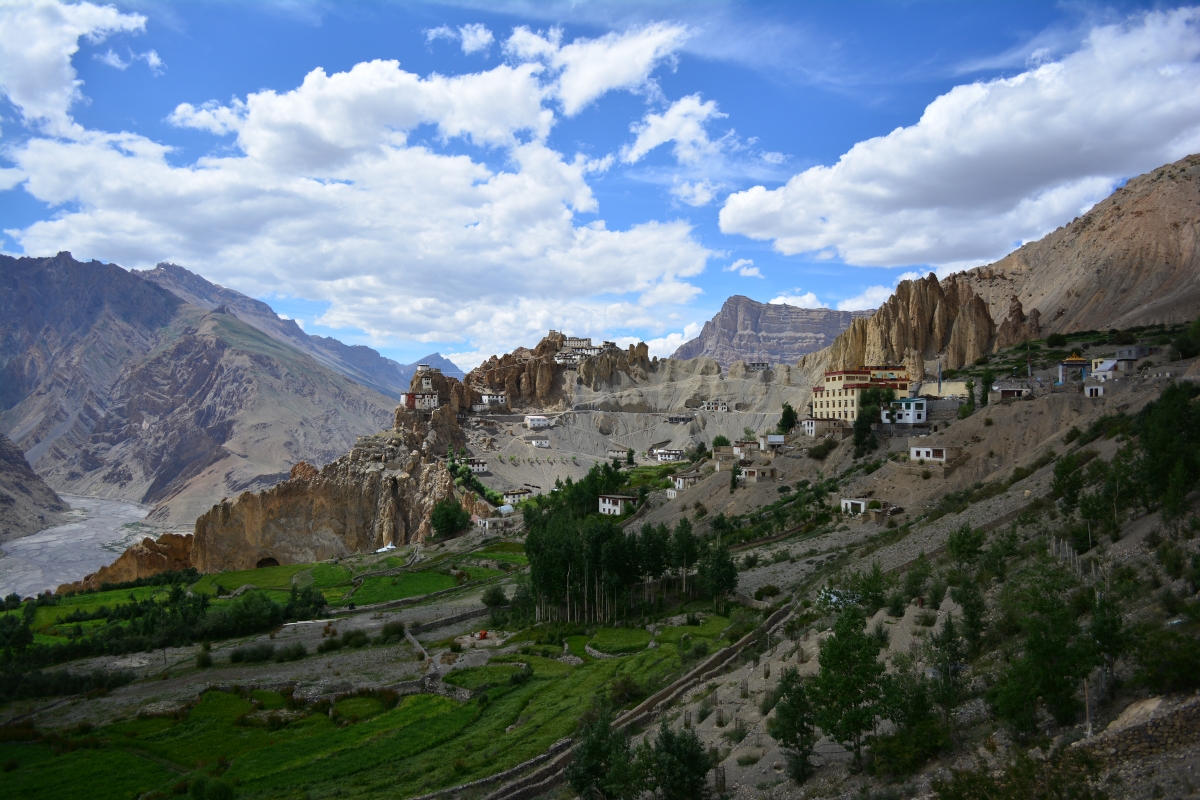
Though very few Indian travellers stop by at Lamayuru, it is frequented by backpackers from across the globe on their way to Leh, and with good reason. The tiny settlement is home to hospitable locals who’ve opened their homes, which lie at a walking distance from Lamayuru Monastery, to those looking for a spiritual break. Founded in the 11th century, the monastery is home to about 200 monks and is one of the largest and oldest ones in Ladakh. Though much of the ancient monastery has crumbled, it still attracts many Buddhist followers today and we think it definitely deserves a place in your Ladakh itinerary.
The stunning village of Dhankar in Spiti Valley. Photo by Kartik
If you’re looking for a life changing trip this summer, look no further than Spiti Valley. A band of about 66 charming villages comprises Spiti Valley, the entire population of which practices Tibetan Buddhism. The picturesque valley is home to multiple Buddhist monasteries, some of which date back to 996 AD. Foremost among these is Tabo Monastery, rebuilt after an earthquake in 1975 yet still retaining its old world charm. A mountain stands in the background, and a short hike will take you to isolated meditation caves. For a hilltop view of the Spiti River, Dhankar Monastery is the best place to go. The highlight of the monastery is its Vairochana statue. Key Monastery is also worth visiting – it accommodates 250 monks and is decorated by beautifully painted murals.
The Tibetan settlement in Coorg is one of a kind and makes for an interesting visit. Photo source: mysticindia.co.uk
Lying along the Periyar river in Coorg is the town of Kushalnagar, an amalgamation of various cultures and traditions. 5 km away from here lies Bylakuppe, the second largest Tibetan rufugee camp outside of Tibet. One can visit Namdroling Monastery here which houses over 7,000 monks and students today. The walls of the monastery are adorned with colourful paintings that depict gods and demons from Tibetan Buddhist mythology. Shopping centres near the temples allow for the purchase of traditional Tibetan items like costumes, statues, carpets, jewelery and more. Sera Monastic University, one of the largest Buddhist universities, also lies here in Bylakuppe. Who knew the coffee plantations of Coorg hid a gem like this!
About the author: Alaric Moras spends most of his time reading, writing and interning with industries that read and write. He aims to become a clinical psychologist, providing therapy and catching Freudian slips during the day, writing and reading through the night. He likes all manner of animals, the smell of books, and the oxford comma.
2014 has been a remarkable journey for us. We launched our website and travelled to different parts of the country to bring some beautiful properties to you. As the year draws to an end, we want to leave you with plenty more reasons to travel in 2015 through our curated platform – great adventures, friendly locals, delicious food, beautiful landscapes, and warm experiences irrespective of where you decide to go. Out of the 800, we’ve painstakingly chosen these 12 beautiful stay options across India that we think you should add to your bucket list – one destination for every month of 2015!
1. Surround yourself by luxury, nature and tens of spotted deer – Udaipur, Rajasthan
You’ll always be surrounded by nature in this luxury homestay.
Amidst verdant and scenic hills of the Aravali mountain range in Udaipur is Shikarbadi. Once the chosen big game hunting area of the royalty of Mewar, Shikarbadi today is home to this beautiful, luxury property that allows you to experience an untouched side of the White City. The six themed suites of the homestay have been set around a manicured garden on a floor above the host’s rooms. Here, you can listen to the songs of the birds and often spot deer, porcupines and foxes trotting outside the fences of the house. Rest assured you can experience true Rajasthani hospitality here through the friendly service and delicious local food, recipes of some of which have come straight from the royal kitchen.
2. Getaway from Mumbai to a hilltop farm overlooking the valley – Chiplun, Coastal Maharashtra
Plunge into this inviting pool and enjoy the view of the mountains and the valley.
If you’re looking for an offbeat getaway from Mumbai, this farm house in Chiplun, built on an 18 acre land, on a hilltop overlooking the valley, is just the place for you. The rooms are very simple, but you’ll have peacocks and friendly dogs here for company, an inviting open pool that you can plunge into, and home-cooked Maharashtrian fares, prepared on the traditional wood-fired stoves under a mango tree, to relish. During your stay, you can spend your day floating on a boat in the Vashisth estuary and your nights either watching a star studded sky from the terrace or driving through the jungle in a jeep. Not a dull moment here! (Also read: A Surprise Anniversary Getaway )
3. Escape to a royal Villa overlooking the Dal Lake – Srinagar, Jammu & Kashmir
This beautiful Villa in Srinagar is owned by the descendants of Maharaja Hari Singh.
Overlooking the Dal Lake and facing the Zabarwan range, this beautiful Villa is home to the descendants of the last ruling Maharaja of the princely state of Jammu and Kashmir. Nestled amongst apple, cherry and plum orchards, it is a part of their larger private estate, one where they organise fortnightly farmers market and the annual Darah Shikoh Festival. With a 36 feet high central atrium, tastefully done rooms and a lounge that comes with a view, it makes for a perfect retreat when in Srinagar. During their stay, guests can enjoy strolls in the walking trail around the estate and the nearby pond that attracts a large number of migratory birds. If you are lucky you may even come across a Himalayan Black Bear!
4. Stay with one of India’s best birding guides – Kewzing, Sikkim
Enjoy the unspoilt beauty of Sikkim while you stay in this Log House.
If you’re a birding enthusiast, this is just the place for you. Mr. Bon, your host, and one of India’s most renowned Ornithologists, has been leading birding tours around Sikkim, Assam, Arunachal Pradesh, Bhutan and Nagaland since 2001. During your stay, you can take guided birding tours to Maenam Wildlife Sanctuary, Borong and on trails that lie close to Doling Monastery in Ravangla and Mambru Monastery that is perched on top of a hill. The homestay itself is located next to a monastery. You can choose to stay in the log houses, suites or the family rooms, and eat delicious organic meals with a view of the Kanchenjunga during your stay.
5. Stay in a charming cottage surrounded by apple orchards – Manali, Himachal
The homestay lies surrounded by apple orchards and green mountains
Located in Bipasha Valley near Manali, this charming cottage lies nestled by apple trees and offers a scenic escape from the chaos of city life. The bedroom comes with a number of windows and a small personal balcony overlooking the hill station of Manali. There is a small garden outside where you can spend time enjoying the view, writing or sipping a cup of hot tea. The friendly hosts also whip up a delicious meal using fresh organic produce from their garden. During your stay, you can go for short treks around the cottage, on a trail leading to the Some River and another to a beautiful waterfall.
6. Explore an exotic village while staying in the midst of a community forest – Mawlongbna, Meghalaya
Your cottage lies a walk away from this breathtakingly beautiful spot.
The beautiful village of Mawlongbna in Meghalaya, tucked away from local tourists, houses two cottages for the adventurous travellers. Reaching the village involves a walk through the community forest, with little streams, brooks and a waterfall en route. During your stay, you can set off with the locals to discover fossils of sea-creatures (remnants of an era when the entire area was covered by the expanse of the seas), go fishing or kayaking in a water reserve nearby, and visit the local markets. The best part? Dining on local Khasi cuisine with a view of the plains of Bangladesh! (Also read: The Bridges that Grow )
7. Experience a lesser-known Ladakh by the cliff bank of River Indus – Uleytokpo, Ladakh
Set on the banks of the Indus river, these cottages let in a stunning view of Ladakh’s landscape.
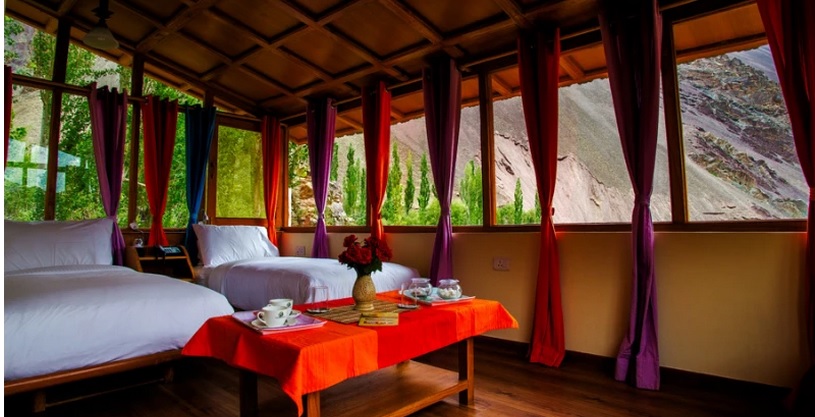
Set at the cliff bank of river Indus, 70 Kilometers into Sham valley is the village of Uleytokpo. Here, set amidst apple and apricot orchards is a beautiful eco property that allows you to experience luxury, serenity as well as a lesser-known side of Ladakh. The rooms are large and spacious with a large number of windows where you can wake up to a view of the vast mountains. During your stay, you can pick from one of the many books in the cosy library, indulge yourself with a refloxolgy session in the in-house spa, or venture out for river rafting and hiking.
8. Spend the night star gazing from an attic room – Chimney, Darjeeling
The stunning bird’s eye view from the village of Chimney
Located in a charming little village called Chimney that lies at an altitude of 6800 feet, this homestay is your window into a side of Darjeeling that not many know or talk about. The best part about the location is the bird’s eye view of Teesta River, Siliguri and neighbouring regions from its roads. On the other side is a beautiful misty juniper forest, and there are a few waterfalls and viewpoints that lie a short hike away. Stay in this cosy attic room, taste some delicious Nepalese food, and spend your night star gazing or watching lights flicker in the valley below. (Also read: Memories of a Dreamy Village )
9. Experience the lavish plantation life in a Colonial Bungalow – Coorg, Karnataka
Experience the lavish plantation life in this Heritage Bungalow in Coorg
Surrounded by sweeping vistas of the ever picturesque Kodagu Hills, this Heritage Bungalow is fit for royalty. With large, spacious rooms, fireplaces, Victorian furniture and manicured lawn, the Bungalow takes you back to a bygone era with its old world charm. During your stay, you can eat scrumptious meals of Coorg delicacies like Pandhi (pork) or Koli (Chicken) Curry, Akki Roti (Rice Roti), Kadumbuttu (Rice Dumplings), Wild Mushroom and Mango Curry. While there, other than strolling through the coffee plantations, you can take a trip to Abbey Falls, Nagarhole National Park and the Namdroling Tibetan Monastery.
10. Stay in a rustic cottage in the heart of a forest – Corbett, Uttarakhand
These rustic cottages allow you to be one with the forest.
These cottages make for a very special wilderness destination where you can be in, and one with the forest. Situated on the banks of the Ramganga River in Corbett National Park, and accessible on foot, it’s for true forest lovers and those that seek the wild in its original, pristine form, away from the crowds, the vehicles and heightened human activity. The cottages here are beautiful and have been constructed with locally sourced clay, savannah thatch and wood inspired by traditional Vangujjar tribal style. While here, soak up the wilderness from your verandas, enjoy some delicious meals, explore the forest on foot, enjoy birdwatching, butterfly spotting, or look for signs of the big ones.
11. Watch the sun set over lush fields from a hill top Bungalow – Kottayam, Kerala
Enjoy a gorgeous sunset from your balcony in the hill top Bungalow.
Set in the hills of the beautiful town of Kottayam, this bungalow lets you soak up the rich natural surroundings of Kerala away from the tourists trails. The charming rooms open up to a view of lush green fields and backwaters, which can be enjoyed with multiple cups of tea from the veranda. Other than enjoying delicious Malayali meals, you can enjoy cycling by the hilly countryside, take long leisurely walks through the fields and go for backwater rides through sleepy villages.
12. Stay in a Wooden Chalet on the banks of a river – Ribandar, Goa
The beautiful wooden chalet by the Mandovi river in Goa.
Situated on the banks of Goa’s largest River, Mandovi, is this beautiful wooden chalet that looks straight out of a Hollywood movie. Built in 1730, the property comes with three bedrooms, one of which opens up to a paved patio by the edge of the river, living rooms, dining hall, kitchen, sun decks and even a convenience store. The house is designed perfectly to allow the view of the river, the Salem Ali Bird Sanctuary and adjacent islands from every location in the house. During your stay, you can enjoy fishing or rent a bike to explore the town of Ribandar.
Which one of these homestays would you add to your 2015 Bucket list? Tell us in the comments section.
About the Author: Born and raised in Assam, Sarita Santoshini has been travelling around India and penning down her experiences over the past year. She currently works as the Content Editor for SaffronStays. You can read more of her travelogues on her blog-http://crumbsfromyourtale.wordpress.com.
There is some serenity about a morning in the Himalayas. The might of the massifs seems humbled by a morning Sun, the cold a little less biting, more like an embrace to a new day and the freshness of the dew under one’s feet, a subtle reminder of age-old childhood memories. If the stay is longer, mornings in the mountains become a ritual. One grows to like the freshness of the air, the calm walks around and the breakfasts to soothe the pangs of hunger that beckon with the cold. I remember starting my volunteering stint in Ladakh with an utter dislike for the apricot jam & the local ‘khambir’ bread and ending it with an insatiable longing for both of them every morning.
And so, during a recent visit to Kargil, in spite of staying in a hotel, I couldn’t get myself to have the ‘English’ bread-butter-coffee breakfast that it so generously offered. A morning walk around the town was in order and off we headed, over the roads that surrounded a gurgling Suru river. Few shops seemed open at this early hour in the morning. Carcasses of lambs hung down from meat shops in the goriest of their forms. Not the best of sights to begin one’s day with. So I turned away, looking for a less overwhelming experience. A little girl waited in front of the window of a shop, her gaze fixed upon the simmering ‘tandoor’ on the other side of the window. The owner then took three breads from the tandoor, wrapped them in a newspaper, and handed over to the girl who scurried away in the same direction as us. As we walked further in the market, more and more such bakeries became visible. Full-fledged baking stores, smaller shops, sometimes merely an ignored corner between two adjacent stores, just wide enough to accommodate a round tandoor and the equally round belly of the man behind it, these bakeries rule the morning hours of Kargil. Men, women, kids, line outside these bakeries, grab a bread or two and head home, like any other morning chore. I was left wondering how different these were from the khambir I ate in Leh during my last stay.
One of the local breads, Chachura, being sold in the markets of Kargil. Photo by Harsh Mehta
Nevertheless, in our hunt for a simple chai, we kept walking further, past more butcher shops and vegetable stores. The Suru was now way closer than earlier, its waters muddied by the rains, flowing ferociously beside the road. The market however, was far smaller than the expanse of the Suru. It ended earlier than anticipated. At the end, we noticed a ‘Darjeeling Hotel’ selling tea and a bakery right beside it. A desi’s delight would know no bounds at this sight. Chai and local bread. Just the way mornings in the mountains are supposed to be. While my friend occupied himself with the task of getting two cups of chai extra-sweetened, I cozied up to the bakery.
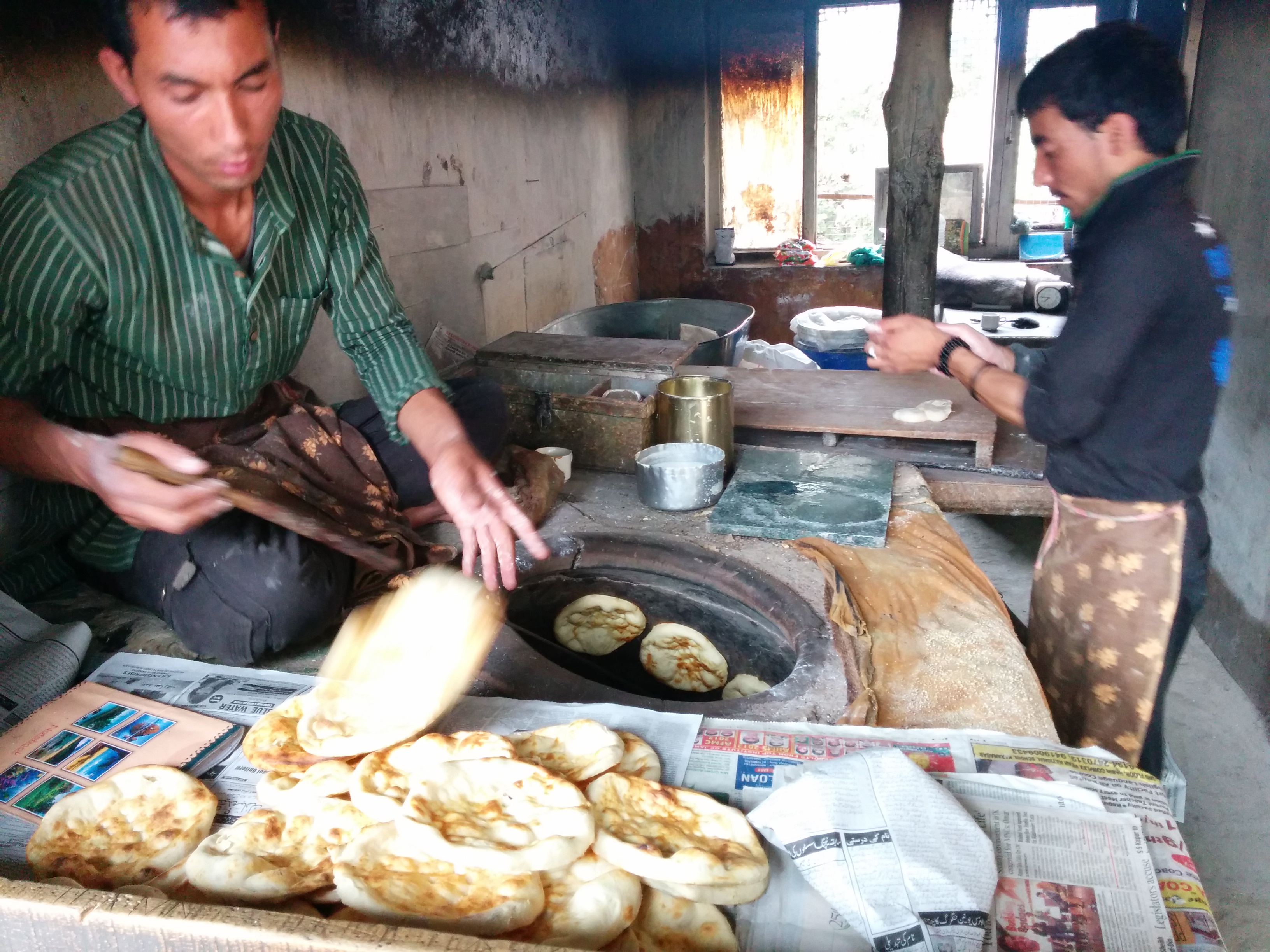
Two men worked in the bakery. One sat right behind the tandoor, his head constantly bowed in search of the latest bread to turn golden brown inside the oven. The other stood beside a table on the far side of the room, extracting the dough, leavening it, turning it into balls of even sizes and then pressing them into flat breads ready to be shoved and slapped inside the tandoor. The bakery was a version of the tandoor in itself, its walls blackened by the soot, its air warmed by the heat. One wall in particular sought attention. It was actually a notice on the wall which deserved a good read. As I went through the prices for the several items mentioned on the notice, I realised that it listed much more than a menu – it listed an entire tradition in baking in this part of the world. Girdeh, Lavasa, Chachura, Kulcha, most of these, names of breads I’d barely heard. When probed about them, our bakery men told that these were local breads and only girdeh and chachura were available in the morning and lavasa in the afternoon. We took our two pieces of girdeh and gulped them down with two cups of tea from ‘Darjeeling hotel’ (actually run by a Nepali). The men also pointed in another direction to the bakery on the other side of the road, which sold ‘chachura’, more importantly, this being one of the only two in Kargil that sold it. The chachura is a crisp, hard bread, actually more like a cross between a bread and a cookie. We took just two of these, they were bland, in desperate need of some accompaniment, and then watched a ministerial cavalcade pass by.
The bakery selling hot and delicious Girdeh. Photo by Harsh Mehta
It was only after we began our journey back when we realised that the market had sort of changed from how we had left it. Several men and women now lined both sides of the road. Beautiful faces, accompanied by equally beautiful fruits, basketfuls of which they’d brought along to be sold here. Fresh apricots from farms and households,lay stored in aluminium and plastic containers to be evaluated by passers-by, held in their hands, smelled through their noses and the apricots’ reddish-orange velvety skin to be carefully inspected through their gaze. Nearby lay crates full of apples, but surprisingly smaller, the size of the apricots and green in colour, yet tasty enough to fill one’s morning with sweetness. On both the fruits, the sellers maintained that they were the best in India – those from Kashmir would fade in comparison to the ones in Kargil. Now that was a big claim to make but I could not agree more with the apricot seller. On apples, given that I have a soft corner for the Kashmiri ones somewhere in my mouth, I decided not to argue.
Fresh Apricots for sale. Photo by Harsh MehtaGreen apples filling the morning with sweetness. Photo by Harsh Mehta
We turned back to the hotel as a life size poster of the Ayatollah watched upon us. The market was even livelier now, this being a Sunday. Several carts with vegetables, fruits and even clothes dotted the street now. Reaching the hotel, I glanced at its restaurant. Portions of generous butter cubes and jam extracts peeped at me through its windows. I smiled and headed back to the room. Had I stayed back for these, I’d never have known what a Chachura or a Girdeh was!
About the author: Harsh Mehta is your typical 20-something traveller who roams around from Krakow to Kerala and Hungary to the Himalayas in his quest to unravel the gems of the world. Having successively lost his heart to the mountains of Kashmir, the sweet traditions of the Ottoman cuisine and the old town squares of Europe, he now fancies anything that travels, from food and culture to music & languages and their linkages across the world. And so, even as he spends dreamy days at his 9-5 job, he derives inspiration from the messy streets of Mumbai to pen down the best of his travels and believes that the best destinations are not the ones that you go to with a wishlist but those that you return from with one. He shares his experiences on his personal blog – Travelbyts, tweets at @harshm09 and can be shown some love at Facebook- TravelByts. He’s also reachable at travelbyts@gmail.com.
“Leh – 1 km away” – As soon as I saw the milestone, my face immediately broke into a wide smile. I was in Ladakh again, and this time for 20 days as part of an assignment for SaffronStays.
We’d taken the 434 km long Leh-Srinagar Highway to get there and the journey, though long and tiring, kept us staring out of our window in delight. I had seen it all before – the barren land dotted with colorful striking monasteries, steep curvy roads, high mountain passes, snow capped peaks, sand dunes, and unbelievably colorful lakes – but Ladakh had me spellbound and soulful again. Here is our journey in pictures –
The striking landscape of Ladakh that greeted us as we drove from Srinagar to Leh.
*************
Leh is one place that really lets you soak up Buddhism. Every street corner gives way to a set of Buddhist Prayer wheels, which you can gently push, watch it spin and send across your quick message to God, and walk past.
****************
During my trip, I was very excited about interacting with Ladakhi families. Living with them, observing their culture, and learning so much from them was a heartfelt experience. Their beautiful match-box like Ladakhi houses, with organic gardens, cosy rooms, hundreds of copper utensils, and the warm families living there, left a great impression on me.
P.S. Whenever you come across any Ladakhi, say ‘Juley’ and experience its magic.
*****************
I had always wanted to visit the Shanti Stupa at sunrise. We shook ourselves awake before dawn and made it there by 5:30 am. We were the only visitors, and watching the sky slowly turn blue and bright at the Stupa’s backdrop was quite a sight.
*****************
Another place where I wanted to watch the sun’s magic is Thiksey Monastery. Being the largest monastery in central Ladakh, it is spread over 12 stories on a hill top, and houses shops, hotel, restaurant, school, museum, temples and even a nunnery. A 49 feet high statue of Maitreya Buddha is also erected here. Spellbinding isn’t it?
***************
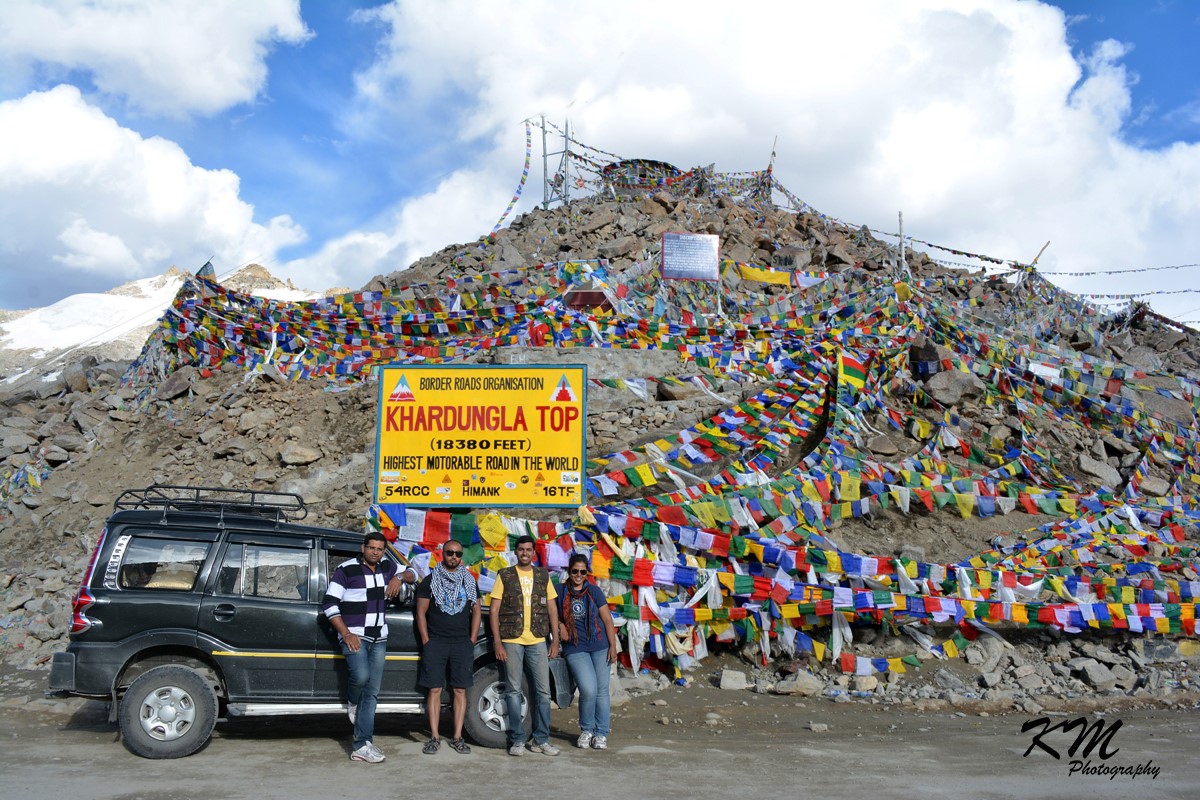
Our journey onwards to Nubra Valley took us through Khardung La – the highest motorable road in the world.
When we reached the highest point of the Pass, I felt like I had reached the top of the world – it was a surreal feeling. There was a small cafeteria run by the Indian Military serving tea and coffee to travellers. Hats off to these soldiers!
*****************
In Nubra Valley, we were welcomed by a beautiful statue of Maitreya Buddha. The view of the valley from the statue is breathtaking. The smallest village in the valley, Hunder gives you a chance to experience camel safari at a height of 10,000 feet! This is the only place where you see a river flowing right next to you, sand dunes, barren land and snow-capped mountains – all at the same time.
*******************
The last region of Ladakh that we explored was the magical Pangong Tso – situated at a height of 14,500 feet.
We crossed Chang la, believed to be the world’s third highest motorable road, to get there. We spent a night by the lake. I perched myself with hot bowls of soup and watched the sun rise and set and the colors of the lake change magically in sync.
Not like I had forgotten, but after this long and fulfilling trip, I am only assured of how much I love Ladakh and how no place can ever be as beautiful and surreal as this.
About the authors: Greeshma Soley is an avid traveller, biker and adventure enthusiast and Kartik Mahajan is a professional Photographer and Videographer. They travelled together to Ladakh, Srinagar and Himachal Pradesh as part of the Travel Ninja programme of SaffronStays in July-August 2014.
This is a very beautiful homestay in the middle of the town, located at a walking distance from main market in Leh. All rooms are spacious and very clean. The guesthouse has a pretty and small garden outside with a sit-out. The host family is very friendly and warm. We stayed here for a month almost, & I must say Sonam didi is a wonderful person to meet and stay with. She is one of the best Ladakhis to meet. This homestay has a clean dining area serves great home made organic food with a light pleasant music playing in background. Totally a must stay place in Leh city.
Turtuk is indeed a very scenic place to stay. This homestay is a perfect option with neat & clean rooms, a big garden and a lovely view. It is situated exactly in the middle of the village. The Host, Salim, is a warm person to stay with. Home made organic and tasty food is served by the host.