Top 5 Destinations You Can Drive to From Delhi This Independence Day Long Weekend

top-places-to-drive-from-delhi-independence-day-weekend

Five weekends out of Delhi look different this August than they have in years. A new expressway just cut one drive in half. A festival lands on the exact same day as Independence Day itself. Another hill town just recorded its wettest week of the year. None of that is fine print, it changes which of these five actually makes sense to book.

Independence Day 2026 falls on a Saturday, so anyone who can take Friday, August 14 gets three days to use. Here is exactly where to drive from Delhi, how long each takes, what monsoon does to it, and which villa to book.

Table of Contents:

BEFORE YOU LEAVE

Delhi Police closes roads around the Red Fort from 4 AM to 10 AM on August 15 for the flag-hoisting ceremony. Kanwar Yatra restrictions also run August 4-12, with a full vehicle ban on the old Delhi-Haridwar highway; the new Dehradun expressway and NH-334 toward Rishikesh both stay open throughout.

Dehradun

Distance: ~250 km   |   Drive time: 2.5-3.5 hrs   |   Villa: SaffronStays Varenya

The Delhi-Dehradun Expressway opened in April 2026, cutting the drive from six hours to two and a half. That single change makes Dehradun the easiest pick on this list this year. SaffronStays Varenya, a six-bedroom pool villa on the edge of Rajaji National Park, sits right off the new route, with deer and peacocks visible from the veranda.

Monsoon works in Dehradun’s favour: the Doon valley’s forests are at their greenest, and the region sits low enough to avoid the landslide risk that affects higher hill routes. Mussoorie is under an hour away for an easy half-day trip.

SaffronStays Varenya villa exterior with private pool, forest edge of Rajaji National Park visible behind, evening light.
SaffronStays Varenya at the edge of Rajaji National Park, Dehradun

Jaipur

Distance: ~280 km   |   Drive time: ~5 hrs   |   Villa: SaffronStays Ambika Farms

Jaipur’s monsoon is mild by Indian standards, rain comes in short bursts, and this particular weekend has a bonus: Hariyali Teej falls on August 15, 2026, the same day as Independence Day, filling the old city with processions and decorated swings. SaffronStays Ambika Farms, a four-bedroom pool villa on Jaipur’s outskirts with a games room and garden, is the pick, and it markets itself directly to travellers coming from Delhi.

The NH48 route rarely floods, making this one of the more reliable drives on the list. Amber Fort and City Palace both photograph better rain-washed, with a fraction of the usual crowds.

SaffronStays Ambika Farms exterior with private pool and garden, monsoon clouds overhead.
Private pool villa with garden, Ambika Farms, Jaipur

Kasauli

Distance: ~300 km   |   Drive time: ~6 hrs   |   Villa: SaffronStays The Hill Abode

Kasauli ranks among the safer low-altitude Himachal bases for monsoon travel, and the road stays smooth until the final 40-kilometre climb. That said, an August 2025 rain event saw Kasauli record the highest 24-hour rainfall anywhere in the state, so check a live weather advisory before leaving rather than relying on general seasonal guidance.

SaffronStays The Hill Abode, a three-bedroom modern villa in Kumarhatti, sits about 1.5 hours from Chandigarh with floor-to-ceiling windows and a viewing deck built for valley views. It has no swimming pool, which fits the destination; Kasauli’s appeal is elevation and quiet, not water. A fireplace and bonfire setup cover the cooler, wetter evenings this time of year.

SaffronStays The Hill Abode exterior with floor-to-ceiling windows and viewing deck, misty Kasauli valley visible.
Modern valley-view villa, The Hill Abode, Kasauli

Rishikesh

Distance: ~250 km   |   Drive time: 5-6 hrs   |   Villa: SaffronStays Tarangini by Ganges

White-water rafting is officially suspended on the Ganga from July 1 to August 31 every year, so this is not the month for an adventure-first trip. Any operator offering private monsoon rafting this month is running an unlicensed, uninsured route.

The Ganga Aarti, ashrams and Laxman Jhula all stay open regardless. SaffronStays Tarangini by Ganges, a four-bedroom riverside villa bordering Rajaji National Park, suits a quieter, walking-and-stillness version of the trip. The Delhi approach road stays reliably monsoon-safe.
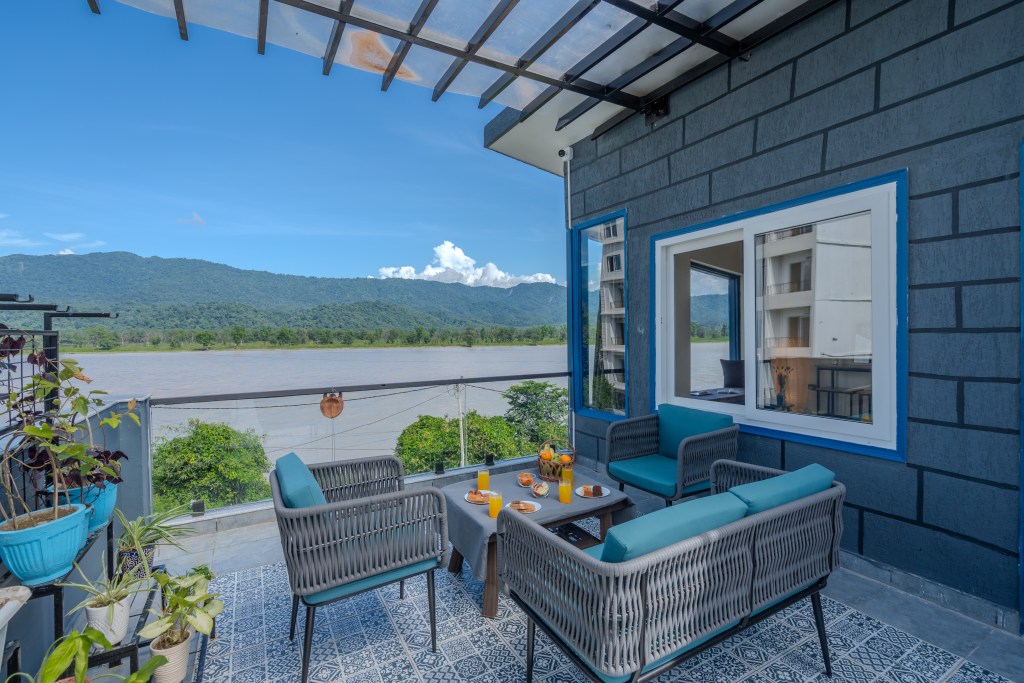
SaffronStays Tarangini by Ganges riverside villa terrace overlooking the Ganga in monsoon, Rajaji National Park forest visible.
Riverside villa terrace overlooking the Ganga, Rishikesh

Nainital

Distance: ~300-320 km   |   Drive time: 6-8 hrs   |   Villa: SaffronStays Naiintara

Nainital is the furthest and riskiest pick on this list. The hill stretch between Haldwani and Nainital carries real landslide risk in August, and several road-safety guides advise against the drive this month. Go only with a buffer day built in and a same-morning weather check, not a general seasonal assumption.

SaffronStays Naiintara sits directly on Naini Lake, with a quieter Mall Road and lake mist as the reward for anyone who still makes the trip prepared.

SaffronStays Naiintara lake-facing villa balcony overlooking a misty Naini Lake in the monsoon, stone architecture visible.
Lake-facing balcony at SaffronStays Naiintara, Nainital

All Five, Side by Side

DestinationDistanceDrive TimeRisk This WeekFeatured Villa
Dehradun~250 km2.5-3.5 hrsNew expressway, low landslide riskVarenya
Jaipur~280 km~5 hrsMild monsoon, reliable roads Ambika Farms
Kasauli~300 km~6 hrsSafer than deep Himachal, not risk-freeThe Hill Abode
Rishikesh~250 km5-6 hrsRafting suspended, town unaffectedTarangini by Ganges
Nainital~300-320 km6-8 hrsReal landslide risk, plan accordinglyNaiintara

Independence Day weekend is peak booking season across all five. Villa rates rise and availability tightens as the date approaches, especially for larger properties. Book two to three weeks out rather than the week of.

Four directions. One weekend. Your call.

Browse private-pool villas in Jaipur, Dehradun, Kasauli and Nainital on SaffronStays and lock your Independence Day weekend.

Frequently Asked Questions

How long does it take to drive from Delhi to Dehradun now?

About two and a half hours via the new Delhi-Dehradun Expressway, down from six hours on the old NH-58 route. The expressway opened in April 2026.

Is Rishikesh rafting open in August?

No. Uttarakhand’s state tourism department officially suspends all Ganga rafting from July 1 to August 31 every year due to dangerous monsoon water levels.

Is Kasauli safe to visit in monsoon?

Mostly, with caveats. It ranks among the safer low-altitude Himachal bases, but an August 2025 event saw it record the state’s highest rainfall. Check a live weather advisory before leaving.

Is it safe to drive from Delhi to Nainital in August?

It carries real risk. The Haldwani-Nainital hill stretch sits inside the monsoon landslide window, and multiple road-safety sources advise against the drive in July and August.

How long is the drive from Delhi to Jaipur?

About five hours covering roughly 280 kilometres via NH48, one of the more monsoon-reliable routes on this list.

What time do Red Fort roads close on Independence Day?

In recent years, Delhi Police has closed roads around the Red Fort from 4 AM to 10 AM on August 15. Exact 2026 timings will be confirmed closer to the date.

The Way India Celebrates New Year Is Changing. Here’s Why It Matters.

Families enjoying New Year party at home in India with decorations and lights

The Way India Celebrates New Year Is Changing. Here’s Why It Matters.

As the New Year approaches, one pattern becomes increasingly clear. The way people celebrate this moment is changing, and in many ways, it is reshaping how India travels.

New Year was once centred around a single night. A countdown, a party, and a sense of closure. Today, it has evolved into something more deliberate. For a growing segment of travellers, New Year is no longer about how the year ends, but about how the next one begins. Where they wake up on January 1, the pace they start the year with, and the kind of time they spend with the people around them now matter far more than midnight itself.

In that sense, New Year has shifted from being a reason to party into a reason to travel.

This reflects a broader move towards experiential and event-led travel, where trips are planned around moments that matter. Celebrations are no longer squeezed into itineraries. Instead, destinations and stays are chosen to support the experience people want to create.

Why Big Groups Are Rethinking How They Celebrate

Big-group travel around New Year reveals one of the clearest behavioural shifts. When families and friends come together to celebrate, the objective is rarely a single highlight. It is continuity, comfort, and shared time.

Large groups bring different ages, energy levels, and expectations into the same space. As a result, rigid celebration formats and crowded venues are increasingly giving way to environments that allow flexibility and flow. This has led to the rise of intent-led travel, where destination choice is driven by how people want to celebrate rather than where everyone else is going.

The Rise of Intent-Led Travel

Distinct traveller archetypes are now emerging around New Year.

The Culture-Plus-Energy Seeker

These travellers enjoy vibrant evenings but also value history, design, culture, and scenic beauty during the day. Their ideal New Year balances celebration with exploration.

SaffronStays Citadel, Goa

In Goa, homes like SaffronStays Citadel reflect this shift. Designed as part of the X-Series collection, it caters to groups who want to celebrate life’s biggest moments while staying connected to the destination’s quieter, more considered side.

SaffronStays Kanota Courtyard, Jaipur

In Rajasthan, properties such as Kanota Courtyard in Jaipur and Rang Havelii in Udaipur resonate with travellers who prefer celebrations grounded in heritage, shared spaces, and a strong sense of place.

SaffronStays Rang Havelii, Udaipur

The Close-to-Home Celebrator

This segment consists largely of travellers from Mumbai and Pune who want New Year to feel like a getaway without the fatigue of long travel. Privacy, natural surroundings, and exclusivity matter more than distance.

SaffronStays Six Degrees, Alibaug

Homes such as Six Degree in Alibaug cater to this mindset, offering space and comfort for group celebrations while remaining close enough to the city to keep travel easy. Similarly, lake-facing retreats like Kosha by the Waters in Pawna appeal to groups who want to celebrate quietly, surrounded by nature, without moving too far from home. Satori in the Sahyadris is for those who like to take things slow — wide views, long chats, and plans that don’t need sticking to. Peaceful, secluded, yet an easy drive from the city.

SaffronStays Kosha by the Waters, Pawna

Satori, Mulshi is for those who like to take things slow, wide views, long chats, and plans that don’t need sticking to. Peaceful, secluded, yet an easy drive from the city, it’s the perfect spot to unwind, reconnect, and let the day unfold at your own pace.

A landscaped view of a traditional-style building with a pyramid-shaped roof, surrounded by greenery and mountains in the background.

SATORI, Mulshi

The Reset-First Traveller

For this group, New Year marks a reset rather than a party. Wellness, nature, and clarity define their travel choices. Celebrations are intentional and quieter, often centred around outdoor living and mindful experiences.

SaffronStays Boudhi Tree Villas, Rishikesh

Spaces like Boudhi Tree Villa in Rishikesh and forest-set stays such as The Timber in Dehradun align with travellers who want to begin the year feeling grounded rather than overstimulated.

SaffronStays Timber Villas, Dehradun

The Quiet Mountain Loyalist

These travellers actively avoid crowded hill stations. They seek lesser-known mountain destinations where the pace is slow and the surroundings feel untouched.

SaffronStays Edelweiss Estate, Ranikhet

Estates like Edelweiss Estate in Ranikhet and curated mountain stays like The Unwind Chalet in Mukteshwar appeal to those who want New Year to be about stillness, views, and uninterrupted time away from urban intensity.

SaffronStays Unwind Chalet, Mukhteshwar

The Offbeat Coastal Explorer

This group looks beyond mainstream beach destinations. They are drawn to quieter coastlines, unexplored trails, and regions that feel undiscovered.

Properties such as Araqila Resort in Sindhudurg reflect this intent, offering space and seclusion for travellers who want their New Year celebrations to unfold away from crowds and predictability.

Araqila Resort, Sindhudurg

This level of segmentation signals a maturing travel market. When travellers choose destinations based on intent rather than trend, it indicates a structural shift rather than a seasonal preference.

What the Data Is Telling Us

These changes are supported by broader travel data. India recorded over 2.5 billion domestic tourist visits in 2023, underscoring the scale of domestic travel. Even small changes in preference within such a large market can reshape entire categories.

Industry research consistently points to the rise of experiential travel, longer stays, and event-led journeys. Travellers are planning earlier, spending more intentionally, and prioritising stays that offer space, privacy, and flexibility, especially around year-end.

New Year travel, in particular, has become a strong signal of how people want to travel through the year ahead.

What This Means for Hospitality

For hospitality brands, asset owners, and investors, the implications are clear. Demand is shifting towards environments that support shared living, flexible pacing, and emotional comfort.

Private home hospitality and large-format stays are not replacing hotels. They are addressing a different need altogether. One rooted in togetherness, control over time, and the ability to celebrate without compromise.

What New Year Travel Is Really Telling Us

If there is one moment that reveals where Indian travel is headed, it is New Year.

When New Year becomes a reason to travel rather than simply a reason to party, it reflects a deeper change in values. People are choosing meaning over noise, time over timelines, and shared experiences over fleeting moments.

This is not a passing trend shaped by one season. It is a long-term shift in how people want to celebrate life’s milestones.

And once a market begins to value intention, privacy, and connection, it rarely looks back.