How to Plan a Celebration Trip for 15+ People in India (Without Losing Your Mind)

It always begins the same way. A simple message on a WhatsApp group: “Guys, let’s plan a trip.”

Within minutes, it spirals. Goa vs mountains. Budget debates. Dates that don’t match. Someone suggests “let’s just see,” and someone else is already planning outfits. And suddenly, planning a celebration for 15+ people starts feeling less like excitement and more like coordination chaos.

But here’s the truth most people don’t realise until it’s too late:

Large group trips don’t fail because of people. They fail because of poor planning decisions early on.

Get those right, and everything else becomes surprisingly easy.

How do you plan a trip for 15+ people in India? (Quick Answer)

If you’re short on time, here’s what actually works:

  • Lock dates early based on majority
  • Set a clear per-person budget upfront
  • Assign responsibilities across the group
  • Choose a destination based on the occasion
  • Book a private villa instead of multiple hotel rooms
  • Keep the itinerary flexible

The biggest difference-maker?
Booking a space designed for large groups from the start.

Step 1: Start With Dates, Not Destinations

Most people begin with “Where should we go?”
The smarter question is “When can most people go?”

With a group this size, perfect alignment doesn’t exist. What works is momentum. Share a couple of date options, let people respond quickly, and lock what works for the majority.

Because once dates are set, the trip becomes real. Everything else starts falling into place.

Step 2: Define the Celebration Before the Location

Not all group trips are built the same.

A 30th birthday celebration has a very different energy from a family reunion. A corporate offsite needs structure, while a friends’ getaway thrives on spontaneity.

When you’re clear about the kind of celebration, the destination almost chooses itself.

For instance, we’ve seen groups pick Goa villas for milestone birthdays, while quick weekend reunions often lean towards Lonavala or Alibaug for easy access and relaxed settings.

A group of six people enjoying drinks and conversing in a sunny garden setting with a modern house in the background. Fairy lights are hung above them, and the atmosphere appears relaxed and festive.

Step 3: Fix the Budget Early (It Solves Half Your Problems)

If there’s one conversation that simplifies everything, it’s this one.

A clearly defined per-person budget removes hesitation, speeds up decisions, and avoids awkward discussions later. It also helps filter options instantly.

Instead of debating endlessly, the group aligns faster when everyone knows what they’re comfortable spending.

Step 4: Don’t Plan Alone — Build a Core Team

There’s always one person who ends up doing everything. Don’t let that be you.

Large group trips work best when planning is shared. Someone handles bookings, someone manages logistics, someone takes charge of food or activities.

Interestingly, when people are involved in planning, they show up more engaged. The trip starts feeling like a collective experience even before it begins.

Step 5: The One Decision That Changes Everything

Here’s where most large group trips quietly fall apart.

Booking multiple hotel rooms feels like the obvious choice. It’s familiar, easy, and seems organised.

But once you arrive, the cracks show.

You’re split across floors. There’s no real space to sit together. Conversations get fragmented. And the one thing you planned this trip for, being together, starts slipping away.

That’s when most groups realise they need something else entirely.

Araqila Resort, Sindhudurg

Step 6: Why Private Villas Redefine Group Celebrations

There’s a noticeable shift when a group checks into a villa instead of a hotel.

The energy changes.

People gather naturally in the living room. Music flows without interruptions. Meals become shared experiences instead of scheduled slots. There’s no rushing, no splitting up, no constant coordination.

For large groups, this isn’t just about comfort. It’s about continuity.

We’ve seen this play out across SaffronStays homes. Groups celebrating birthdays in Goa villas with private pools, families reconnecting over long meals in Alibaug, teams unwinding across expansive lawns in Lonavala.

And practically speaking, when the cost is shared across 15–20 people, villas often offer far better value than booking multiple hotel rooms.

This is exactly why searches for villas for large groups in India have grown rapidly in recent years.

A woman relaxing on a lounge chair by a swimming pool at sunset, with a table displaying various colorful cocktails; two people playing volleyball in the pool in the background.

SaffronStays Satori, Mulshi

Step 7: What Makes a Villa Truly Work for 15+ People

Not every villa can handle a large group well.

It’s not just about fitting everyone in. It’s about how the space feels when everyone is there.

Look for:

  • Spacious common areas where everyone can gather comfortably
  • Outdoor spaces like lawns or decks for evenings together
  • Thoughtful layouts that balance privacy and shared moments

The best villas don’t just accommodate people. They bring them together.

Step 8: Where to Go: Best Destinations for Group Getaways in India

Some destinations consistently work better for large groups because they combine accessibility, space, and the right kind of experiences.

These are also destinations where curated homes, like those by SaffronStays, are designed specifically for group stays and celebrations, making planning significantly easier.

A modern villa exterior at dusk featuring a swimming pool, outdoor seating area, and large glass doors that reveal a stylish interior.

SaffronStays Waters by Kosha Villas, Pawna

Step 9: Leave Space for the Unexpected

There’s a tendency to over-plan, especially with large groups.

But the most memorable parts of any trip rarely come from the itinerary. They come from the in-between moments. Late-night conversations. Unplanned games. Long, unhurried meals.

When the setting is right, you don’t need to fill every hour. The experience unfolds on its own.

Step 10: Keep It Simple, Keep It Transparent

A little structure makes a big difference.

Shared tools for expenses, quick polls for decisions, and open communication can eliminate most of the friction that comes with group planning.

When everything feels clear and easy, people relax. And when people relax, the trip becomes what it was meant to be.

A group of diverse friends enjoying a meal outdoors at a beautifully set table, surrounded by greenery and flowers.

SaffronStays Hacienda by the Sea, Alibaug

What Actually Makes a Group Trip Work

Planning for 15+ people will never be completely seamless.

But it doesn’t have to feel overwhelming.

Because in the end, it’s not about managing every detail perfectly. It’s about creating an environment where everything feels effortless once you arrive.

And more often than not, that comes down to one choice:

Choosing a space where everyone can truly be together.

Planning Your Next Celebration Stay?

If you’re looking for spaces that are thoughtfully designed for large groups, celebrations, and shared experiences, explore SaffronStays’ collection of villas across India.

From beachside homes in Goa to expansive villas in Lonavala and Alibaug, each space is designed to make group stays feel seamless, comfortable, and memorable.

Because when the setting is right, the celebration takes care of itself.

Wag More, Worry Less: Late Winter Pet-Friendly Travel Guide to Villas in India

February is when travel in India finally exhales. The holiday crowds have dispersed, the weather has settled into a comfortable rhythm, and destinations feel open again. Mornings are cool, afternoons are pleasant, and evenings invite you outdoors, making this one of the best months for slow, pet-friendly travel across the country.

For travellers planning a pet-friendly vacation in India, February offers ideal conditions. Temperatures are well suited for long walks, open lawns, and outdoor living. Coastal regions feel breezy without humidity, hill areas remain crisp without being cold, and countryside destinations are calm and accessible. It is a month that supports movement without exhaustion and exploration without pressure, especially when travelling with dogs.

Pet-friendly travel in India is becoming more visible, but meaningful travel with pets depends on choosing the right season and the right kind of stay. February allows pets to adapt more easily to new environments, routines, and surroundings. Days unfold slowly, daily walks become central to the experience, and accommodation choices play a crucial role in how relaxed the trip feels.

This guide focuses on February travel with pets in India, offering practical insights into choosing destinations, understanding pet-friendly stays, and planning villa holidays that prioritise comfort, space, and calm. Whether you are travelling with family, friends, or solo with your dog, this is a season that supports thoughtful, unhurried travel designed around shared experiences rather than packed itineraries.

A young woman joyfully interacting with a golden retriever dog while sitting on the grass in a park during sunset.

What Truly Makes a Stay Pet-Friendly in India

Travelling with pets in India is not regulated uniformly. While many hotels say they allow pets, the experience varies drastically. A truly pet-friendly stay means:

Clear Policies –Clear guidelines around pet size, numbers, and rules remove uncertainty and help travellers plan with confidence.

Unshared Outdoor Space – Space is equally important. Pets, especially dogs, need room to move freely without navigating shared corridors, elevators, or busy common areas

Ease of Movement –  Easy outdoor access allows pets to follow natural routines, whether that means early morning walks or quiet evening time outdoors. 

Safety and Comfort – Comfort also plays a role. Shaded areas, safe flooring, and calm surroundings help pets adjust faster and settle into unfamiliar environments. 

When these elements come together, travel stops feeling like a compromise and starts feeling inclusive.

The Challenges of Travelling With Pets in India

Travelling with pets in India requires practical awareness. Transport can be a challenge, as not all flights, trains, or local travel options are designed with pets in mind. Once you arrive, environmental conditions matter more than expected. Certain destinations may feel mild on the calendar but can still be warm underfoot during the day, making open lawns and shaded ground essential.

Public pet infrastructure is still limited across many regions. Dog parks, pet-friendly cafes, and dedicated walking zones are not yet common. Noise is another factor that often catches travellers off guard. Markets, festivals, or sudden fireworks can be stressful for pets sensitive to sound. Understanding these challenges does not limit your travel choices. Instead, it helps you select destinations and stays that work with your pet’s needs rather than against them.

A Pomeranian dog peeking out of a car window. Dog travelling

How Different Pets Experience Travel

Dogs are individuals, and travel affects them differently.

High-Energy Dogs – These dogs need space and activity. Long walks, open lawns, and shade matter most.

Older Dogs – Smaller distances, shaded areas, comfy bedding, and predictable routines make a big difference.

Anxious or Sensitive Pets – Avoid loud places. Slow introductions to new spaces help. Quiet outdoor areas are key.

As you read villa recommendations below, think of them in terms of what your pet experiences,  not just what the property offers.

Why Late January and February Are Ideal for Pet-Friendly Travel

Many travellers aim for December and miss something important,  weather stability.

Weather WinsLate January and February are generally:

  • sunny without heat
  • cool mornings and mild afternoons
  • low humidity in coastal areas
  • clear skies in hill regions

This weather balance is perfect for pets and humans alike. Your dog can enjoy longer walks without overheating. Outdoor time becomes the daily norm.

Fewer Crowds, More Room

Post-holiday crowds are gone. Parks, trails, and beaches feel expansive. This makes staying outdoors more rewarding and less stressful.

Seasonal Experiences Open Up

Local markets become regular again, nature trails feel private, and restaurants open outdoor seating for long lunches.

This seasonal clarity makes your travel with a pet both easier to plan and more pleasant to live.

A woman interacts playfully with a dog in a sunlit garden, with greenery in the background and the dog standing on its hind legs.

How Your Choice of Stay Shapes the Entire Holiday

Your accommodation is not just a roof. It becomes the base camp of your holiday life.

Here’s what matters most and why villas often work best:

1. Predictable Daily Rhythm

Pets thrive on routine. Villages, towns, and villas allow gentle morning schedules that aren’t dictated by reception rules or shared breakfasts.

2. Space to Move and Play

Private lawns and open grounds allow you to play fetch, stroll, and exercise without crowding.

3. Ease of Outdoor Access

Instead of elevators and busy hallways, villas often open directly to lawns, gardens, or quiet streets.

4. Quiet, Predictable Surroundings

Less traffic, fewer strangers, and calmer soundscapes reduce anxiety for pets who are sensitive to noise.

In this guide, the recommendations below highlight stays that align with these benefits.

Coastal Destinations for Late Winter Travel With Pets

Coastal regions work especially well for pet-friendly travel during late January and February. Cooler sand in the mornings, steady sea breezes, and wide open beaches create ideal conditions for dogs who enjoy movement and exploration. Without the pressure of peak-season crowds, walks along the shore feel calmer and more spacious.

Villas near the coast often allow pets to enjoy both outdoor relaxation and easy access to walking routes. Days can unfold slowly, beginning with early beach walks and ending with relaxed evenings outdoors, without the discomfort that summer heat often brings.

A swing seat in a lush garden overlooking the ocean, with a small table set with drinks and fruit.

SaffronStays Time and Tide, Alibaug

Hill and Riverside Retreats for Calm, Comfortable Stays

Hill regions and riverside destinations come into their own during late winter. February brings pleasant daytime temperatures, cool evenings, and shaded walking paths that suit pets who prefer gentler activity. Forest edges, riverside trails, and quiet roads offer variety without overstimulation.

These destinations tend to be quieter during this season, which benefits pets sensitive to noise or crowds. Staying in such areas allows you to combine light exploration with ample rest, creating a rhythm that feels balanced and restorative rather than busy.

A modern A-frame house with a wooden exterior and large windows, set in a lush green landscape with trees and mountains in the background, during sunset.

SaffronStays Cheese Cottage, Tanmarg

Travelling with pets opens up a world of shared experiences that go beyond basic sightseeing.

Here are realistic activities you can include:

Morning Walks

Early hours before the sun heats the ground are ideal for long dog walks.

Gentle Trail Explorations

Nearby nature trails or rural paths make for relaxed scenic time.

Open Lawn Playtime

Simple games like fetch, scent trails, and hide-and-seek enrich your dog’s day.

Quiet Community Exploration

Visiting local markets, small town streets, and waterfront promenades together.

These activities help you bond, reduce stress, and enjoy travel in a meaningful, pet-aware way.

How to Choose Your Pet-Friendly Stay

Before you book, consider these criteria:

Check Pet Policies
Know what size, number, and breed conditions exist.

Proximity to Walkable Space
You want a place that lets you step outside and go walking without long drives.

Shade and Ground Comfort
Sunny lawn or sandy beach — both need shade and soft walking surfaces for pets.

Nearby Quiet Spaces
Dogs benefit more from calm walks than crowded streets.

Use these real travel insights to evaluate every place you consider. Choosing with these factors in mind helps ensure your travel experience feels comfortable rather than complicated.

Why Travelling With Pets Changes How You See a Place

Travelling with pets naturally slows you down. You notice light, sounds, and rhythms more closely. Morning routines matter. Quiet streets feel valuable. Outdoor time becomes central rather than optional.

Pets invite presence and observation. They shift the focus from ticking off sights to experiencing moments. A New Year vacation in India during late January and February offers the perfect opportunity to embrace this pace. It allows you to travel in a way that feels intuitive, grounded, and shared.

Late January and February offer one of the most rewarding windows for pet-friendly travel in India. With the right destination, season, and stay, travel becomes less about adjustment and more about ease.

By understanding what truly makes a stay pet-friendly, planning for real challenges, and choosing environments that support both movement and rest, you create a holiday that feels calm, connected, and joyful.

Travel with intention. Observe with curiosity. And enjoy the season alongside those who walk with you every day.

Panchgani vs Mahabaleshwar During Strawberry Season: A Complete Travel Comparison

Elephant's Head Point in Mahabaleshwar, Maharashtra

Strawberry season brings Panchgani and Mahabaleshwar into sharp focus every winter. From December to March, this part of Maharashtra becomes the country’s strawberry belt, drawing travellers who want fresh produce, cool weather, scenic viewpoints, and relaxed hill-town days.

Because the two destinations are close to each other and often visited together, many travellers struggle to decide between them. This guide offers a complete comparison of Panchgani vs Mahabaleshwar during strawberry season, covering sightseeing, strawberry farms, food experiences, crowds, accessibility, and stay options so you can plan with clarity.

A person sitting on a ledge, overlooking a scenic landscape with a river and mountains in the background, framed by a bare tree branch.

Strawberry Season Timeline in Panchgani and Mahabaleshwar

Strawberry season typically runs from early December to March, but the experience varies depending on when you visit.

  • December to early January
    Early harvest period with fewer visitors, cooler mornings, and limited strawberry availability. Ideal for travellers who want quiet sightseeing.
  • Mid-January to late February
    Peak strawberry season. Best fruit quality, most farm visits open, maximum food options, and highest crowd levels, especially on weekends.
  • March
    Late season with strawberries still available, warmer afternoons, and steady crowds as visitors try to catch the season before it ends.

Daytime temperatures usually range between 15°C and 24°C, making this one of the most comfortable travel windows in the region.

Panchgani vs Mahabaleshwar: How the Two Towns Feel

Although Panchgani and Mahabaleshwar are geographically close, they feel very different to explore.

Panchgani is known for its open tablelands, wide roads, and expansive views. Sightseeing feels unhurried and crowd movement is more evenly spread.

Mahabaleshwar is a classic forested hill station with winding roads, clustered attractions, and a livelier atmosphere, especially during peak strawberry weeks.

This difference becomes most apparent when sightseeing and moving between attractions.

Sightseeing in Panchgani During Strawberry Season

Panchgani sightseeing revolves around open viewpoints and short drives, which pair well with strawberry farm visits.

Popular places to see in Panchgani include:

  • Table Land for wide plateau views and morning walks
  • Parsi Point overlooking the Krishna Valley and Dhom Dam
  • Sydney Point for sunset views and photography
  • Rajpuri Caves for short walks and historical interest
  • Bhilar village nearby, known for quiet roads and scenic surroundings

These spots are spread out and spacious, which helps Panchgani feel calmer even during peak season.

Sightseeing in Mahabaleshwar During Strawberry Season

Mahabaleshwar offers more sightseeing options, but they are closer together and tend to get busier.

Must-visit places in Mahabaleshwar include:

  • Arthur’s Seat for dramatic valley views
  • Elephant’s Head Point surrounded by forested landscapes
  • Venna Lake for boating and food stalls
  • Lingmala Waterfall viewpoint for seasonal scenery
  • Old Mahabaleshwar for temples and quieter surroundings

Sightseeing here benefits from early starts, especially during peak strawberry weekends.

Strawberry Farms in Panchgani: What and Where

Strawberry farms in Panchgani are usually located on the outskirts of town and along the Panchgani–Mahabaleshwar road. Most are small, family-run farms that open to visitors during peak season.

What you can expect at Panchgani strawberry farms:

  • Walks through active strawberry fields
  • Fresh strawberries sold by weight
  • Simple tasting experiences
  • A quieter, more personal atmosphere

Farm visits here are usually short and relaxed, making them easy to combine with sightseeing.

Strawberry Farms in Mahabaleshwar: What and Where

Mahabaleshwar has a more established strawberry tourism circuit, with farms located around Old Mahabaleshwar, Lingmala, and the main access roads.

Popular strawberry stops include:

  • Mapro Garden, known for strawberry-based products, food counters, and cafés
  • Larger strawberry farms offering packaged fruit and tasting counters
  • Roadside farm stalls selling fresh produce and desserts

These places can get busy during peak season, but they also offer the widest variety of strawberry-based food and products.

Best Time of Day for Strawberry Farm Visits

Strawberry farms are best visited late morning to early afternoon, once dew has lifted from the plants.

Helpful tips:

  • Visit viewpoints early in the morning
  • Plan farm visits after 10.30 am
  • Expect higher prices and limited quantities during peak season
  • Carry cash for smaller farm stalls

Food Experiences During Strawberry Season

Strawberry season adds a strong food focus to both destinations.

Food Experiences in Panchgani

  • Roadside stalls serving fresh strawberries with cream
  • Small cafés near viewpoints offering strawberry milkshakes
  • Farm-adjacent stalls with seasonal desserts

Food Experiences in Mahabaleshwar

  • Food gardens serving strawberry ice creams and shakes
  • Shops selling strawberry jams, syrups, and preserves
  • Cafés around Venna Lake and central areas with expanded seasonal menus

Travellers looking for variety usually prefer Mahabaleshwar, while those who enjoy quieter food stops often prefer Panchgani.

Accessibility and Getting Around

Both destinations are well-connected by road.

  • From Pune: Around 2.5 to 3 hours
  • From Mumbai: Around 5 to 6 hours depending on traffic

Panchgani lies on the route to Mahabaleshwar, making it easy to cover both towns in one trip without changing accommodation.

Sample Itineraries for Strawberry Season

Two-Day Itinerary

  • Day 1: Panchgani viewpoints, strawberry farm visit, sunset at Parsi Point
  • Day 2: Mahabaleshwar sightseeing, food gardens, Venna Lake

Three-Day Itinerary

  • Day 1: Panchgani sightseeing and farms
  • Day 2: Mahabaleshwar viewpoints and food experiences
  • Day 3: Revisit favourite spots or explore quieter areas like Old Mahabaleshwar

A scenic view of a modern bungalow with a red tiled roof, surrounded by lush greenery and mountains in the background under a cloudy sky.

SaffronStays Valley’s Edge

Where to Stay During Strawberry Season

Accommodation choice becomes especially important during peak season.

Many travellers prefer private villa stays that offer space, parking ease, and quieter surroundings. Villas also allow flexible meal timings and relaxed evenings after busy sightseeing days.

Villa stays in Panchgani suit travellers who want calm views and easy access to farms. Villa stays in Mahabaleshwar work well for those who want proximity to sightseeing and food hubs.

SaffronStays offers curated private villas in both Panchgani

A spacious red-brick house with a tiled roof, surrounded by lush greenery and colorful flowers in a well-maintained garden.

SaffronStays Garnet, Mahabaleshwar

Frequently Asked Questions

Q. When is the strawberry season in Panchgani and Mahabaleshwar?

Strawberry season in Panchgani and Mahabaleshwar usually begins in early December and lasts until March. The peak season, when strawberries are at their sweetest and farms are most active, is from mid-January to late February.

Q. Which is better during strawberry season, Panchgani or Mahabaleshwar?

Both destinations are excellent during strawberry season, but they suit different travel styles. Panchgani is better for travellers who prefer open views, lighter crowds, and a relaxed pace. Mahabaleshwar is better for those who want more sightseeing options, organised strawberry farms, and a lively hill-station atmosphere.

Q. Which place is less crowded during strawberry season?

Panchgani generally feels less crowded than Mahabaleshwar, especially during peak weekends. Its open tablelands and spread-out viewpoints help manage visitor flow better. Mahabaleshwar sees higher footfall around popular attractions and food gardens during peak season.

Q. Can visitors go strawberry picking in Panchgani and Mahabaleshwar?

Yes, visitors can explore strawberry farms in both Panchgani and Mahabaleshwar during the season. Some farms allow limited strawberry picking, while others focus on selling freshly harvested fruit and offering tasting experiences. Availability depends on the farm and the time of visit.

Q. What is the best time of day to visit strawberry farms?
The best time to visit strawberry farms is late morning to early afternoon, usually after 10.30 am. By this time, dew has lifted from the plants and farm activities are fully underway. Early mornings are better reserved for sightseeing and viewpoints.

Q. Is it possible to cover both Panchgani and Mahabaleshwar in one trip?
Yes, Panchgani and Mahabaleshwar are located close to each other and are connected by a short scenic drive. Most travellers comfortably cover both destinations in a two- or three-day trip without changing their accommodation.

Q. What should travellers expect in terms of prices and availability during peak strawberry season?
During peak strawberry season, especially in February, strawberry prices can be higher and availability may be limited at some farms due to demand. Accommodation and sightseeing spots also see higher footfall, so advance planning is recommended.

Q. Where should one stay during strawberry season for a better experience?
During peak season, staying in a private villa slightly away from busy town centres often offers a more comfortable experience. Villas provide easier parking, quieter surroundings, and flexibility for early sightseeing starts. Both Panchgani and Mahabaleshwar have villa options suited for strawberry-season travel.

Panchgani vs Mahabaleshwar – What to Choose?

If you value open landscapes, lighter crowds, and relaxed sightseeing combined with simple strawberry farm visits, choose Panchgani.

Choose Mahabaleshwar if you want a wider sightseeing circuit, more structured strawberry farms, and a lively food-focused hill-station experience.

Both destinations offer memorable strawberry-season experiences. With the right timing and planning, either can be the perfect winter escape.

SaffronStays Jallosh – The Story of a Timeless Retreat

Have you ever walked in a space and felt a significant shift in your energy? That is exactly how you feel when you step into Jallosh’s premises. There is something special about this place that makes you want to return to it before you have even left. This makes you wonder, what is it about Jallosh that makes it larger than life? Well, the answer lies in the story of two individuals with a longing to create a space deep-rooted in culture and heritage.

The Creators of SaffronStays Jallosh

As a couple, they came from two different worlds—different cultures, different heritage, different lifestyles.

He grew up in the old-time charm of Bombay, when Bollywood, cricket, disco, and jazz pulsed through the city’s veins. His childhood smelled of the sea breeze, of Irani café debates under lazy ceiling fans, and of monsoon evenings where the city’s Art Deco buildings glowed like faded film reels. Bombay wasn’t just a city to him, it was a mood, a rhythm, a way of life.

She belonged to the sleepy, garden-city Bangalore of another era where mornings began with the aroma of filter coffee, where colonial bungalows stood shaded under ancient rain trees, and where time moved at the pace of rustling leaves. Bangalore taught her that luxury wasn’t just in grand things, but in quiet moments—the hush of a verandah swing, the sweetness of a backyard mango plucked straight from the tree.

Jallosh is where these two worlds didn’t just meet—they intertwined, they danced, they became something entirely new.

The Architecture of Love

Every inch of Jallosh tells their story—not through words, but through design, through space, through soul.

The Maharashtrian Wada Courtyard

Step outside, and you’ll find yourself in an open, sunlit embrace – a nod to his roots, to the ancestral wadas of Maharashtra. This courtyard recreates the heart of old Bombay where families gathered under shady trees and neighbors chatted on stone benches. It’s not just a design feature; it’s his childhood memories brought to life.

The Bangalore Verandah

Cross the threshold, and the rhythm shifts. The verandah—wide, airy, lined with teakwood—is her homage to Bangalore’s colonial bungalows. This is where time slows, where mornings are meant for coffee and newspapers, where the Sahyadris peek through hanging ferns. It’s the kind of space that doesn’t just invite you to sit, it asks you to linger, to breathe, to exist without hurry.

Where Heritage Meets Modern Luxury

Jallosh elevates this cultural fusion with extraordinary experiences:

Riverside Serenity: Nestled along the banks of a glistening river, the villa offers private access to refreshing dips in crystal-clear waters—nature’s perfect counterpoint to the curated luxury within.

Cinematic Splendor: The in-house theatre brings their shared love of storytelling to life—whether screening classic Bollywood films from his childhood or international cinema that reflects their global outlook.

Equestrian Elegance: The property’s majestic horses stand ready for sunrise rides through mist-laced trails, blending Bombay’s spirited energy with Bangalore’s connection to nature.

The Soul of Jallosh

This is why SaffronStays Jallosh feels magical—it strikes the perfect balance between the convergence of two cultures and modern luxury. But beyond the architecture and amenities, it’s the passion and love poured into every detail that makes it extraordinary. That’s what transforms a villa into a home. SaffronStays Jallosh doesn’t just represent their story—it invites you to become part of it.

How Gholvad is an ideal hideout!

A chunk of Parsi Population is found within and outside Maharashtra. Beginning from northern stretch of Mumbai i.e. Kelwa, traces of Parsi culture, Parsi homes and food is found in Dahanu – Gholvad – Bordi – Umargaon – Sanjan and all the way till Udvada. The Parsi stretch is absolutely famous and spoken about for the Parsi Cuisine in these locations. Gholvad which literally means ’round tree’ has been around for a long time. The old fire temple, Jain dharamshala, and Parsi-Irani homes are also proof that this village-town has been inhabited for very long. It is situated just 155kms North of Mumbai, in an ecologically fragile zone and only tourism is encouraged as an industry here. This discouragement for industrial development has enhanced the beauty and value of Gholvad. When in Gholvad, one can find chikoo orchards, a serene beach and ancient Parsi-Irani bungalows.

How the place derived its name:

Famously known as the ‘Chikoo Bowl’ of Maharashtra, the history states that it is here where the first sapling of chikoo was planted  by an Irani family in 1901. And thus the name Gholvad which literally means a ‘round tree’. The nature lover Ardeshir Irani cut a few chikoo saplings from a garden in Bombay’s Dinshaw Petit Lane to plant them in his village about 114 years ago. It is their love for trees, that Gholvad is today known as leading producers for its chikoo plantations.

Growth & survival of Parsi Community in India:

Parsis are a people who uprooted themselves from the province of Parsis in Iran and moved to a different part of the world to save their religion and culture. The followers of Zoroastrianism left their country forever by sailboats, to seek refuge and freedom to practice their religion in the far off land of India over one thousand two hundred years ago. They landed at the port of Diu in Kathiawar (Gujarat) in the year 716 AD. However, the soil and climate was unsuitable for the form of agriculture that they practiced, and so after about 19 years they once again set sail southwards when a great storm arose and few sailboats were washed ashore some 25 miles south of Daman on the west coast of India. Liberal Hindu king, Jadi Rana, ruled the area that time & he on request granted the Persian refugees a stretch of land that had not been cultivated. With a lot of hard work and toil they were able to convert the land into farms of fruit trees and vegetables.

Before moving northwards and into the interiors of Gujarat, due to their increase in numbers, the Parsis remained at or near the village of Sanjan for nearly 300 years. The landing of Parsis at Sanjan has been commemorated by a pillar erected in 1903. As they prospered they acquired more land, and with the help of the locals, developed these into orchards, fruit farms, fields of cotton, sugarcane, and various species of millets.

How Gholvad became the Chikoo Bowl of Maharashtra:

Gholvad is just 2 kms away from the scenic Bordi beach and therefore serves as a chief link between village-town. The road from station up to the beach is lined with chikoo orchards & so this region is known as the ‘Chikoo Bowl’ of Maharashtra. Elsewhere in the world, the chikoo is known as sapodilla, and the drab oval fruit traces its origin to Central America. But in India it is said to have got the fruit from Spain. If the sources are to be believed, in 2014, the state-run MTDC conducted a festival in Gholvad & Dahanu to promote tourism centred on the fruit. An all-season fruit, grown over 1,100 acres of land in and around Dahanu, the fruit has spawned an industry, giving livelihood to thousands in this region. At one time, the economy of Dahanu and Gholvad survived on the chikoo. Now the scene is dismal and alarming. Earlier, the Gholvad and Dahanu chikoo farmers had three crops of the fruit every year. In November, April and September. Now, with environmental changes, which they blame upon the BSES’ thermal plant on the Dahanu coastline, the chikoo season is unpredictable. Many of the Parsi-Irani chikoo farmers have migrated to other cities and different professions. And now there must exist not more than 50 of them in the coastal belt who continue farming chikoos. Incredibly, despite the environmental changes, the proximity of the sea and mountains, still favour the growth of chikoos in Dahanu and Gholvad.

Not just the environmental changes but also the political communists about 30 years ago targeted Parsis in this region and the tribal population came to the rescue of this migrated community. They learned the art of cultivating chikoos and thereby protected & sustained the fruit’s popularity. Chikoo is the main crop plant within and around Gholvad but litchi and mango trees are also well grown by the Parsi/Irani community. Banana and other crops are grown as intercrops because a chikoo plant takes five years for good fruits and during the first year chikoo requires shade for plant growth. Thus intercropping helps the chikoo trees in their early stage of development.

About food & drinks in Gholvad:

Taari, or toddy, is an all-time favorite drink of the Parsis and Iranis living in the coastal areas of southern Gujarat. It is a drink they would dearly like to have everywhere they go or settle down. The date needs the climate of a coastal area, the sandy soil, and brackish water, for it to blossom and fruit and in towns of Dahanu, Gholvad, Nargol, and Sanjan, on the west coast of India the conditions are perfect. And almost every Parsi family used to own a wadi or farm where the date palm tree grows. From these trees, the families tap the toddy juice and harvest it before dawn every day. If anyone visits them for breakfast, they are more likely to offer a glass of neera (i.e., toddy before it ferments) rather than a cup of tea!

The Parsis and Iranis believe that their taari has great medicinal values as well. They make ‘ooni keedheli taari’, which is a mixture of warm toddy with ginger and jaggery aid to be an excellent cure for stomach upset. Some Parsis are also known to prepare a drumstick dish in toddy. The drumsticks are heated in a pan with ghee and ground spices and then simmered with toddy for a while. Parsi bakers use toddy in the doughnuts called bhakhra. Some Parsis use toddy like Gujaratis use yogurt, to make a curry served with khichdi and papad.

More about this region:

If you are an art admirer, you’d want to visit at least one Warli Artist’s home in Bordi. The tribals of this area traditionally decorate the walls of their homes with an art form unique to coastal Maharashtra-Gujarat. Warli paintings are dominated by squares, triangles and circles. If you would like to experience the peak chikoo season, visit towards the end of May.

Reasons to visit Gholvad:

  • Quaint bordi beach in close proximity
  • Weekly haat, an assortment of stalls selling art & craft, vessels & groceries
  • Go cycling amid the chikoo orchards
  • Sip on the cup of a tea by the dam gazing at the sunset
  • Stay at an old parsi bungalow & enjoy the yummy Parsi food from local eateries in the town

Nearby landmarks:

  • Bordi beach where you will be alone wandering with your thoughts.
  • Walk around the chikoo orchards, admiring the old Parsi houses with tiled roofs and shaded verandahs.
  • Zai pronounced as Jhai, is 3kms from Bordi. This northernmost village of Maharashtra’s coast is a home to hundreds of fishing boats.
  • Asvali Dam, about 6kms from Bordi is a lovely spot to visit. Photography is prohibited here, but given the beautiful location of naturally formed green lake at the backdrop of 1,160-foot-long dam, nobody returns without clicking a picture or two.
  • Umergaon, about 10kms from Bordi is famous for its Kalpataru Botanical Gardens and Vrindavan Studios where the bulk of the TV epic Ramayana was shot.

Wish to visit this place? You might want to experience all of the above while staying here.


About the Author: Keenjal Patel, a reader at mind, a writer at heart, a believer at soul and an achiever overall, is what she want to be. She loves to express through words. She’s a firm believer that imagination rules the world and the day this world absorbs the essence of her words, that would be a day of pride for her!

A Cycling Introduction to the Pink City of Jaipur

The Pink City

By Bhavani

“The city was not always pink!” Raja, my guide, drawled in a voice that was laced with the smell and colour of pan. My guide was a cycle rickshaw driver. He had persuaded me to a quick tour around the walled city laced with many stories—all for Rs. 200.

“They say,” he continued, “that Queen Victoria was visiting long ago. The Maharaja believed that pink was the colour of hospitality. He ordered the entire city to be painted in pink!:

“What! I thought it was about the stones!” I exclaimed. He simply shrugged it away.

By then, we had reached the massive gates to enter the walled city… Centuries ago elephants would have passed through but today cars, autos and two-wheelers honk their impatient way into the heart of Jaipur.

Cycle rickshaw in Jaipur
Cycle rickshaws still ply inside the walled city and are a sustainable way to get around. I tend to tip big for the effort involved. Photo by Bhavani

Jaipur Sanganeri Gate
There are three gates along MI Road each as beautiful as the other. Photo by Bhavani

“You see, this was the first city in the plains, otherwise all the cities used to be in the hills. Maharaja Sawai Jaisingh II took double precautions to keep his kingdom safe. He had check-posts high in the hills to keep a lookout for an approaching enemy. And these walls are 3 metres thick and 6 metres high! There are seven gates though a couple were built later.”

We entered from the Ajmeri Gate, went along Nehru Bazaar and then Bapu Bazaar, both lined with a neat row of shops on either side, till we reached Sangameri Gate. “This is the famous Johari Bazaar,” he said. “Do you have money?”

“Huh?”

“This bazaar is famous for gold and silver jewellery. If you don’t have money you can buy some cheaper costume jewellery.”

“No, let’s continue,” I said, still shaken by the first question!

Jaipur Bazaar
A view of the bazaar from over my guide’s shoulders. Photo by Bhavani

Bazaars of Jaipur
The bazaars are quite organised and demarcated by the goods they specialise in! Photo by Bhavani

JohariBazaar
It all looks deceptively simple from the outside, but your wallets will get emptied inside. Photo by Bhavani

Cycling up Johari Bazaar, Raja pointed out the important landmarks…

“And there is LMB Sweet shop, don’t forget their famous ghewar before you leave the city. It will stay good for three to four days. Now keep looking to your left… You will see Jama Masjid… It’s pretty no? And now we have reached Badi Chaupar, the main square of Jaipur… there were underground pipes and people could get water through the year!”

Aqueducts, I thought. Wow, there were aqueducts here more than two hundred years ago. His voice trailed away as he continued cycling through this mad intersection of vehicles, people, noises and my thoughts!

Jama Masjid Jaipur
In a line of similar looking buildings squashed together, Jama Masjid stands out with its minarets and painted work shining against the pink. Photo by Bhavani

Before I knew it, we had reached Hawa Mahal. The facade of bright pink balcony like structures, each decorated and shimmering in the bright sun. It took my breath away.

“There are around 500 tiny windows they say, so the hawa (or breeze) is very nice inside. The Maharanis would peep down from those little windows and look onto the streets… they were not allowed to step out.”

I quickly looked up, looking for that Maharani but all I saw was design and beauty.


Hawa Mahal
It feels as dainty as a cardboard set, but has stood here for 200 odd years! The world goes on around it, but this monument stands as a testament to a more beautiful time. Photo by Bhavani

I was to come back later to soak it up at length, so Raja continued till we reached Tripolia Gate or the Triple Gate.

“You know, my father used to tell me that if a commoner used this gate, something bad would happen. This gate is only for the Royalty… you cannot enter from here!”

I looked at the light yellowish gate in front of me through my lens and suddenly there was an angry policeman waving his hands and shouting at me, “Arrey, what are you doing? Nahi nahi… no no… Don’t click photos here!”

Tripolia Gate Jaipur
This light yellow gate stands out against the pink surroundings. Photo by Bhavani

A short distance away, through a gate meant for commoners, was the City Palace and closeby, Jantar Mantar. But that was for later in the day. Instead Raja turned into a doorway, took an immediate left, continued till he stopped in front of a board that read Isar Lat. “Go up, you will see all of Jaipur. The tour is over Madam.”

“Where did you learn all the stories from?” I asked as I paid him.

“I pay attention to the guides when they come in my rickshaw. It’s not that difficult.”

An enterprising young man for sure! I thanked him, wished him well and bought myself an entrance ticket.

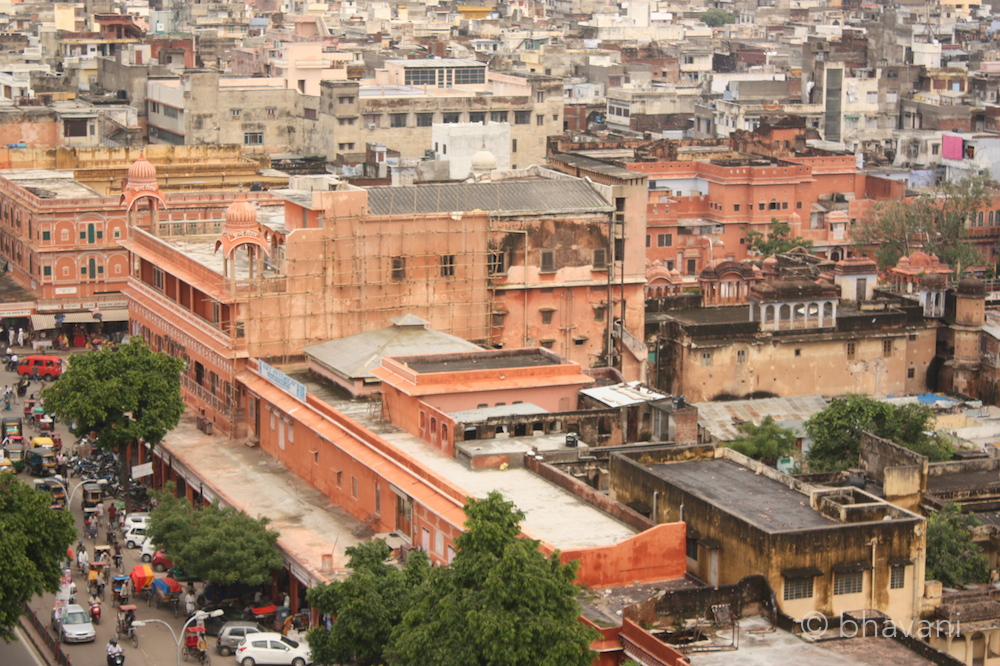
After a steep walk up, a breathless me reached the top of Isar Lat or the watch-tower. To each side spread the great city of Jaipur from the City Palace and Jantar Mantar, to Hawa Mahal and the tops of all the bazaars. On the hills surrounding Jaipur were the famous Nahargarh Fort and in the distance I could see the green grass of the Chaugan Stadium. I stood there taking in this silence of being far removed from the noise and chaos of the roads below. Peaceful. Silence… Reached into my pocket for my phone; instagram was my favourite travel companion. But it wasn’t there! I searched my jhola bag, camera bag… oh… and ran down, breathless again by the time I came out of the main entrance to Isar Lat.

 Raja was leaning against his cycle rickshaw and talking to the security guard. He looked up and said calmly, “Arrey Madam, you left your phone on the seat?”

Isar Lat Jaipur
Reflections on the passage of time. Photo by Bhavani

Isar Lat Jaipur
In the distance I see Nahargarh Fort, the pathway up to it and the temples dotting the hills surrounding this city . Photo by Bhavani

The Pink City
The pink city spreads around you in all directions! Photo by Bhavani


Visit our website to book homestays in Jaipur and the rest of Rajasthan. 

About the traveller: Bhavani is a traveller by choice, photographer by interest and writer by desire. She has crafted 12 heritage walking tours for Audio Compass and her articles have been published in Indian Express, Lonely Planet India, The Alternative and Unboxed Writers. She is in a dedicated relationship with chocolate, her husband and lower case – though confused about the order of preference! She blogs at  merry to go around and tweets @bhavan1.