Villa Wedding vs Hotel Wedding: What’s Better for an Intimate Celebration in India?

A new wave of celebrations is sweeping through India. Smaller guest lists, longer stays, relaxed itineraries and weddings that feel more personal than performative. As families shift from scale to sentiment, the big question emerges:

For an intimate wedding in India, what works better: a hotel or a private villa?

Hotels have long been the standard choice, but couples today are gravitating toward private homes. Beautiful villas where everyone stays together and the celebration unfolds over days instead of hours. Here is a thoughtful, brand-appropriate look at why the villa format is becoming the preferred backdrop for intimate weddings across India.

An outdoor wedding setup featuring a white altar adorned with flowers and drapes, surrounded by chairs on a green lawn with a beach and water in the background.

Understanding the Intimate Wedding Mindset

Modern couples are redefining what it means to celebrate together. They want:

  • A curated guest list
  • Two or three days of relaxed, meaningful time
  • Privacy instead of crowded public spaces
  • A seamless blend of stay, rituals and celebrations
  • A setting that feels personal, natural and close-knit

In this context, the venue becomes more than a location. It becomes the heart of the celebration.

The Case for Hotels: Structured, Familiar, Convenient

Hotels offer familiar conveniences that work well for large-scale weddings:

  • Standardised service
  • In-house catering
  • Reliable infrastructure
  • Accommodation and venue under one roof

These benefits matter when you have hundreds of guests and need structure.

But as weddings get smaller and more experience-led, the format shifts. A banquet hall built for 250 guests rarely feels intimate when your list is 80. Public lobbies, fixed meal slots and parallel events create a rhythm that does not align with the warmth couples now seek.

Why Private Villas Are Emerging as the Preferred Choice

1. True Exclusivity

In a villa, the entire property becomes your family’s home for the days you celebrate.
No shared lawns, no other events, no divided focus.
It is just you, your people and your celebration.

2. A Natural Multi-Day Flow

An intimate villa wedding is not boxed into event slots. Guests arrive, settle in, reconnect and move naturally through mehendi, cocktails, pheras and brunches.
Every corner of the house is part of the celebration.
Lawns, verandahs, courtyards and terraces create a fluid experience.

3. Elevated Design Possibilities

Villas offer design and decor flexibility that hotels often cannot.
Imagine:

  • a haldi by the pool
  • sunset pheras on the lawn
  • long-table dinners under the stars
  • a sangeet in the courtyard
  • a relaxed day-after brunch on the verandah

Villas allow creativity without the limits of preset layouts or vendor restrictions.

4. A Photogenic, Character-Rich Setting

A villa brings personality to the celebration.
From riverside verandahs to heritage stone walls to dense green gardens, the setting elevates both the experience and the photographs.
The home becomes a part of your wedding narrative.

5. Thoughtful Use of Budget

Intimate weddings are not about cutting back but about spending with intention.
When you choose a villa, your investment goes toward stay, food, decor and shared experiences.
You pay for what you personally use and value, not for excess capacity.

6. A More Relaxed Guest Experience

In a villa, guests stay together, linger longer and actually unwind.
They are not shuttling between rooms and venues.
They share breakfast, enjoy the pool, take mid-day naps and have long conversations.
The celebration becomes a holiday that everyone remembers.

Addressing Planning Logistics

Celebrations in a private villa do require attention to detail.
This is where curated villa brands add real value.

SaffronStays ensures that homes suitable for intimate celebrations have:

  • Verified infrastructure
  • Professional housekeeping and service staff
  • Local teams for decor, food and vendor coordination
  • Backup systems
  • Clear guidelines for sound, setup and capacities
  • Proximity to additional rooms for extended guest lists

The joy of a villa wedding is in its warmth and personalisation, and the right hospitality partner ensures the logistics remain effortless.

An intimate wedding ceremony set in a beautifully decorated outdoor space, featuring a floral backdrop adorned with pink and white flowers. The bride and groom, dressed in traditional attire, are seated in front of a small altar, surrounded by family members participating in the rituals.

Choosing the Right Venue for Your Celebration

A hotel may still make sense if:

  • your guest list is very large
  • you prefer a fully standardised, preset format
  • convenience matters more than ambience

A villa is the better choice if your celebration is meant to be:

  • close-knit
  • immersive
  • design-forward
  • multi-day
  • emotionally meaningful

The Verdict: For Intimate Weddings, Villas Have a Distinct Advantage

A hotel gives you efficiency. A villa gives you soul.

For couples dreaming of a celebration that feels personal yet luxurious, unhurried yet elegant, intimate yet unforgettable, the villa format is not just an alternative.
It is a better fit.

And when that villa is curated, serviced and celebration-ready, the experience becomes effortless, elevated and entirely your own.

Sylvan Farms: A Retreat for Sustainable Living in Mount Abu

In a time when the sounds of birdsong and the feeling of bare feet on earth are fading memories, there exists a place that gently reminds us of what truly matters.

Sylvan Farms and family dreams:

Tucked deep in the forests of Mount Abu, within the protected bounds of a wildlife sanctuary, SaffronStays Sylvan Farms is more than a homestay— it’s a living embodiment of a family’s values. Created by Shailesh Jain, a conservationist and advocate for sustainable living, the farm was never intended to be a luxury escape. Instead, it was envisioned as a home grounded in simplicity, intention, and ecology; It is a place where mornings began not with screens, but with medication, and where every meal could be traced back to the land it came from.

Originally built for the family to spend time together, to cook, to meditate, and to reconnect with one another and the land, the space actively resisted distractions of urban life. TVs were purposefully left out, and still today, guests are encouraged to disconnect digitally and reconnect spiritually.

A wooden table set outdoors at Sylvan Farms, surrounded by lush greenery, featuring a spread of breakfast items, beverages, and decorative flowers, creating a serene and inviting atmosphere.

The design reflects this philosophy: more than a villa, it’s an ecosystem of spaces that promote communal joy and personal stillness. Open balconies, shaded farm paths, and quiet corners for reflection are woven throughout the property, while common areas invite shared meals and conversation. It encourages a natural flow in harmony with light, air, and sound, all built on sustainable principles.

The pandemic and embarking on development:

During the COVID-19 pandemic, while the world halted, Sylvan Farms grew. At a time when employment in Mount Abu had nearly vanished, the family chose not to pause their plans, but to move forward with and for their community.

A picturesque sunrise over Sylvan Farms, showcasing lush greenery, palm trees, and a winding stone pathway leading through the landscape.

More than 650 local workers, many from tribal and under-resourced communities, were employed during the pandemic to help shape the land, plant trees, and develop the farm and garden. Families stayed on the property, working closely with the land and each other. The homeowners ensured they were supported with fresh produce from the farm, free medical dispensaries, and even legal aid. “We needed those people more than they needed us”, the current homeowner humbly reflects. 

This shared endeavour extends beyond labor. It’s a co-created vision. A family of locals who knew the owner’s family, understood the land, helped develop the gardens using indigenous methods. The family still lives at the farmhouse, tending to its garden and guests. Their wisdom lives in every plant, every vegetable as it is grown organically without the use of any pesticides or chemicals. 

From its inception, the goal was never to create a business, but to nurture a society where relationships and ties to the land are at the forefront. That ideal took form during the pandemic, turning hardship into opportunity and strangers into kin.

An outdoor dining area set under an expansive tree, featuring a round table with a pink tablecloth and turquoise chairs. Lanterns hang from the branches, and the table is prepared with dishes and cutlery, surrounded by lush greenery.

A farm-to-table philosophy and sustainable ecosystem:

The core of Sylvan farms is its deeply rooted farm-to-table philosophy. The land produces seasonal grains, fruits, vegetables, and spices, all grown using organic, chemical-free methods. Crop rotation maintains soil health and trade with neighboring farms (such as produce in exchange for cow dung) preserves a closed-loop, thus a sustainable farming system.

Milk is derived from nearby farms and meals are lovingly prepared with what’s grown on the land. Guests are invited to participate in harvesting, walk the farm, and even take home seeds tailored to their local soil. It’s not just a stay–– it’s education in slow living and ecological respect.

Sylvan Farms goes beyond sustainability; it’s energy positive. Solar panels generate more electricity than the property uses, powering everything from lighting to water systems. Water harvesting replenishes wells without drawing from external sources. Composting, plastic-free practices, and zero-pesticide use age further reduce environmental impact. Everything echoes how indigenous people once tended the land: with reverence, restraint, and responsibility. 

The nature, community, and Mount Abu:

A serene garden setting at Sylvan Farms featuring turquoise chairs arranged around a fire pit, surrounded by lush greenery and palm trees under a colorful sunset sky.

The garden now hosts over thirty varieties of fruit trees, thoughtfully arranged with stone pathways to guide guests through peaceful walks. Over 250 species of birds call the area home, including the elusive Green Munia, a rare delight for photographers and wildlife lovers alike. Birdwatching indexes and guided treks with local Bheel tribe members open doors to the region’s deep ecological and cultural knowledge.

At night, stargazing under India’s clearest skies connects guests with the cosmos—Mount Abu is also home to one of Asia’s highest-resolution telescopes. It’s a space for stillness and awe.

The property now supports seven families who live and work on the land. Their traditions infuse the space with meaning. A small temple on the property honors Veer Baba, a local deity. Rituals like weekly pujas and annual offerings, rooted in Rajasthani traditions of sacrifice and remembrance, preserve stories of ancestors whose names may be lost, but whose spirits are honored.

SaffronStays Sylvan Farms is not just a farm stay. It is a living, breathing example of what happens when land, people, and purpose come together in harmony.

From feeding guests from its own soil to building a sanctuary with the help of those who call this land home, from honoring local deities and traditions to healing the very ecosystem it sits within, in a world rushing forward, Sylvan Farms invites us to remember that our roots are not in concrete, but in soil. 

A serene view of Sylvan Farms in Mount Abu, featuring lush greenery, a small outdoor dining area with wooden tables, and a rustic building surrounded by trees and mountains in the background.

Come experience a way of life where the days flow with nature, not notifications. Where you wake up to birdsong, eat what’s grown on the land, and spend time with people, not screens.

This isn’t just a getaway. It’s a chance to slow down and live differently.

4 Gorgeous Luxury Homestays In Udaipur We Discovered This Year

Udaipur, the City of Lakes, is known for its royal heritage, serene lakes, and breathtaking views of the Aravalli Hills. This year, we discovered four stunning luxury homestays in Udaipur that blend cultural charm with modern indulgence. Whether you’re planning a romantic getaway, a family escape, or a celebration with friends, these Udaipur villas are perfect for creating unforgettable memories.

Pristine ManorLuxury by Fateh Sagar Lake

If you’re looking for luxury homestays near Fateh Sagar Lake, Pristine Manor is a true gem. Just a short walk from the lake, this 8-bedroom villa offers a tranquil escape with breathtaking views and a private pool. Whether it’s an intimate getaway or a grand celebration, Pristine Manor provides all the amenities you’d expect from a high-end Rajasthan villa. This homestay effortlessly marries modern design with timeless heritage for an unforgettable stay.

Villa BougainA Cozy Retreat with Scenic Views

Villa Bougain is a boutique homestay in Udaipur that promises a peaceful escape. With just two elegant bedrooms, this villa is perfect for an intimate getaway. Enjoy a private plunge pool, BBQ area, and entertainment options like a projector, board games, and music speakers. The villa is also perfectly positioned for exploring Udaipur’s nearby attractions, including the Nathdwara Temple and Lakhawali Lake. Its combination of rustic charm and modern luxuries makes it an ideal spot for anyone seeking tranquility.

Camelot by the LakeA Nature-Filled Escape Near Udaipur

Located just 12 km from the heart of Udaipur, Camelot by the Lake offers stunning views of Lakhawali Lake and the surrounding mountains. With lush gardens and glass-walled bedrooms, this villa near Udaipur provides a modern yet cozy ambiance. Guests can enjoy a bathtub, board games, a projector, and even table tennis. Perfect for couples or families, this homestay is a harmonious blend of nature and comfort, with easy access to Udaipur’s attractions.

Villa Rohi– A Poolside Escape with Cultural Landmarks Nearby

Villa Rohi is a 4-bedroom luxury homestay in Udaipur that offers something for everyone. Spend your evenings by the pool or huddle around a cozy bonfire with friends and family. Its location is a huge plus—you’ll be close to popular attractions like Sajjangarh Palace, Lake Pichola, Fateh Sagar Lake, and Bagore Ki Haveli. For travelers looking for a vibrant blend of relaxation and cultural exploration, Villa Rohi is the ideal choice.

Rajasthan: 3 reasons to visit post August!

Its palaces and forts are reminders of the many great kingdoms; its people adore the colors of religious festivals and the first rains transform this land. Ever thought of visiting Rajasthan post July? Three reasons why you MUST visit here are Monsoons (yes, rains)festival of lights, i.e., Diwali and third reason being, its an ‘off-season’, so its the best time to beat the crowds.

India’s very own desert turns into a home to flora and fauna and abstract beauty in its own during rainfall. The fortresses, when lit up with lights, touch the sky with its beam, well almost. The fiesta of lights is nearing, and it’s  one of those festivals that ties people from almost every religion, caste and community together. These 11 places across Rajasthan will bring out the best of monsoons and the festival that follows.

UDAIPUR

The City of Lakes, has romance stretching away in every direction, from Lake Pichola which shimmers full of life during monsoons, to Aravalli Hills setting an unmatched location across India.  The boat rides on the lake, hustle of its age old bazaars, the tempting food shops, and ever so colorful clothes, do justice to its tag, ‘most romantic destination of India’.  This city is specifically very famous for its beautiful lakes and water bodies with all the greenery around, come alive in the rains! During monsoons, the sky remains dark and overcast, the temperature falls and long drives along the stretch of the lake city at Rani road or Badi lake will make you fall in love with it.

# 1 Detox yourself in the old city of Udaipur

Wondering where you could stay to experience all of the above? A two floor apartment with its own private roof terrace, located amid the old city of Udaipur is a retreat for anyone looking to spend time in a quiet place. Facing the Lake Pichola, the sunset gives an amazing view from the terrace.

Click here to know more about this lakeside apartment in Udaipur

# 2 Rediscover your love for Lakes in Udaipur

All your life you might think that you have had enough of beaches and lake views. Oh no! You are so mistaken till the time you spend at least a day at this place facing Pichola Lake. Imagine spending your time in an apartment that is located on the banks of this lake which provides an uninterrupted view of City Palace, Aravalli Hills and the Lake Palace.

Click here to know more about this lake facing rooms in Udaipur

# 3 Rejuvenate yourself at the Lakeside Villa

This lakeside Villa gives a simple yet beautiful view from your doorstep. The serene view makes this an ideal place to relax and spend your time sipping on your cup of tea, reading a book or conversing with your beloved or just sit there looking over the lake.

Click here to know more about this place

# 4 Experience a day in a Royal Palace in Udaipur

Surrounded by Aravalli ranges, you can spend hours by embracing the calmness of Fateh Sagar lake while sitting in your room or in the lush green lawns. In addition to the breath taking location of the Villa, it also has a private collection of vintage and classic cars which add up to the royal lifestyle.

Click here to know more about this Royal Villa in Udaipur

AJMER

A popular stop over on the Udaipur-Jaipur route, Ajmer is among the most important religious sites in India. Surrounded by tranquil lake of Ana Sagar, this is the 5th largest city of Rajasthan and the most important in terms of Islamic history. It is a home to the shrine of Khwaja Muin-ud-din Chishti, most important pilgrimage centres for Muslims.

# 5 Spend your time looking over Anna Sagar Lake in Ajmer

What feeling it did be like to sit in your balcony with a mug of hot chocolate and watch the running water at Anna Sagar Lake! If you are in a need for some solitude away from the hustle bustle of your daily routines, this place at Ajmer is a real rescue partner!

Click here to know more about this stay in Ajmer

# 6 Witness the warmth of a Rajasthani family in Ajmer

A British Colonial Bungalow with varied roof line which hints at cool, high-ceiling interiors protected from the hot desert air by thick walls and deep, shaded verandas, is a birdwatcher’s paradise with its small tranquil garden at the back of the lawn, while the house is approached across a large front lawn.

Click here to know more about this stay

JODHPUR

Jodhpur is famous for its architecture and the city shares a vibrant culture with its guests. The second largest city of Rajasthan has a beautiful past. The city that is known for its blue building actually has a historical reason behind it, meaning, the blue color years ago was chose to represent that the family belongs to Brahmin’s community.

# 7 Spend your Diwali like a Royal would do at Jodhpur!

This famously known as old city has to offer you a eighty year old residence located in a peaceful, well connected area. It stands as an oasis of hospitality and warm Rajput charm. Don’t be taken aback by its old world elegance for it comes with the modern comforts of a classic heritage property and the essence of being a guest of the family. Where else can you find a homestay that has a restaurant, swimming pool, a private lounge and a lush green lawn all under one roof? Now that’s a royal lifestyle!

Click here to know more about this place in Jodhpur

PUSHKAR

Besides Diwali, Pushkar is home to a very enchanting cultural festival, “Pushkar mela”, in the month of November where people come out of their houses, all decked up in beautiful clothes and ornaments, music in the air and lights everywhere.

# 8 Because at Pushkar brick houses are real!

Where we are surrounded by concrete jungle from every side, there is this holy place set in the arms of Rajasthan where you will find not one or two but majority of brick houses. Ever thought of spending your monsoon under a roof that smells so full of moist and mud? But wait until you spend one rainy day here and you might forever love the fragrance of rainfall.

Attending Pushkar Festival, November 2015? Click here to know where to stay!

JAIPUR

Rajasthan is popular for its festivals every year. Jaipur, specifically, boasts of the ‘Best Diwalis’ in the country. It paints the city red with red-topped turbans, painted Elephants, decked up Camels, candle lit balconies, and the sky filled with fire crackers! The famous monuments like City Palace, Jantar Mantar, Gopinathji Temple as well as Shopping areas are all lit up with colorful lights, lanterns and rangolis’.

# 9 Experience the ‘Best Diwali’ in the country in the Pink city

Spend your time at a Heritage Haveli situated in the Jaipur city, which gives you a glimpse and feel of the hustle and bustle of the people of this ancient city. The terrace offers an enthralling view of the famous Nahargarh Fort perched on the hilltop overlooking the Haveli.

Click here to know more about this place in Jaipur

# 10 Get drenched with locals in Jaipur

Rural people of Rajasthan would be more than honored to welcome you for a homestay. Given that it is pouring in Jaipur, the pink city, or a festive season, they are bound to be happy,  and would gladly invite you over for a family goath, i.e. family outing / dinner. Spend some quality time with the local family and get a taste of their regular life.

Click here to know more about this stay at Jaipur

JAISALMER

The desert city of Jaisalmer is known for its golden fort perched on top of a small hill. The city offers a lot of fairytale sights which could keep the photographer in you busy! This place is a desert mystery, it is sound and remote but very famous among the tourists. One can have a laid back stay at the sand dunes where camel rides is a famous mode of transport.

# 11 Camping in the interiors near Sand Dunes in Jaisalmer

This old-styled house located in Khuri village, 45 kms away from Jaisalmer, is a place which is in close proximity of Sand dunes, Desert National Park and Godawan Bird Sanctuary. If you are craving Rajasthani food, you could stay here, spending lazy time, laying on the ground, gazing at the sky, camping under the stars in Khuri village.

Click here to know more this place in Jaisalmer

There are enough places for you to pick your suitable desires and plan before the city runs out of festive enthusiasm! Plan your holiday at majestic Rajasthan, the King of lands, a must-see state of India!

Click here to check all stay options in Rajasthan

P.S. Cover Photo Credits: http://www.diwalidussehra.in


About the Author:

Keenjal Patel

A reader at mind, a writer at heart, a believer at soul and an achiever overall, is what she want to be. She loves to express through words. She’s a firm believer that imagination rules the world and the day this world absorbs the essence of her words, that would be a day of pride for her!

A Glimpse of Rural Rajasthan

Homestays in Bishnoi

Having spent ten days in four beautiful, vibrant cities of Rajasthan, I wanted to experience its rural life before heading to Udaipur, my last destination of the trip. That is when I met Dhanraj, an enterprising and friendly local who organises safaris to a few villages in the Marwar region of Rajasthan. He welcomed me to his sprawling Farm house in Jhalamand, a Bishnoi village that lies a 20 min drive away from Jodhpur. The house stood there surrounded by farms, a garage lined with exquisite Jeeps and a shed that was home to two beautiful Marwari horses. His family shared that space with that of his brother’s and they all warmed up to me at the very instant.  A brief chat and a hearty breakfast of hot aloo parathas and a glass of Lassi later, I started my village safari.

Here is a glimpse of the day that followed:


Homestays in Bishnoi

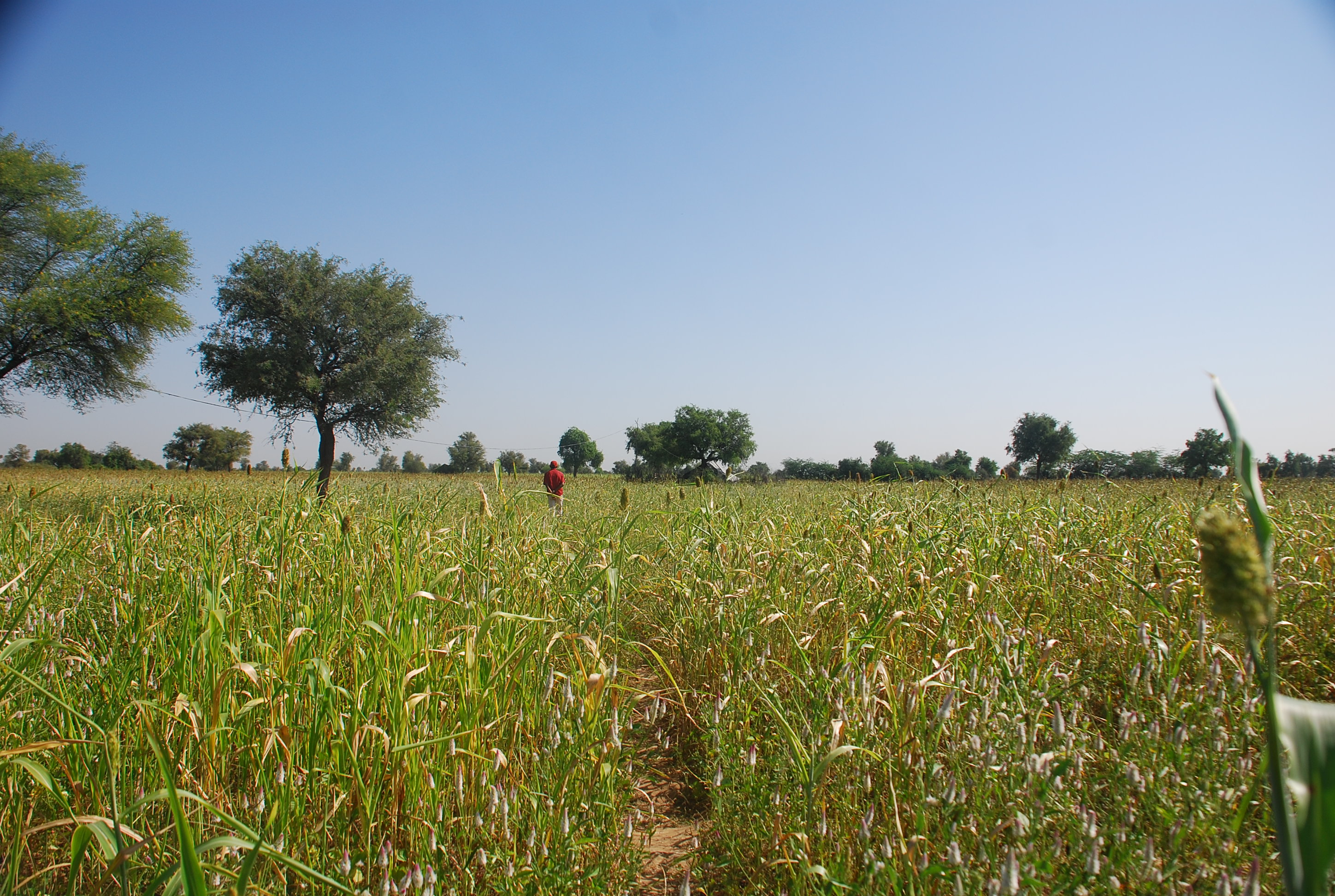
I followed Dhanraj as he took me for a walk through the vast millet fields of Guda Bishnoi village. The community is known to worship nature and for its beliefs in the conservation and protection of all forms of life.

As we parked our vehicle and walked our way to one of the farmers’ houses, it lay empty as the entire family was busy in the fields. It was harvest season and the family had moved to a make-shift tent under the shade of a tree. As I sat down with them, they offered me a cup of hot sugary tea, and even though neither of us understood the language the other spoke, there was a warmth in their company. The youngest bride then offered to show me another make-shift tent that lay at a distance. To my surprise, it was complete with a Cable TV, refrigerator, table fan and cupboard! She then pulled out a large photo album from a steel suitcase – her wedding album – and smiled as she handed it to me.


DSC_4342

DSC_4336

The village of Chota Guda is home to the Raika or Shepherd community of Rajasthan. The community is known to lead a semi-nomadic life and for their ability to handle large herds of animals in the harsh environment. While they traditionally bred and managed camels for the Maharajas for hundreds of years, they now manage herds of sheep and goats as well. While I was there, the children were very enthusiastic about showing me around their houses, most of which were simple one room establishments with a small fenced space for the sheep outside. These kids, used to tourists visiting their homes time and again, were more camera friendly than I had expected!


DSC_4366

Singhasni village is one of the places where some of Rajasthan’s finest pottery comes from. In a display workshop set up for tourists, I met Nizammudin, who created some beautiful clay elephants, puppets and vessels with such ease.


DSC_4371

In the same workshop space, I met Nathu Khan, a young man of the Chippa community which is know for its block painting skills. I heard him explain the way vegetable dyes are used to turn simple handloom cotton into works of art. He spread out colorful bedsheets in front of me, each more beautiful than the other, and showed me the casts that were used to create imprints on them.  The international tourists buy his bedsheets in bulk, he said, and I could see why.  Interestingly, he also turned out to be a Harry Potter fan!


Homestays in Bishnoi

The last village that I visited was Salawas – home to the weavers community that makes carpets and wall hangings using cotton, silk and camel hair among other things. Leela Dhar sat there with a radio and hummed to himself as he worked on a carpet that he said would take another week to finish. He dejectedly spoke of juggling between farming and weaving owing to the work being too slow and tiresome, but immediately lit up as Dhanraj spoke of the time he’d made a carpet that was 150 feet long, ordered to be used for the staircase in Buckingham Palace!


Homestays in Bishnoi

While I travelled before the Siberian cranes perched themselves in Guda Bishnoi Lake, one of my colleagues, Tejaswinee, was there recently and was lucky enough to enjoy this sight with her family.


Bishnoi homestay

photo 1 (2)

After my safari, I went back to Dhanraj’s farm house and spent the rest of the evening sitting on a Charpai and  discussing everything from pets to adventure sports to education with his little kids. The day went by too soon but it is one that I most fondly remember from my trip.

Oh, and if you’re a fan of good looking automobiles, the picture above is that of a Russian UAZ, a jeep once used by the Soviet Army and acquired by Dhanraj owing to the vast reliable network of jeep enthusiasts that he is friends with.


My safari was arranged by Mr. Dhanraj of Bishnoi Village Safari Private Tours. You can book your safari by reaching him at +91 9829126398 or by visiting their website www.bishnoivillagesafari.com.


About the Traveller: Born and raised in Assam, Sarita Santoshini has been travelling around India and penning down her experiences over the past year. She currently works as the Content Editor for SaffronStays. You can read more of her travelogues on her blog- http://crumbsfromyourtale.wordpress.com.

A Cycling Introduction to the Pink City of Jaipur

The Pink City

By Bhavani

“The city was not always pink!” Raja, my guide, drawled in a voice that was laced with the smell and colour of pan. My guide was a cycle rickshaw driver. He had persuaded me to a quick tour around the walled city laced with many stories—all for Rs. 200.

“They say,” he continued, “that Queen Victoria was visiting long ago. The Maharaja believed that pink was the colour of hospitality. He ordered the entire city to be painted in pink!:

“What! I thought it was about the stones!” I exclaimed. He simply shrugged it away.

By then, we had reached the massive gates to enter the walled city… Centuries ago elephants would have passed through but today cars, autos and two-wheelers honk their impatient way into the heart of Jaipur.

Cycle rickshaw in Jaipur
Cycle rickshaws still ply inside the walled city and are a sustainable way to get around. I tend to tip big for the effort involved. Photo by Bhavani

Jaipur Sanganeri Gate
There are three gates along MI Road each as beautiful as the other. Photo by Bhavani

“You see, this was the first city in the plains, otherwise all the cities used to be in the hills. Maharaja Sawai Jaisingh II took double precautions to keep his kingdom safe. He had check-posts high in the hills to keep a lookout for an approaching enemy. And these walls are 3 metres thick and 6 metres high! There are seven gates though a couple were built later.”

We entered from the Ajmeri Gate, went along Nehru Bazaar and then Bapu Bazaar, both lined with a neat row of shops on either side, till we reached Sangameri Gate. “This is the famous Johari Bazaar,” he said. “Do you have money?”

“Huh?”

“This bazaar is famous for gold and silver jewellery. If you don’t have money you can buy some cheaper costume jewellery.”

“No, let’s continue,” I said, still shaken by the first question!

Jaipur Bazaar
A view of the bazaar from over my guide’s shoulders. Photo by Bhavani

Bazaars of Jaipur
The bazaars are quite organised and demarcated by the goods they specialise in! Photo by Bhavani

JohariBazaar
It all looks deceptively simple from the outside, but your wallets will get emptied inside. Photo by Bhavani

Cycling up Johari Bazaar, Raja pointed out the important landmarks…

“And there is LMB Sweet shop, don’t forget their famous ghewar before you leave the city. It will stay good for three to four days. Now keep looking to your left… You will see Jama Masjid… It’s pretty no? And now we have reached Badi Chaupar, the main square of Jaipur… there were underground pipes and people could get water through the year!”

Aqueducts, I thought. Wow, there were aqueducts here more than two hundred years ago. His voice trailed away as he continued cycling through this mad intersection of vehicles, people, noises and my thoughts!

Jama Masjid Jaipur
In a line of similar looking buildings squashed together, Jama Masjid stands out with its minarets and painted work shining against the pink. Photo by Bhavani

Before I knew it, we had reached Hawa Mahal. The facade of bright pink balcony like structures, each decorated and shimmering in the bright sun. It took my breath away.

“There are around 500 tiny windows they say, so the hawa (or breeze) is very nice inside. The Maharanis would peep down from those little windows and look onto the streets… they were not allowed to step out.”

I quickly looked up, looking for that Maharani but all I saw was design and beauty.


Hawa Mahal
It feels as dainty as a cardboard set, but has stood here for 200 odd years! The world goes on around it, but this monument stands as a testament to a more beautiful time. Photo by Bhavani

I was to come back later to soak it up at length, so Raja continued till we reached Tripolia Gate or the Triple Gate.

“You know, my father used to tell me that if a commoner used this gate, something bad would happen. This gate is only for the Royalty… you cannot enter from here!”

I looked at the light yellowish gate in front of me through my lens and suddenly there was an angry policeman waving his hands and shouting at me, “Arrey, what are you doing? Nahi nahi… no no… Don’t click photos here!”

Tripolia Gate Jaipur
This light yellow gate stands out against the pink surroundings. Photo by Bhavani

A short distance away, through a gate meant for commoners, was the City Palace and closeby, Jantar Mantar. But that was for later in the day. Instead Raja turned into a doorway, took an immediate left, continued till he stopped in front of a board that read Isar Lat. “Go up, you will see all of Jaipur. The tour is over Madam.”

“Where did you learn all the stories from?” I asked as I paid him.

“I pay attention to the guides when they come in my rickshaw. It’s not that difficult.”

An enterprising young man for sure! I thanked him, wished him well and bought myself an entrance ticket.

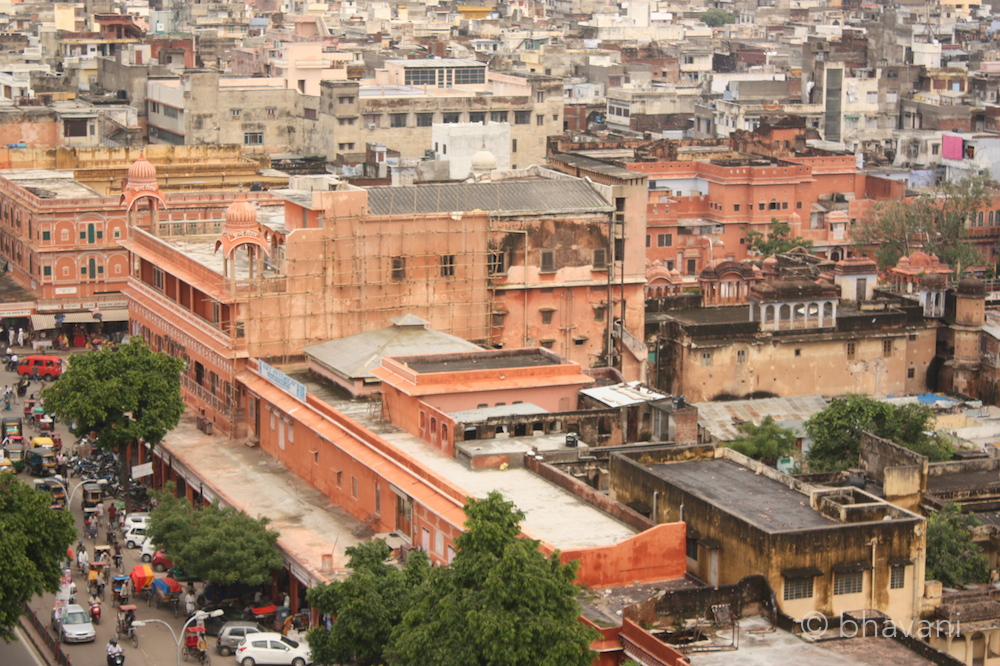
After a steep walk up, a breathless me reached the top of Isar Lat or the watch-tower. To each side spread the great city of Jaipur from the City Palace and Jantar Mantar, to Hawa Mahal and the tops of all the bazaars. On the hills surrounding Jaipur were the famous Nahargarh Fort and in the distance I could see the green grass of the Chaugan Stadium. I stood there taking in this silence of being far removed from the noise and chaos of the roads below. Peaceful. Silence… Reached into my pocket for my phone; instagram was my favourite travel companion. But it wasn’t there! I searched my jhola bag, camera bag… oh… and ran down, breathless again by the time I came out of the main entrance to Isar Lat.

 Raja was leaning against his cycle rickshaw and talking to the security guard. He looked up and said calmly, “Arrey Madam, you left your phone on the seat?”

Isar Lat Jaipur
Reflections on the passage of time. Photo by Bhavani

Isar Lat Jaipur
In the distance I see Nahargarh Fort, the pathway up to it and the temples dotting the hills surrounding this city . Photo by Bhavani

The Pink City
The pink city spreads around you in all directions! Photo by Bhavani


Visit our website to book homestays in Jaipur and the rest of Rajasthan. 

About the traveller: Bhavani is a traveller by choice, photographer by interest and writer by desire. She has crafted 12 heritage walking tours for Audio Compass and her articles have been published in Indian Express, Lonely Planet India, The Alternative and Unboxed Writers. She is in a dedicated relationship with chocolate, her husband and lower case – though confused about the order of preference! She blogs at  merry to go around and tweets @bhavan1.