
Udaipur earns both of its epithets honestly. The City of Lakes needs no explanation once you’ve watched the sun drop behind the Aravallis from a rooftop above Lake Pichola, and Venice of India holds up rather than embarrasses itself, water running through this city’s identity the way canals run through the other one. But there’s a third description that explains more about Udaipur than either of the famous two: this is a city built by an unbroken instinct for art, four centuries running, an instinct that turned palace walls, temple havelis and roadside workshops into canvases long before either nickname existed.
This is the Udaipur art and heritage story most visitors miss, the one where the real souvenirs aren’t in the shops but in the stories behind them.
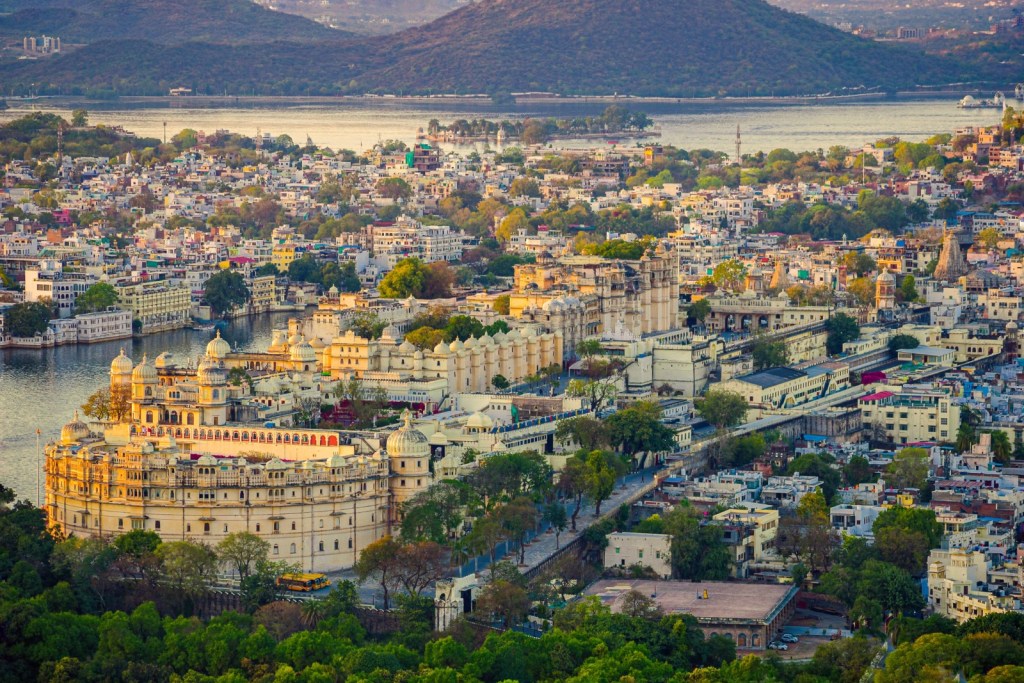
Table of Contents-
The History of Udaipur: A City Built Beside Water, and Beauty That Followed
In 1559, Maharana Udai Singh II chose a valley ringed by the Aravalli hills and fed by a natural stream to build his new capital. Legend has it a hermit meditating above the water pointed him to the exact spot. Whether or not that’s true, the Maharana had an eye for it: a lake at the centre, hills on every side, a setting that felt as much like a retreat as a capital.
Over the next few centuries, his successors kept adding to that water, lake after lake, each one commissioned by a different ruler with a vision of his own: Fateh Sagar, Udai Sagar, Swaroop Sagar. What began as practical planning slowly became something closer to a design philosophy: build near water, let the water reflect what you build, and let the whole city feel unfinished without art and grandeur woven into it. Palaces and hunting estates grew in scale to match the setting, many of them still standing four hundred years later against the same Aravalli hills, built at a scale meant to be lived in, not merely admired from a distance.
Mewar Miniature Painting: The Art That Became the City’s Identity
Somewhere inside the City Palace’s old ateliers, the Mewar school of miniature painting began to take shape, and it remains one of India’s most distinctive painting traditions. The style is immediately recognisable: bold reds and deep golds, elongated figures with large, expressive eyes, scenes drawn from the Ramayana, the Bhagavata Purana and courtly life, rendered in extraordinary, jewel-like detail. This was not art reserved for private collectors. It decorated palace walls, court manuscripts and everyday royal life, a visual language the Mewar rulers used to express identity, devotion and pride in equal measure. The technique itself is exacting: squirrel-hair brushes and pigments traditionally drawn from minerals and plant matter, built up in layers fine enough to survive four centuries of scrutiny. Walk into the old city’s heritage havelis today, Rang Havelii among them, and a room or two is still worked entirely in this style, hand-painted rather than reproduced, a living demonstration of miniature art that most visitors otherwise only see behind museum glass.
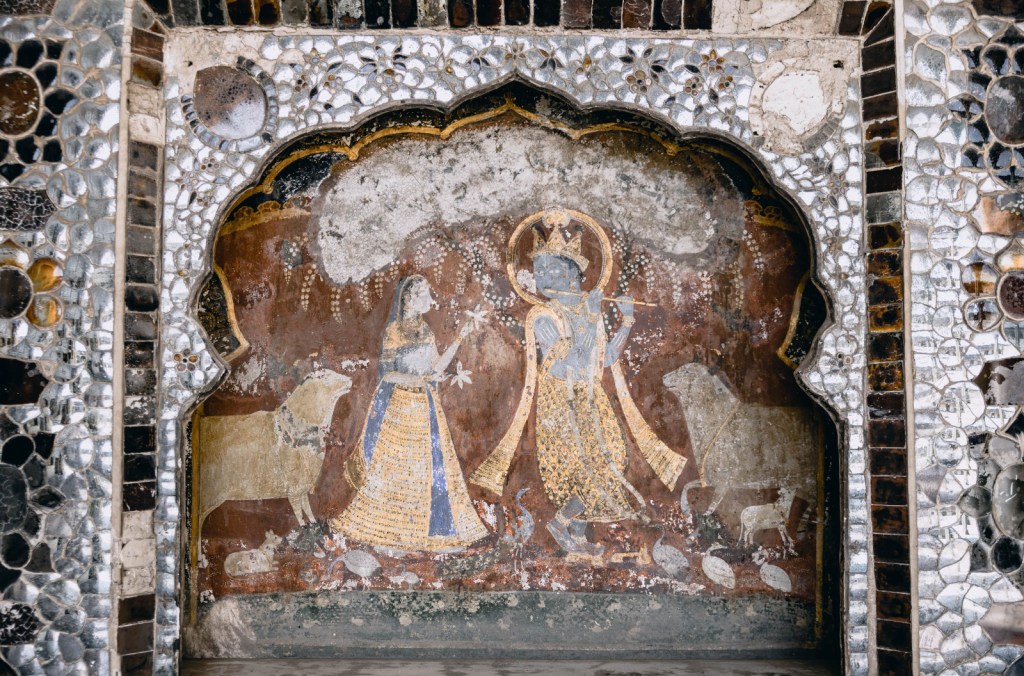
Not far north of the city, in the pilgrim town of Nathdwara, a parallel tradition was flowering. Here, generations of artists have painted Pichwai: large, intricately detailed cloth paintings hung behind the sacred idol of Shrinathji, changed with each festival and season. Painted in deep blues and warm ochres, with lotus ponds, peacocks and gopis rendered in painstaking detail, Pichwai painting is still practised today almost exactly as it was centuries ago, by families who have passed the craft down without interruption. Spend an afternoon with a Pichwai artist in Nathdwara itself and you’ll understand why collectors around the world now consider a single handmade piece an heirloom.
| Art here was never meant to sit behind glass. It was meant to be lived with, worshipped alongside, carried through the streets, and passed down at the family dinner table. |
Why Gujarat Keeps Coming Back to Udaipur
Shrinathji, the deity behind Udaipur’s most treasured art tradition, is also the presiding deity of Pushtimarg, the Vaishnav devotional path followed by millions of Gujarati families for generations. The Nathdwara temple, however, was never only a place of worship. Its havelis are Pichwai galleries in their own right, redressed and repainted with every festival, the deity dressed and decorated eight times a day as part of ritual seva, a practice that turned devotion itself into a living art form. For Gujarati Vaishnav households, this is not distant heritage. Many keep their own small shrines at home, modelled on Nathdwara’s, with Pichwai backdrops passed down the family the way jewellery or land might be elsewhere. The art is the identity, carried from temple to household and back again for generations.
This is what makes a trip to the region feel like a double homecoming for many travellers from Ahmedabad, Surat and Vadodara: darshan at Nathdwara, followed by a few days in Udaipur surrounded by the same devotional art that fills their own homes. It is part pilgrimage, part heritage trip, and an easy one, with Udaipur a straightforward drive up NH48 from Ahmedabad, comfortably done over a long weekend.

When the City Palace Lights Up
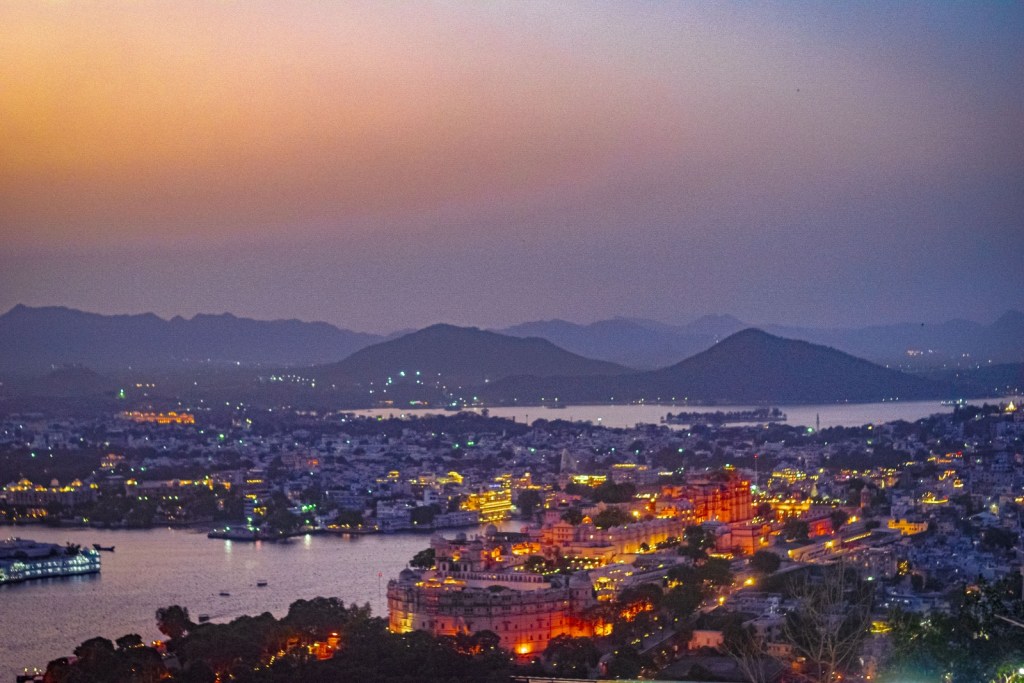
Udaipur after dark has its own rhythm, built around the same instinct that shaped everything else in this city: performance as much as painting. At Bagore Ki Haveli, an eighteenth-century mansion on the Pichola waterfront, the nightly Dharohar show sets Rajasthani folk dance against a restored courtyard, building to a dancer balancing seven brass pots on her head. A sunset boat ride timed to the City Palace’s evening illumination remains one of the simplest, most reliable pleasures in the city, the whole structure turning gold and then white against the dark water.
Some evenings, the better plan is not to go anywhere at all. A few of Udaipur’s heritage havelis have quietly built their own version of that same evening indoors: floor seating laid out on a rooftop, a Rajasthani thali served by candlelight while the City Palace lights up across the skyline, a Sarangi player or a Kalbelia dancer arranged for the night on request. Rang Havelii’s rooftop, sitting close enough to watch that illumination directly, is set up for exactly this kind of evening. Further out against the Aravallis, at estates like The Shikargarh Palace, the same instinct shows up differently: folk musicians and local performers, arranged for the evening in a four-hundred-year-old courtyard built for royal hospitality long before it hosted paying guests. Either way, the show that draws crowds to the waterfront each night has quieter, more private versions scattered across the city, for travellers who would rather stay in than go looking for it.
The Crafts Made for Living, Not Just Looking
Some of Udaipur’s most remarkable art was never destined for a gallery wall at all.
About two and a half hours from the city, in the small town of Bassi near Chittorgarh, artisan families have spent four hundred years making Kavad: wooden shrines that fold open like a storybook, each panel revealing another painted scene. Traditionally, a Kavad was carried from home to home, opened one fold at a time while its story was narrated aloud, making it one of the only Indian art forms designed to be performed rather than simply displayed. A hand-carved Kavad from Bassi sits in the common areas at Rang Havelii, one of the old city’s heritage havelis, less a decoration than a conversation starter for guests who ask what it is. Watching one opened in person is closer to theatre than craft demonstration, and the form remains rare enough outside Rajasthan that a single viewing justifies the detour on its own.
In the village of Molela, potters shape terracotta plaques of deities in striking high relief, using techniques found almost nowhere else in the country. In Bhilwara, Phad painters create vast narrative scrolls celebrating local folk heroes, traditionally unrolled and sung by travelling performers under moonlight. And inside Udaipur itself, Thikri, a mirror-inlay technique using cut glass set into plaster, was developed to catch candlelight and multiply it across a room, turning ordinary havelis into something that shimmered long after dark, a detail still worked into old-city interiors today.
Where Udaipur’s living crafts are made:
| Craft | Origin | Distance from Udaipur | Best Experienced |
| Mewar miniature painting | City Palace ateliers, Udaipur | In the city | City Palace art gallery; a handful of old-city havelis keep a room worked entirely in the style |
| Pichwai painting | Nathdwara | ~45 km, about 1 hour | Artist studios and havelis around the Shrinathji temple |
| Thikri mirror inlay | Udaipur and the wider Mewar region | In the city | Old-city heritage havelis with candlelit mirror-glass rooms |
| Molela terracotta | Molela village, Rajsamand district | ~50 km, about 1–1.5 hours | Potters’ workshops in the village itself |
| Kavad shrine-making | Bassi, near Chittorgarh | ~115–140 km, about 2.5 hours | Artisan workshops in Bassi; a finished piece on display in old-city havelis |
| Phad scroll painting | Bhilwara belt | ~148 km, about 2.5–3 hours | Shilpgram demonstrations (Udaipur) or artisan studios in Bhilwara |
Together, these crafts make the same argument about this part of Rajasthan: craftsmanship here was never confined to a workshop or a gallery. It moved through processions, sat inside family shrines, and passed from hand to hand long before anyone thought to call it heritage.
| TRAVELLER ADVISORY • Most artisan workshops in Bassi, Molela and Nathdwara are working homes, not formal galleries — call ahead or go through a local guide rather than arriving unannounced. • Morning visits (before noon) are best for watching potters and painters actually at work, especially in Molela. • October to March is the most comfortable window for day trips to Nathdwara, Bassi and Bhilwara; summer heat makes the longer drives (Bassi, Bhilwara) considerably harder. • Buying directly from an artisan’s workshop, rather than a city-centre shop, generally means a fairer price for the maker and a more reliable account of the piece’s origin. |
Where to Go Looking for It
Experiencing Udaipur’s art and heritage rewards a slower pace than most itineraries allow. The City Palace’s art gallery is the logical starting point, showing Mewar miniatures in something close to their original setting. Shilpgram, a crafts village just outside the city, brings artisans from across Rajasthan and neighbouring states together under one roof, often demonstrating their craft live. Ambrai Ghat’s stalls are well suited to browsing marble inlay and stone carving at every budget. And for anyone with a free morning, the drive to Nathdwara justifies itself, not as a curated tourist experience, but as the rare chance to watch Pichwai painting happen in the town that gave it its name.
Udaipur repays close attention. Beyond the lake views and palace domes is a city that has spent four centuries turning devotion, storytelling and everyday craft into art worth crossing the country for, an instinct its old quarters still carry in nearly every wall you pass.
| STAY INSIDE THE STORY Udaipur’s heritage havelis and estates put you within walking distance of the craft traditions in this piece — from old-city rooms built around a single art form to rooftop evenings under a lit-up City Palace. BROWSE VILLAS IN UDAIPUR → |
Frequently Asked Questions
What is Udaipur famous for in terms of art and culture?
Udaipur is best known for the Mewar school of miniature painting, its Thikri mirror-inlay work, and its proximity to the Pichwai painting tradition of Nathdwara. The City Palace and its ateliers were the historical centre of this artistic output, and several of these traditions are still actively practised in and around the city today.
What is Pichwai painting and where can I see it near Udaipur?
Pichwai is a large, intricately detailed cloth painting hung behind the idol of Shrinathji, traditionally produced in Nathdwara, about 45 km and roughly an hour from Udaipur. Artists in Nathdwara still paint in this style, changed with each festival and season, and a handful of Udaipur’s heritage havelis display commissioned pieces sourced directly from Nathdwara artists.
What is the Mewar school of miniature painting?
Mewar miniature painting is a distinctive Rajasthani painting tradition that developed inside the Udaipur City Palace’s ateliers, known for bold reds and golds, elongated figures, and scenes drawn from the Ramayana, the Bhagavata Purana and courtly life. It differs from the more widely known Mughal miniature tradition in palette and subject matter.
Where does Kavad art come from?
Kavad shrine-making comes from Bassi, a small town near Chittorgarh roughly 115–140 km (about 2.5 hours) from Udaipur. A Kavad is a wooden shrine that folds open panel by panel, each one revealing a painted scene, traditionally narrated aloud by travelling storytellers.
Is Udaipur a good weekend trip from Ahmedabad and Gujarat?
Yes. Udaipur is a straightforward drive up NH48 from Ahmedabad, commonly done as a long weekend, and it holds particular significance for Gujarati Vaishnav travellers because of its proximity to the Nathdwara temple, the seat of the Pushtimarg devotional tradition many Gujarati households follow.
What is Thikri art?
Thikri is a mirror-inlay technique native to Udaipur and the wider Mewar region, in which small pieces of convex mirror and coloured glass are cut, polished and set into plaster to catch and multiply candlelight across a room. It’s still worked into interiors in the old city today.
What does Udaipur’s evening and nightlife look like?
Evenings in Udaipur centre on performance: the nightly Dharohar folk dance show at Bagore Ki Haveli, sunset boat rides timed to the City Palace’s evening illumination, and lakeside dining. A number of heritage havelis and estates also offer in-house versions of this, from rooftop dinners to on-request folk musicians.