10 Treks In India That’ll Make You Fall In Love With Monsoon

It’s monsoon time, the most awaited time of the year. The skies turn grey, and a bright green cover is what you see everywhere. It’s also the perfect time to set out on a trail to the hills enveloping the countryside. Trek through the rocky terrain, lush green forests and steep steps and visit the marvellous waterfalls. It’s the time when nature offers you its best side. Here are some popular and easy treks in Maharashtra you can take part in to feed your adventurous bones! Save this handy guide for when the lockdown ends.


Head to SaffronStays Niramay, Velhe, a 2-hours drive from Pune, and set out for a small trek that takes you to a spot from where you can enjoy beautiful panoramic views of the Bhatghar Dam. This 3-bedroom villa is also located close to the Torna and Rajgad Forts, a favourite among trekking enthusiasts during the monsoon season. While staying at this home, you can also head for a long drive to Madhe Ghat and catch spectacular views of the waterfall there.


If you plan to head to the strawberry capital this season, then SaffronStays Redfields by Venna River, Mahableshwar, should be your obvious choice of stay. This veg-only 3-bedroom private villa in Mahabaleshwar, overlooking verdant mountains and strawberry farms, is just 5 minutes from the famous Lingmala Waterfall. A short serene trek from this lovely home to the Lingmala Waterfall is a visual treat and is ideal for photography enthusiasts. On your return, you can unwind with a fresh cup of chai or coffee and later experience the scrumptious farm-to-table meals.


Heading to Karjat in the rain is another alternative you can think of. In the misty weather, a drive through the winding hills roads lands you at SaffronStays Sundowner, Karjat, an 8-bedroom private pool villa. Situated at the end of Karjat amid hills and near Morbe Dam, this villa is a perfect choice for the season. A short trek up the hill right next to the estate gives you a breathtaking view of the Morbe Dam. You could also head to the Katwan Mountain View Point, which is 20 mins from the home or hike through the waterfall and embark on the Palasdari Fort trek. During monsoons, you can enjoy blissful views from the Umroli Waterfalls.


Another gorgeous home surrounded by the towering Sahyadris that you could head to, is SaffronStays Olive Greens, Karjat. This 4-bedroom pool villa with verdant, lush greenery is a great choice at this time of the year. If you choose to stay here between August to October, you can catch fireflies and witness stunning waterfalls on every mountain around the villa. Trekking enthusiasts can opt for a guided trail walk or trek to Kondana caves to explore the cultural heritage of Maharashtra. Alternatively, you visit the nearby Ulhas river and just sit by and enjoy by the riverside.


If a visit to Alibaug is on your list this monsoon, SaffronStays Sunglade, Kashid, should be your choice of stay. Not too far away from the city of Mumbai, at the top of a hillock, overlooking the ocean and on the edge of a wildlife sanctuary, this five-acre estate is skirted by a stream from around the back that gurgles during the monsoon season. The Janjira Fort in the middle of the ocean is close to this Wadi-style home. You could also take a trek to the Reserve Forest (Phansad Wildlife Sanctuary) during your stay here.


While in Alibaug, staying at SaffronStays The Forest, a nature retreat, is another choice you make. Feel the adventure of living in a forest and trek down to the nearby lake, which is only accessible to the locals of village Bhal. A local guide from the village can escort you on this trek to ensure you don’t get lost along the way.


Travel enthusiasts do not restrict themselves to locations. So this monsoon, if exploring a different destination is on your list, then SaffronStays Nandanvan Estate, Kodaikanal, should be one option you should consider. Engulfed in a 35-acre organic coffee plantation, this 3-bedroom pet-friendly estate was established with the sole objective of enjoying an exceptional cup of coffee with family and friends in the lap of nature. You can enjoy a leisurely trek on the estate or even plan a picnic by the stream. Birdwatchers, keep your binoculars handy and be ready to spot around 30-40 species of birds. You may even spot a herd of elephants, bison or mouse deer as you trek through the woods. The estate has multiple trails around where guests can wander.


If you wish to head further down to the state that announces this arrival of monsoon, then a gorgeous undulating terrain, flanked by mountains and trees as far as the eyes can see, greets you at SaffronStays Bella Verdura, Wayanad, a 5-bedroom private pool, pet-friendly villa. Head over to the Neemgiri waterfall, which is most resplendent during rainy months. Find new hiking and walking trails to explore in and around the hills surrounding the property. The Chirapulla peak and Kurumpada point are popular trekking spots for adventure seekers.


For those planning a trek to the hills in the north, SaffronStays Persimmon House, Raison, a 4-bedroom villa in Manali, could be a great option. Stunning mountain capes surround this hidden gem in Manali. For those interested in some short nature treks, Chandrakhani Pass trek is ideal for both beginners and experienced trekkers. Hiking-enthusiasts can head to the surrounding forests for some great hiking adventure. Those who wish to enjoy tranquil nature treks can visit the rejuvenating Babeli Nature park.


If you opt to stay at SaffronStays Snowdrop, Raison, a 2-bedroom private villa, a hike up to Beas Kund is the one to engage in. This famous trek around Manali combines big snowy summits, the greenery of the grasslands, and the emerald lake out of which the river Beas emerges.

So, pack your haversacks, lace up your boots for the ultimate trekking holiday and book your SaffronStays villa now!

The Bridges that Grow

Meghalaya trekking

By Bhavani

A couple of years ago, three of us went on an all-girls trip to Meghalaya . Deciding against popular tourist haunts, we skipped the main Cherrapunji town and made our way to a hotel 15 km in the outskirts instead. The Cherrapunjee Holiday Resort, contrary to the name, is a family run guesthouse perched on top of a hill that boasts better views than Cherrapunji itself. It definitely lived upto every bit of the promise! The host told us about a range of the activities we  could engage in and one caught our fancy—the root bridges. How could there be roots that were directed to grow across the rivers? Root bridges that could bear 50 people at one time? There were four bridges close by and we decided to do the easiest trek down to the one that lay in Umunoi. A determined trio went to bed but the less sleepy duo set out the next morning with some fruit, water, and a backpack stuffed with gumption.

Meghalaya trekking
Locals run down the slopes as we crawl. Photo by Bhavani

Our guide, a local from the village, was wearing flip-flops! I looked at our expensive ‘trekking’ shoes designed to navigate this terrain and asked, ‘Will you manage?’ He smiled and shook his head with that all-over nod that probably meant ‘Yes I will’. At the beginning, the trek seemed simple, but soon the road turned into a steep descent over rough stone steps covered in  moss. Moss in May? I wondered to myself. Doesn’t it grow in monsoons or maybe it’s… WHAM! My friend had fallen flat on her behind. And that set the tone for the rest of the trek. Two falls and one ‘sole-less’ shoe later we reached the base of the hill with zero pride. That ‘easy’ trek moved to difficult in our dictionary, but all pain vanished when we saw the root bridges in front of us.

Intertwined roots ran from one bank to the other forming a bridge of comfortable width to carry two abreast. It had a side railing for support, formed by yet another root. The bridge was dynamic and growing in strength with every passing day. Our guide told us about his Khasi ancestors, the masterminds behind these bridges. The roots of the rubber tree are directed to grow horizontally through hollowed betel nut trunks. These bridges take over 10 to 15 years to grow and can extend over 50 to 100 feet. They are believed to last over 500 years with little ‘maintenance work’. In a place that once received the highest amount of rainfall in the world , other wooden bridges might rot and decay, but these, thrive.

Living Root Bridge
The roots grow thick and strong across the river; you can hardly imagine a stream rushing below. Photo by Bhavani.

‘Living bridges’ our guide called them—I rolled those words over my tongue, liking the sound of it and the sheer ingenuity on display! I removed my shoes and walked across barefoot, feeling the firm roots, the soft mud and the stones all forming a carpet for me.. Below me, the river went by rapidly, as I lingered above, secure. Nature goes out of its way, literally, to help man. Do we reciprocate?

A little time later, rested and content we turned to go back to our hotel. We reached the base of the path and it hit us—a steep descent meant a steep ascent! We stood there staring up at the path in front of us with our mouths open and eyes round like saucers.Would we ever reach the top?

P.S. We were at our lowest levels of fitness then; others completed the entire trek in  4 hours with little difficulty. Today, we might too!

 To explore stunning homestay options in Meghalaya : Homestays in Meghalaya

About the traveller: Bhavani is a traveller by choice, photographer by interest and writer by desire. She has crafted 12 heritage walking tours for Audio Compass and her articles have been published in Indian Express, Lonely Planet India, The Alternative and Unboxed Writers. She is in a dedicated relationship with chocolate, her husband and lower case – though confused about the order of preference! She blogs at  merry to go around and tweets @bhavan1.

Going off the grid in Sikkim

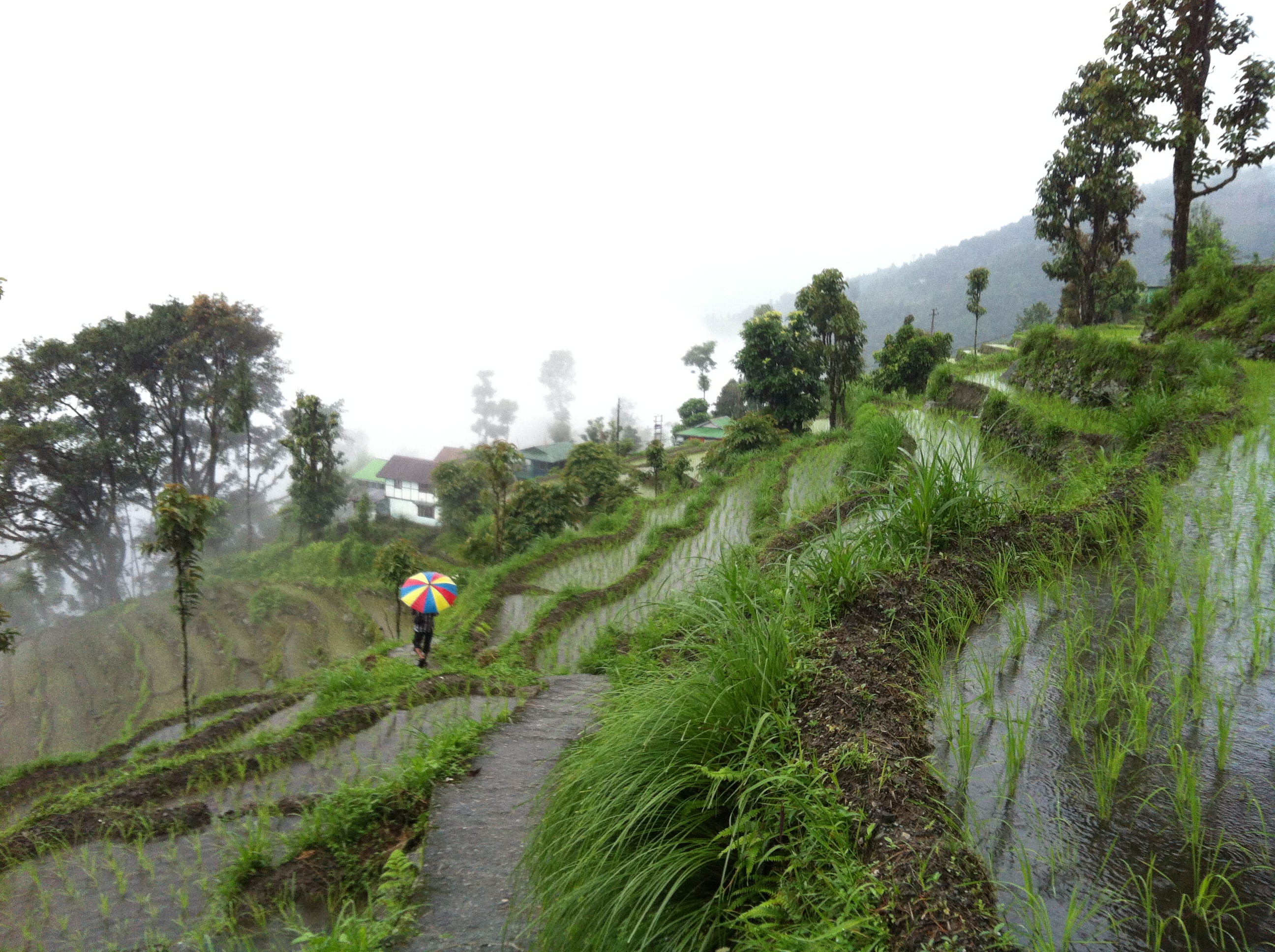
Terraced farms Payong

It was 5:30 pm and the quiet forest seemed to have suddenly come alive. A downpour later, the howling wind violently rustled the trees. The kids in the house were running about, singing songs in Nepalese. My host was out plucking pears for all of us while his wife stood stirring curry in a steel saucer in the kitchen. For a moment, it seemed like a regular day in a Sikkimese household, until I looked out.

There was neither another person nor another house in sight. The view from my small two-bedded room, done in green and red, was mostly shrouded in mist. The clouds had enveloped the mountains and I had been watching them shift and change shapes for a while. There were trees as far as I could see, in shades of green that I did not even know existed.

I was in Lingee Payong, a remote twin village in South-east Sikkim that lies at the base of Maenam Wildlife Sanctuary. Untraceable on the map and with very little information about it available on the internet, the village was undoubtedly the most beautiful discovery during my ten-day long Sikkim trip.

lingee payong view
The breath-taking view from the window


A week before I was to leave for my assignment for SaffronStays, I had gotten in touch with Mr. Gitanath Koirala, the General Secretary of Comprehensive Tourism Development Committee Payong, who patiently helped me plan the trip over countless phone and email conversations. Once in East Sikkim, three nights in Gangtok and half a day in Assam Lingzey later, I finally met him in the transit town of Singtam. We were to travel to his village together. I shared a packed cab with his wife and two little kids for an hour until it dropped us on a deserted road. There on, with our bags carefully strapped to our shoulders, we were to trek up to Mr. Gitanath’s house, which, like all other houses in Payong, was built on a solitary slope. The 500 meter uphill trek, through dense forests at one point and through narrow trails by the edge of the hill at another, was enough to exhaust a non-trekker like me.  Panting and slipping, I managed to reach Mr. Gitanath’s house after about forty-five long minutes, his two kids trotting much ahead of me. As I finally put the heavy bag down, caught my breath and looked around, I was instantly convinced that the struggle had been worth it. Away from all forms of civilization, the family lived there in a small house amidst acres of self-grown vegetable farm, orange orchards and fodder trees. The distant mountains stood at the backdrop like a protective shield.

Almost all houses in Payong were built the same way and lay scattered at considerable distance from each other across the slope of a hill. This made access to outsiders very difficult, unless guided by a villager himself. The locals here enjoyed their space and solitude. Lingee, the other half of the twin-village, was quite different. It lay above Payong and could be reached by driving through a scenic forest road. All its houses, however, were located by the motorable road.

Lingee Payong trek
Mr. Gitanath hiking with his little daughter

Lingee Payong trek
Hiking through dense forests in the rain


Until a few years ago, Lingee Payong was a prosperous village owing to the growth and sale of large cardamom in huge quantities. Mr. Gitanath himself recalls producing 1200 kilos of it in one season.  In the year 2000, however, a viral disease attacked the crop, drastically reducing its growth by 90 percent. To make up for the sudden loss of income, the locals took to cutting and selling timber – a highly unsustainable alternative. Soon, alarmed by their own desperate measures, the village gathered and formed a committee that decided to use tourism to generate income. With no knowledge as to how to do so, the committee took the first step by sending two people to North Sikkim for tourist guide training. The young guides returned, having witnessed some form of village tourism and discussed its feasibility with the rest of the locals. The Ecotourism and Conservation Society of Sikkim, a non-governmental organization, helped promote the twin-village and provided tourism  related training to locals. A hall was built for tourism related group activities a few months later and a number of home stays have opened their doors to guests ever since.

Considering the remoteness of the location, I was amazed by how ambitious the locals had been and how much they’ve achieved over the years. Mr. Gitanath went on to show me an extremely detailed five year tourism plan for the area that was mapped by a German traveler a few months ago and one that they want to implement to the minutest detail. He told me about their collaboration with Shankara Institute of Technology in Rajasthan whose students visit the village every year for one of their papers. And finally, before we sat down for a hot meal made of organic vegetables, he showed me architectural sketches, made with the help of international travellers, for home stays that will be built using the grant sanctioned by Sikkim Tourism Department in the future.

Terraced farms Payong
Hiking through beautiful terraced farms to reach the home stays in Payong.

Terraced farms Payong
This little kid gives me company while I try to catch up with Mr. Gitanath.


He doesn’t own a home stay himself, but as we hiked through the village the next morning, he introduced me to hosts and their homes with such zeal that I was often lost for words. Located in perfectly unspoilt locations, by the terraced farms, forests and sacred trees, these homes radiated warmth and hospitality like no other. Locals spoke to me in half-baked Hindi, offering hot tea and steamed corn cobs to keep away the cold. It wasn’t long before I stopped complaining about the pouring rain and my aching feet. It was all worth it, I reminded myself.

After spending a fulfilling morning with the locals, I hesitantly sat in the car to proceed with the rest of my journey around Sikkim. But before I could leave, Mr. Gitanath let me in on a few secrets about the place. He told me about the hanging bamboo bridge at a height of 200 feet that allowed you a glimpse of a beautiful waterfall only after you had walked a certain distance. He also told me about the sacred cave that lay at a depth of about 120 feet and villagers visited it every Shivratri, with ropes and lamps, to offer prayers. He recalled the scenic camp site that he had spent chilling days in and the nights when fireflies lit up the forest around his house. His daily life was an extraordinary treat for us travellers and he was visibly excited to show it to the world.

Lingee Payong bridge
This suspended bridge in the midst of a beautiful forest lies on the way from Payong to Lingee


As I write this, it’s almost been a month since I spent those 24 hours in the beautiful twin village of Lingee Payong. I am counting on the lingering warmth, and the many stories, secrets and memories to take me back there again.


Sikkim driver
My driver, Mr. Bhim, driving me to darjeeling at the end of my Sikkim trip

Note: From Lingee Payong, I travelled to the rest of South and West Sikkim with Bhim. He is an excellent driver, reliable and has a good knowledge about the roads and the regions around the state. He is also very friendly and made great company during the trip. You can avail his services by calling him at  +91 9733220703.

Continue reading “Going off the grid in Sikkim”