
Nobody built a hunting house this deep in the jungle by accident. Four hundred years ago, a royal hunting party from Mewar would leave their main residence and travel out to a single stone structure standing alone in the wilderness, built for one purpose only: to hunt from. Today, that structure is still standing. It is the oldest working piece of a genuine royal hunting palace you can now book a bed inside, on the edge of Udaipur, and it is the reason The Shikargarh Palace is not quite like anything else the city’s heritage-hotel circuit has to offer.
Everything else on the property is newer than that structure, and that is precisely what makes it worth understanding properly before you book it. This is not a single royal residence handed down through generations and converted, unaltered, into a hotel. It is a nearly 400-year-old hunting house, called an Odi, standing at the centre of an entirely new palace built around it during a recent revival, one that was dressed with old material rather than being old itself. Knowing which parts are which is what turns a pretty photograph into a story worth telling, and it is why this piece leads with the hunting house itself rather than the swimming pool.
Table of Contents:
What an Oudhi Actually Was
In the language of the Mewar region, a hunting house of this kind is called an Oudhi, sometimes written Kodi. It is a smaller, more utilitarian cousin of the grander Rajasthani hunting lodges found elsewhere in the state, the kind that get called Shikargarh or Oudhi in other parts of Rajasthan, both words that trace back to the same idea: a retreat built specifically for the hunt, not for court life or daily residence.
The mechanics were straightforward and, by the standards of the time, quite effective. Rather than trekking into dense forest on foot or on horseback to track game, Mewar’s royal hunting parties would travel out from their main residence to a structure like this one, built deliberately in the middle of the wilderness the animals already moved through. Tinted glass windows let the hunters see out clearly while staying largely unseen from outside. They would sit, wait, and hunt directly from the building itself, with no stalking required once you were inside. It turned hunting from an expedition into something closer to a vigil.
This was common practice across princely Rajasthan, where hunting lodges of varying scale dot the landscape from Jaipur to Bikaner to Udaipur’s own Aravalli foothills, the forested hill system that also surrounds the better-known Sajjangarh, Udaipur’s Monsoon Palace, itself built on ground that served as a royal hunting ground before it became a wildlife sanctuary in 1987. The Shikargarh Oudhi belongs to that same regional tradition, on a more intimate, single-structure scale.
What’s Genuinely Old, and What’s Been Built Around It
Here is the honest version, because it is also the more interesting one. The Oudhi itself, the compact stone hunting house at the centre of the property, is the part that is authentically close to four centuries old. It is the only element that predates the modern revival by a wide margin, and it sits at the physical and narrative centre of everything else.
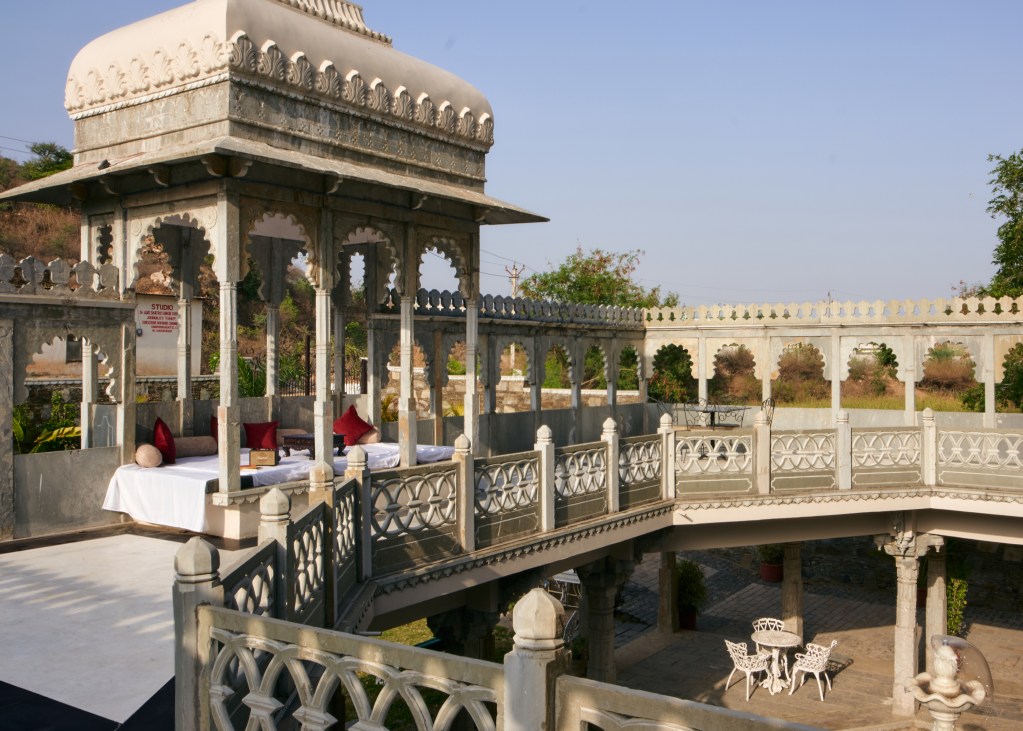
The larger building that now surrounds it, the one visitors first register as “the palace” with its tinted-glass facade, domed chhatri towers and layered stone balconies, is not an old structure at all. It was built recently, as part of the property’s revival, standing around the Oudhi rather than descending from it. What makes it read as older than it is are the stone pillars worked into its construction: sourced from an old temple elsewhere, roughly a century old themselves, and reused here rather than carved for this site. The building is new. The material dressing it is not.

The fourteen guest rooms follow the same logic. Eight sit within the new palace building itself, arranged across a basement level, a ground floor, a first floor and a second floor. The remaining rooms are housed in a separate residential complex built alongside it, an entirely new addition rather than a converted wing of an old building. Guests booking the full property are, in effect, booking two distinct layers: a near-400-year-old hunting core, the only genuinely old structure on site, and an entirely new palace and residential complex built around it, furnished with material considerably older than the walls holding it.
That older material extends well beyond the pillars. The antique furniture, the vintage cutlery, the collected artefacts and, notably, a set of paintings depicting royal hunting scenes, game laid out after a hunt, that now hang inside, are all genuinely old and heritage in character. None of it originated on this specific site. It was gathered from elsewhere, different towns, in some cases, and placed here as part of the revival, which is a different, and in its own way more interesting, kind of authenticity than a single unbroken family heirloom collection would be.
This kind of layered honesty is unusual in the heritage-hotel category, where marketing copy often collapses a building’s entire timeline into a single, rounder-sounding number. Elsewhere in Rajasthan, properties like Rawla Narlai near Jodhpur and Gajner Palace in Bikaner carry similar hunting-lodge origins, each with its own mix of original structure and later addition. Shikargarh’s version of that story happens to sit within Udaipur itself, a city whose heritage-stay identity is otherwise built almost entirely around the City Palace and Lake Pichola, rather than around the forested Aravalli terrain just beyond it.
| The Shikargarh Palace | Typical City-Palace-side Haveli | |
| Heritage core | A c. 400-year-old hunting Oudhi at the centre of the property | Colonial-era or early-20th-century townhouse |
| Setting | Aravalli hillside, away from the old city, forest-adjacent | Dense old-city lanes near Lake Pichola / City Palace |
| Group size | 14 bedrooms, 2–42 guests across palace + residential wing | Typically 2–8 bedrooms |
| Signature experience | Jungle safari on the estate grounds, callback to its hunting past | Walking heritage tours, lake-view rooftop dining |
| Best suited to | Large families, destination weddings, shoots, retreats | Couples, small families, short city-break stays |
| This was never a palace built to be admired from a distance. It was a hunting house, built to be used. |
Rooms and Spaces
The Shikargarh Palace sleeps between two and forty-two guests across its fourteen bedrooms, all fitted with king beds, en-suite bathrooms, WiFi, air conditioning and heating, with several rooms opening onto private balconies or sit-outs. Bedrooms are split between the palace building (basement, ground, first and second floor) and the newer residential complex alongside it, which makes the property genuinely workable for a large multi-generational group without everyone being crammed into a single wing.
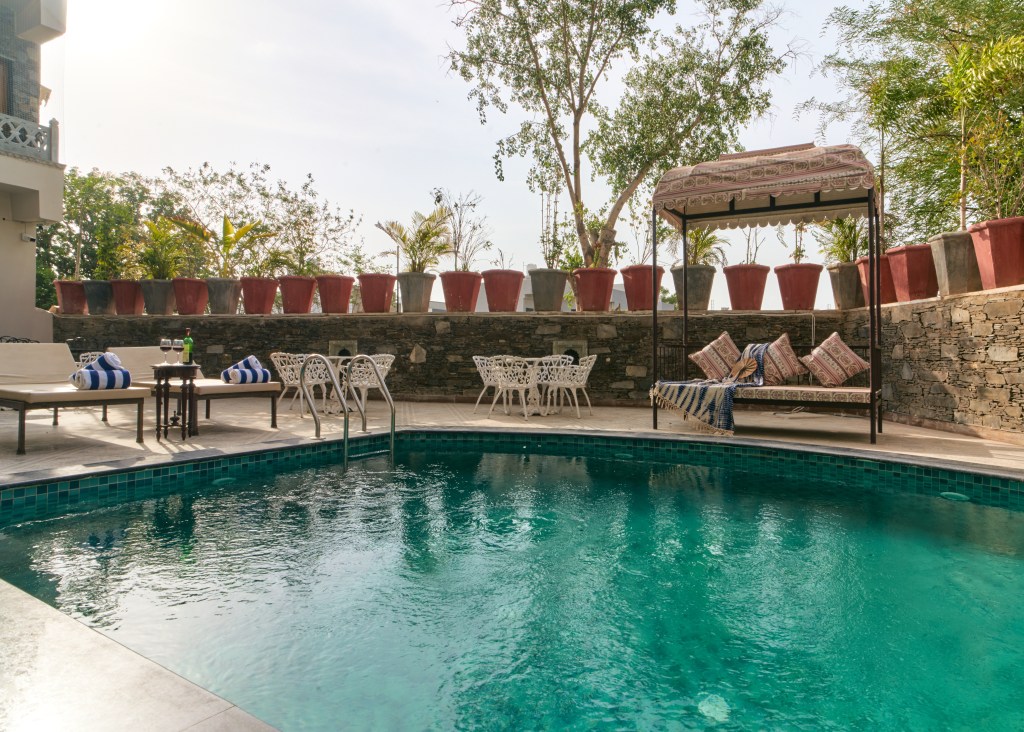
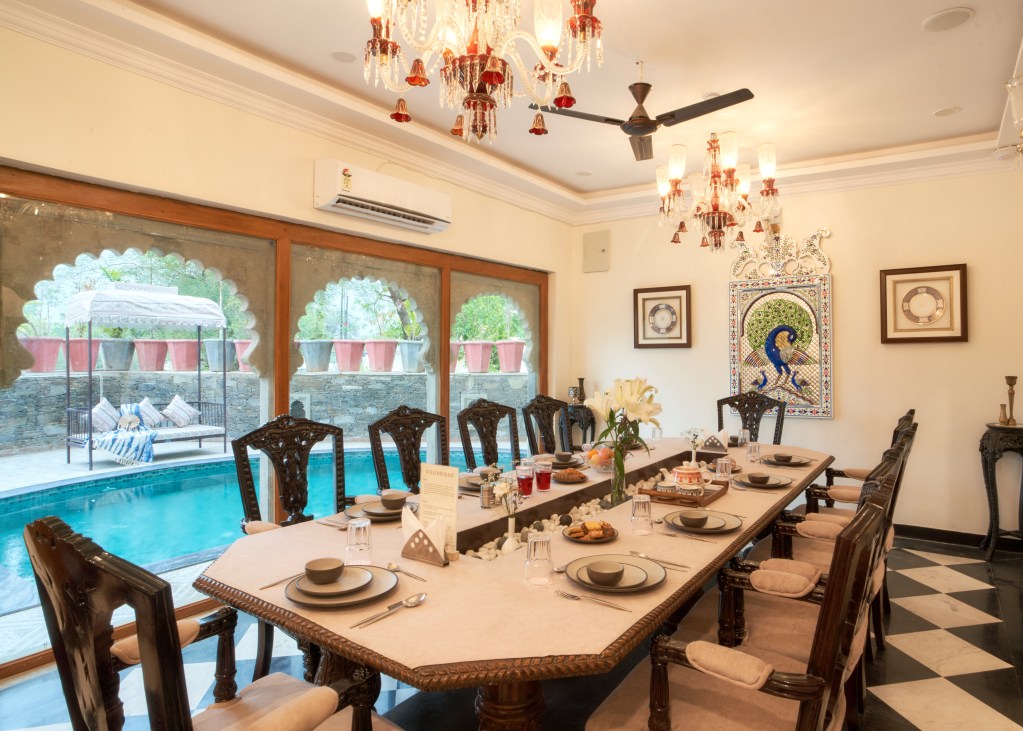
Shared spaces lean into the property’s dual identity as both a heritage structure and a livable, modern group home: a private swimming pool with a stone-walled terrace and a canopied daybed swing, open courtyards, a long carved-wood dining room that seats large parties comfortably and looks straight out onto the pool through arched glass doors, and layered stone balconies and jharokha-style painted window niches that carry the palace’s Mewar architectural character without it ever feeling like a museum.

A Day at Shikargarh, Then and Now
The estate’s most direct link to its own history is its jungle safari experience, run on the grounds much as the site’s original purpose would suggest, though today it is entirely observational rather than a hunt. It is one of the few Udaipur heritage stays where the safari on offer isn’t a bolt-on add-on but a genuine echo of what the property was originally built for.
Beyond the safari, a stay here moves at a deliberately unhurried pace: candlelight dinners set up around the pool or courtyard, folk artists and live singers performing local Rajasthani shows, a portable projector and screen for courtyard movie nights, bonfires, barbecues, and an on-call massage service for guests who want the stay to lean more toward rest than sightseeing. Celebration décor is available for birthdays, anniversaries and other milestones, and the property’s scale makes it a workable base for destination weddings, retreats, corporate offsites and film or brand shoots, alongside its core business of family holidays.
Meals draw on authentic North Indian and traditional Rajasthani cooking, vegetarian and non-vegetarian, with a home-style rather than restaurant-style approach: the kind of Laal Maas, Dal Baati Churma and full Rajasthani thali that the region is known for, prepared to order once the in-house team understands a group’s preferences.
| PRACTICAL NOTES • Two cars can be parked onsite in a covered area; a public car park is available nearby for larger groups arriving in multiple vehicles • The nearest airport is Maharana Pratap Airport (Dabok), roughly 25 km from central Udaipur, with regular flights from Delhi and Mumbai. • A caretaker is based onsite throughout the stay • Loud music is permitted within limits and specific hours, given the property’s residential surroundings, worth factoring into wedding or celebration planning |
Beyond the Palace: Udaipur Around You
Shikargarh‘s position in the Aravalli foothills keeps it close to Udaipur’s core attractions without sitting inside the congestion of the old city. The City Palace complex, Lake Pichola, and the old city’s markets are all a short drive away, as is Fateh Sagar Lake. Sajjangarh, the Monsoon Palace, sits on hill terrain with its own hunting-ground history, and pairs naturally with a stay here for travellers interested in how Mewar’s royal families used the landscape around Udaipur, not just the city itself, for both leisure and hunting.
Udaipur draws most of its domestic visitors from a fairly predictable set of cities: Delhi and Mumbai, connected by direct flights into Maharana Pratap Airport, and Ahmedabad and the wider Gujarat belt, close enough for a comfortable road trip and drawn by long-standing cultural and trade ties to the region. Shikargarh’s group-friendly scale makes it a natural fit for exactly this mix of travellers, whether that means a Gujarati joint family arriving by road for a milestone celebration or a Delhi or Mumbai wedding party flying in for a long weekend. Winter, from October through March, remains the most comfortable window for exploring the grounds and the city on foot, while the monsoon months bring a cooler, greener version of the Aravalli hills that suits guests planning to spend more time on the property itself than out sightseeing.
Who Shikargarh Is Built For
This is not a two-person romantic hideaway, and it isn’t trying to be one. With fourteen bedrooms and capacity up to forty-two guests, Shikargarh is built for scale: large joint families travelling together for a milestone trip, wedding parties who want the ceremony, the stay and the after-party under one roof, corporate groups after an offsite with genuine character, and film or brand teams who need a location with real architectural depth rather than a generic set. Heritage-curious travellers who want more than a lake view and a palace facade, who want to understand what a building actually was before it became a hotel, are, in a sense, this post’s ideal reader as much as its ideal guest.
| Plan Your Stay at The Shikargarh Palace 14 bedrooms · Private pool · Jungle safari · 2–42 guests · Aravalli hills, Udaipur Book on saffronstays.com |
Frequently Asked Questions
- How old is The Shikargarh Palace, really?
The estate’s original hunting structure, the Odi, is roughly 400 years old and is the only genuinely old structure on site. The surrounding tinted-glass palace is new construction built during the property’s revival, dressed with stone pillars sourced from an old temple elsewhere (roughly a century old themselves) rather than being an old building in its own right. The fourteen guest rooms are also part of that newer revival.
2. What does “Oudhi” mean?
Oudhi (also written Kodi) is a term for a small royal hunting house, a structure built specifically for hunting expeditions, distinct from a residential palace or fort.
3. Is the furniture and artwork inside original to the property?
No, and the property is upfront about this. The antique furniture, artefacts, cutlery and paintings inside are genuinely old and heritage in character, but they were sourced from elsewhere and placed here during the recent revival rather than being original to this specific building.
4. How many guests can The Shikargarh Palace accommodate?
The property accommodates 2 to 42 guests across 14 bedrooms, split between the palace building and an adjoining residential complex.
5. Is Shikargarh Palace suitable for destination weddings?
Yes. Its scale, grounds and event spaces make it suited to destination weddings, celebrations, corporate retreats and film or brand shoots, alongside family holidays.
6. How far is the property from central Udaipur and the airport?
The property is a short drive from the City Palace, Lake Pichola and Fateh Sagar Lake. The nearest airport, Maharana Pratap Airport (Dabok), is roughly 25 km away, with direct flights from Delhi and Mumbai.
7. What is the best way to reach the property?
A private car or taxi is recommended. Public transport options include State Transport buses and Udaipur Railway Station, both connecting onward to the property by road.