By Amrita Das
It was an uphill task. For years, I stood there and imagined the prospect of climbing the hill to my school. There were many ways I tried to cheat it; sometimes taking alternate route which was more elaborate, sometimes keeping unwanted company and most often, getting a car drop to school. Soon, school was over and I never had to walk up that hill again.
Years later, I was visiting my hometown, Shillong, during my semester break in college and I stood at the same junction, looking at the road which went upward to my school. The only marked difference this time was that my feet craved for the walk up the hill. And as I concluded the infamous walk, I was glowing with contentment.

I have lived out of home for more than a decade and one of the essential lessons from Shillong is the habit of walking. As a child who has grown up in this scenic city, this form of exercise was forced upon me by my family members as ‘kilometres of morning walk’ or by situations ‘walk to the market’ when there was something to be purchased. At that point, it was least desirable. However, as I grew up I realised that I soaked up some of my favourite conversations and memories while engaged in this activity. It defined companionships, helped me explore the unknown spaces within my home, and introduced a certain stability within me.
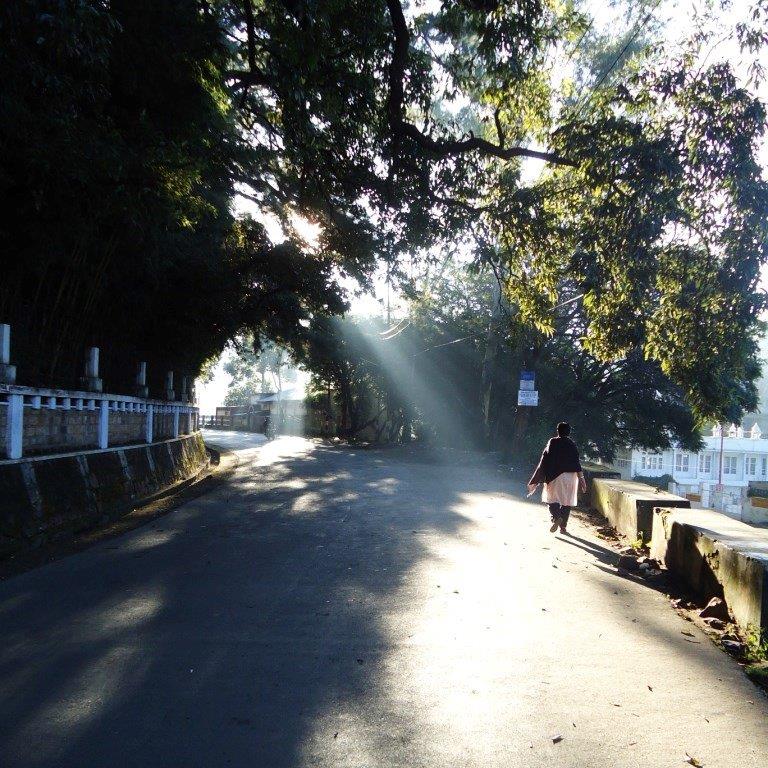
As the sunlight made its way through the tall trees of Shillong, I would near the completion of my morning walks. Attempting a different route every day, these walks were now idyllic and therapeutic. Recovering with a hot cup of chai, placidly seated on the stairs of my balcony, I have spent hours writing in my journal. Most of them, inane feelings or elaborate letters to loved ones across the country. You know, writer’s block is an illusory concept which promptly disappears if you’re writing after a walk. Until this recent article in the New Yorker, I never realised the scientific co-relation behind walking and writing. And even now, when I am filled with distractions before writing, I go for a walk.

Then I remember the first time I discovered that alternate way to my best friend’s home. It was across the steep hill in Upper Lachumiere and steeper were the steps which comprised this ‘shortcut’. If anyone believed that shortcuts were easy in life, didn’t climb these flight of stairs! Towards the end of it, I was out of breath, panting and relieved. However, what stays with me was the quaint houses I discovered en route, the shrubs of wild flowers that paved our path, our exhausted-laughs and the 10 minutes that I saved having taken this route. These additional minutes were well-invested in our conversations and my walk through this route only got easier every day.

Shillong taught me the only way to truly discover a place is on foot. From those elusive short routes to the unknown turns in city centre, when we are walking, we are accurately observing the sights and the vibes of the place. This has also helped me build my sense of navigation. Walking can put even sophisticated applications like Google Maps to shame. Trust me, the richest of experiences don’t show up on apps; they are chanced upon while curiously peering through corners of an unknown neighbourhood.

Whether it has be the countless strolls around the streets of Lower Lachumiere or the questionable trails around Shillong Cantonment area or the impromptu hikes around Upper Shillong, every time, my legs have grown stronger and deepened my relationship with the outdoors. There are moments when I escape into the clean environs of Shillong in my head, wandering through the forest on foot and breathing in the fresh greens. Immediately, I transcend into a calmer space, no matter where I may be.
Visit our website to book homestays in Shillong
About the traveller: Amrita Das is a travel blogger and a freelance travel writer. She travels solo and has travelled across 20 states in India and explored countries in Europe. Her travelogues have been featured in National Geographic Traveller India magazine, amongst other publications and websites. She blogs at www.travellingidesofmarch.com, tweets at @Amrita_Dass and shares regular photo stories on her Facebook page – www.facebook.com/travellingidesofmarch.